

Quizbank/University Physics Semester 2
Wright State University Lake Campus/2018-9/Phy2410 Template:EduV/announcement

- Quizbank now resides on MyOpenMath at https://www.myopenmath.com (although I hope Wikiversity can play an important role in helping students and teachers use these questions!)
- At the moment, most of the physics questions have already been transferred. To see them, join myopenmath.com as a student, and "enroll" in one or both of the following courses:
- Quizbank physics 1 (id 60675)
- Quizbank physics 2 (id 61712)
- Quizbank astronomy (id 63705)
The enrollment key for each course is 123. They are all is set to practice mode, giving students unlimited attempts at each question. Instructors can also print out copies of the quiz for classroom use. If you have any problems leave a message at user talk:Guy vandegrift.
- Latest essay: MyOpenMath/Pulling loose threads
- Latest lesson: Phasor algebra
- To use this resource you need to download 11 large pdf files. Here are links to them: T1 T2 T3 T4 T5 T6 T7 T8 T9 T10 T11
- To see them as Wikiversity pages: T1 T2 T3 T4 T5 T6 T7 T8 T9 T10 T11
- For more information on how to print out the tests visit: Quizbank/Instructions
- (new) To give quick 2-4 questions quizzes use All and All1 (need two pages to avoid the 2048 kB maximum.)
- Equations sheets are under construction and are based on
- The students can use the next section to see what "might" be on the test, and the equations shown can be displayed for the students to use:
University Physics Semester 2
[edit | edit source]This unit has 11 exams (tests) that can viewed by clicking the links (e.g., T1). They are classroom-ready exams based on the collection of quizzes shown below each exam. The fraction indicates the ratio of the number of questions randomly selected to the number of questions on each quiz. Students can access these quizzes using either the (uneditable) permalink or directly via links to subpages of QB. Students and instructors can also view all the questions on this unit's /Questions list. Ideas for use by instructors can be found at Quizbank/Instructions.
- Note change of date for this quiz
3/6 from Special:Permalink/1894334 to QB/d_cp2.5 |
Equations
2/4 from Special:Permalink/1863337 to QB/a18ElectricChargeField_findE |
Equations (solutions)
5/13 from Special:Permalink/1863397 to QB/c18ElectricChargeField_lineCharges |
Equations (solution)
8.85×10⁻¹² F/m = vacuum permittivity.

e = 1.602×10⁻¹⁹C: negative (positive) charge for electrons (protons)
= 8.99×10⁹ m/F

where

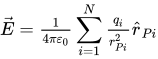
where


= field above an infinite plane of charge.

is the electric field at the field point, , due to point charges at the source points, , and points from source points to the field point. is the electric field at the field point, , due to point charges at the source points, , and points from source points to the field point.



Errata
[edit | edit source]- QB/d_cp2.5
-
- Question 2: The angle is above the x-axis not the −x axis.
- Question 4: There is an error of 109 which can be removed by changing nC to C (nano-Coulombs to Coulombs) in the question.
- Question 5: I forgot to give you a value for z. Take z=1 until this gets fixed.
- Question 6: Perhaps the student should be informed that the approximation of the field near an infinite plane should be used here.[1]
- QB/d_cp2.6
- Question 1: Replace C by nC for both charges in the question.S
Quizbank/University Physics Semester 2/T2 Tue 9/18
[edit | edit source]4/6 from Special:Permalink/1894335 to QB/d_cp2.6 | Equations
2/3 from Special:Permalink/1863399 to QB/c19ElectricPotentialField_SurfaceIntegral |Equations
4/6 from Special:Permalink/1863398 to QB/c19ElectricPotentialField_GaussLaw |
Equations
= electric flux

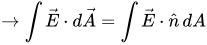
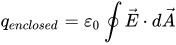
where

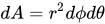

Calculating and with angular symmetry
Cyndrical: . Spherical:




Calculating and with angular symmetry
Cyndrical: . Spherical:
3/11 from Special:Permalink/1893815 to QB/d_cp2.7 |
Equations
2/4 from Special:Permalink/1893633 to QB/d_cp2.8 |
Equations
3/5 from Special:Permalink/1863338 to QB/a19ElectricPotentialField_Capacitance |
Equations
2/4 from Special:Permalink/1863339 to QB/a19ElectricPotentialField_KE_PE |
Equations
= electric potential


= change in potential energy (or simply )



Electron (proton) mass = 9.11×10⁻³¹kg (1.67× 10⁻²⁷kg). Elementary charge = e = 1.602×10⁻¹⁹C.
=kinetic energy. 1 eV = 1.602×10⁻¹⁹J

near isolated point charge

Many charges: .
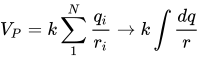
The alpha-particle is made up of two protons and two neutrons.
defines capacitance.

where A is area and d<<A1/2 is gap length of parallel plate capacitor




= energy density
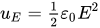
Available at special:permalink/1925995
2/10 from Special:Permalink/1893634 to QB/d_cp2.9|Equations
2/9 from Special:Permalink/1895273 to QB/d_cp2.10|Equations
2/4 from Special:Permalink/1863340 to QB/a20ElectricCurrentResistivityOhm_PowerDriftVel | Equations
2/21 from Special:Permalink/1863341 to QB/a21CircuitsBioInstDC_circAnalQuiz1 |
Equations
2/5 from Special:Permalink/1863342 to QB/a21CircuitsBioInstDC_circuits |
Equations
Electric current: 1 Amp (A) = 1 Coulomb (C) per second (s)
Current=, where

= (density, charge, speed, Area)

where =current density.
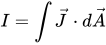

= electric field where = resistivity


, and ,
![{\displaystyle \rho =\rho _{0}\left[1+\alpha (T-T_{0})\right]}](https://wikimedia.org/api/rest_v1/media/math/render/svg/b63fbf7f93624cb84d99cade118b295c49351ffb)
![{\displaystyle R=R_{0}\left[1+\alpha \Delta T\right]}](https://wikimedia.org/api/rest_v1/media/math/render/svg/f43d434660a8941a886bce1f85d9d027d30d6303)
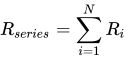
where is resistance

and Power=


where =internal resistance and =emf.



and
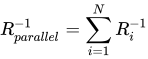
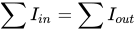

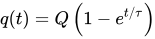
Charging an RC (resistor-capacitor) circuit: and where is RC time, and .


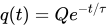
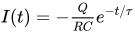
Discharging an RC circuit: and
2/9 from Special:Permalink/1902372 to QB/d_cp2.11 | Equations | Textbook links for d_cp2.11
2/11 from Special:Permalink/1892310 to QB/d_cp2.12 | Equations | Textbook links for d_cp2.12
2/4 from Special:Permalink/1863344 to QB/a22Magnetism_forces | Equations
2/6 from Special:Permalink/1828922 to QB/c22Magnetism_ampereLaw | Equations
2/4 from Special:Permalink/1863400 to QB/c22Magnetism_ampereLawSymmetry | Equations

,
,
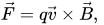
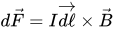
Magnetic force: .
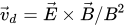
=EXB drift velocity
Circular motion (uniform B field): Period=







Dipole moment=.
Torque=.
Stored energy=.
Hall field =
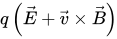
Lorentz force =



Free space permeability
T·m/A
Force between parallel wires
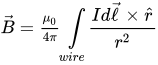
Biot–Savart law
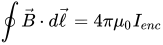
Ampère's Law:
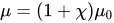
Magnetic field inside solenoid with paramagnetic material = where = permeability



Quizbank/University Physics Semester 2/T6 Wright State Lake skips T6
[edit | edit source]1/6 from Special:Permalink/1894334 to QB/d_cp2.5 | Equations
2/6 from Special:Permalink/1894335 to QB/d_cp2.6 | Equations
2/11 from Special:Permalink/1893815 to QB/d_cp2.7 | Equations
1/4 from Special:Permalink/1893633 to QB/d_cp2.8 | Equations
2/10 from Special:Permalink/1893634 to QB/d_cp2.9 | Equations
2/9 from Special:Permalink/1895273 to QB/d_cp2.10 | Equations
8.85×10⁻¹² F/m = vacuum permittivity.
e = 1.602×10⁻¹⁹C: negative (positive) charge for electrons (protons)
= 8.99×10⁹ m/F
where
where
= field above an infinite plane of charge.
= electric flux
where
= electric potential
= change in potential energy (or simply )
Electron (proton) mass = 9.11×10⁻³¹kg (1.67× 10⁻²⁷kg). Elementary charge = e = 1.602×10⁻¹⁹C.
=kinetic energy. 1 eV = 1.602×10⁻¹⁹J
near isolated point charge
Many charges: .
defines capacitance.
where A is area and d<<A1/2 is gap length of parallel plate capacitor
= energy density
Electric current: 1 Amp (A) = 1 Coulomb (C) per second (s)
Current=, where
= (density, charge, speed, Area)
where =current density.
= electric field where = resistivity
, and ,
where is resistance
and Power=
where =internal resistance and =emf.
and
Charging an RC (resistor-capacitor) circuit: and where is RC time, and .
Discharging an RC circuit: and
3/9 from Special:Permalink/1893631 to QB/d_cp2.13 | Equations
2/6 from Special:Permalink/1892308 to QB/d_cp2.14 | Equations
3/8 from Special:Permalink/1894891 to QB/d_cp2.15 | Equations
1/2 from Special:Permalink/1863345 to QB/a23InductionACcircuits_Q1 | Equations
1/4 from Special:Permalink/1863343 to QB/a21CircuitsBioInstDC_RCdecaySimple | Equations
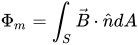


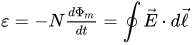

Unit of inductance = Henry (H)=1V·s/A
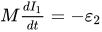
Mutual inductance: where =flux through 1 due to current in 2. Reciprocity:


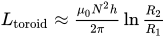
Self-inductance:

, , Stored energy=


in LR circuit where .
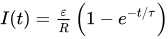

in LC circuit where


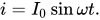
AC voltage and current if
RMS values and
Impedance
Resistor where
Capacitor where
Inductor where
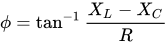
RLC series circuit where and
Resonant angular frequency
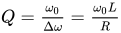
Quality factor
Average power
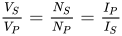
Transformer voltages and currents













Next test: Quizbank/University Physics Semester 2/T8 Tues 4 Dec
[edit | edit source]5/8 from Special:Permalink/1863346 to QB/a25GeometricOptics_image
2/4 from Special:Permalink/1863347 to QB/a25GeometricOptics_thinLenses | Equations
3/4 from Special:Permalink/1863348 to QB/a25GeometricOptics_vision
Final exam: Quizbank/University Physics Semester 2/T9
[edit | edit source]2/9 from Special:Permalink/1902372 to QB/d_cp2.11 | Equations
2/11 from Special:Permalink/1892310 to QB/d_cp2.12 | Equations
1/9 from Special:Permalink/1893631 to QB/d_cp2.13 | Equations
1/6 from Special:Permalink/1892308 to QB/d_cp2.14 | Equations
1/8 from Special:Permalink/1894891 to QB/d_cp2.15 | Equations
2/6 from Special:Permalink/1895295 to QB/d_cp2.16 | Equations
2/4 from Special:Permalink/1863401 to QB/c24ElectromagneticWaves_displacementCurrent | Equations
(there might be a bit more?)
,
,
Magnetic force: .
=EXB drift velocity
Circular motion (uniform B field): Period=
Dipole moment=.
Torque=.
Stored energy=.
Hall field =
Lorentz force =
Free space permeability
T·m/A
Force between parallel wires
Biot–Savart law
Ampère's Law:
Magnetic field inside solenoid with paramagnetic material = where = permeability
Unit of inductance = Henry (H)=1V·s/A
Mutual inductance: where =flux through 1 due to current in 2. Reciprocity:
Self-inductance:
, , Stored energy=
in LR circuit where .
in LC circuit where
AC voltage and current if
RMS values and
Impedance
Resistor where
Capacitor where
Inductor where
RLC series circuit where and
Resonant angular frequency
Quality factor
Average power
Transformer voltages and currents
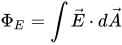
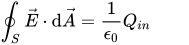
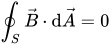
Displacement current where is the electric flux.


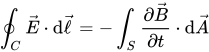
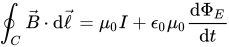
and
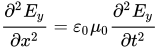

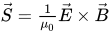
Average intensity

Radiation pressure (perfect absorber) and (perfect reflector).


To be continued
1/8 from Special:Permalink/1878340 to QB/d_Bell.solitaire | Discussion
5/18 from Special:Permalink/1878339 to QB/d_Bell.polarization | Discussion
5/25 from Special:Permalink/1885266 to QB/d_Bell.photon | Discussion
1/10 from Special:Permalink/1878495 to QB/d_Bell.Venn | Discussion
We might not need an equation sheet for this quiz. These are "conceptual" quizzes so instead of "Equations" we have "Discussion".
1/6 from Special:Permalink/1894334 to QB/d_cp2.5 | Equations
1/6 from Special:Permalink/1894335 to QB/d_cp2.6 | Equations
1/11 from Special:Permalink/1893815 to QB/d_cp2.7 | Equations
1/4 from Special:Permalink/1893633 to QB/d_cp2.8 | Equations
1/10 from Special:Permalink/1893634 to QB/d_cp2.9 | Equations
1/9 from Special:Permalink/1895273 to QB/d_cp2.10 | Equations
1/9 from Special:Permalink/1902372 to QB/d_cp2.11 | Equations
1/11 from Special:Permalink/1892310 to QB/d_cp2.12 | Equations
1/9 from Special:Permalink/1893631 to QB/d_cp2.13 | Equations
1/6 from Special:Permalink/1892308 to QB/d_cp2.14 | Equations
1/8 from Special:Permalink/1894891 to QB/d_cp2.15 | Equations
1/6 from Special:Permalink/1895295 to QB/d_cp2.16 | Equations
8.85×10⁻¹² F/m = vacuum permittivity.
e = 1.602×10⁻¹⁹C: negative (positive) charge for electrons (protons)
= 8.99×10⁹ m/F
where
where
= field above an infinite plane of charge.
= electric flux
where
= electric potential
= change in potential energy (or simply )
Electron (proton) mass = 9.11×10⁻³¹kg (1.67× 10⁻²⁷kg). Elementary charge = e = 1.602×10⁻¹⁹C.
=kinetic energy. 1 eV = 1.602×10⁻¹⁹J
near isolated point charge
Many charges: .
defines capacitance.
where A is area and d<<A1/2 is gap length of parallel plate capacitor
= energy density
Electric current: 1 Amp (A) = 1 Coulomb (C) per second (s)
Current=, where
= (density, charge, speed, Area)
where =current density.
= electric field where = resistivity
, and ,
where is resistance
and Power=
where =internal resistance and =emf.
and
Charging an RC (resistor-capacitor) circuit: and where is RC time, and .
Discharging an RC circuit: and
,
,
Magnetic force: .
=EXB drift velocity
Circular motion (uniform B field): Period=
Dipole moment=.
Torque=.
Stored energy=.
Hall field =
Lorentz force =
Free space permeability
T·m/A
Force between parallel wires
Biot–Savart law
Ampère's Law:
Magnetic field inside solenoid with paramagnetic material = where = permeability
Unit of inductance = Henry (H)=1V·s/A
Mutual inductance: where =flux through 1 due to current in 2. Reciprocity:
Self-inductance:
, , Stored energy=
in LR circuit where .
in LC circuit where
AC voltage and current if
RMS values and
Impedance
Resistor where
Capacitor where
Inductor where
RLC series circuit where and
Resonant angular frequency
Quality factor
Average power
Transformer voltages and currents
Displacement current where is the electric flux.
and
Average intensity
Radiation pressure (perfect absorber) and (perfect reflector).
Check transclusion
See also:
[edit | edit source]- Questions list (useful for students as they prepare for the tests)
- Quizbank/Instructions (classroom use suggestions)
- Subpages
Transclusion problem:Copied from Talk
[edit | edit source]transclustion problem with cp2.5 and 2.6
|
|---|
|
{{#lsth:OpenStax University Physics/E&M/Electric Charges and Fields|For quiz at [[QB/d_cp2.5]]}}<ref>Not transcluding for some reason</ref> = electric flux
where
|