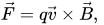
Example 11.1 from OpenStax University Physics2: https://cnx.org/contents/eg-XcBxE@14.1:KiBTyzfq@6/11-2-Magnetic-Fields-and-Lines An alpha-particle (q=3.2x10⁻¹⁹C) moves through a uniform magnetic field that is parallel to the positive z-axis with magnitude 1.5 T. What is the x-component of the force on the alpha-particle if it is moving with a velocity (2.2 i + 3.3 j + 1.1 k) x 104 m/s?
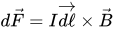
Example 11.4 from OpenStax University Physics2: https://cnx.org/contents/eg-XcBxE@9.7:BLPqsvDS@2/114-Magnetic-Force-on-a-Curren_1 A 50 cm-long horizontal wire is maintained in static equilibrium by a horizontally directed magnetic field that is perpendicular to the wire (and to Earth's gravity). The mass of the wire is 10 g, and the magnitude of the magnetic field is 0.5 T. What current is required to maintain this balance?
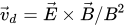
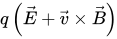
Example 11.8 from OpenStax University Physics2: https://cnx.org/contents/eg-XcBxE@9.7:kh61-j3_@2/116-The-Hall-Effect_1 An electron beam (m=9.1 x 10⁻³¹kg, q=1.6 x 10⁻¹⁹C) enters a crossed-field velocity selector with magnetic and electric fields of 2 mT and 6.000E+03 N/C, respectively. What must the velocity of the electron beam be to transverse the crossed fields undeflected ?
Example 11.9 from OpenStax University Physics2: https://cnx.org/contents/eg-XcBxE@9.7:kh61-j3_@2/116-The-Hall-Effect_1 The silver ribbon shown are a=3.5 cm, b=2 cm, and c= 0.2 cm. The current carries a current of 100 A and it lies in a uniform magnetic field of 1.5 T. Using the density of 5.900E+28 electrons per cubic meter for silver, find the Hall potential between the edges of the ribbon.