Hold a pendulum a moderate distance from equilibrium and release it by tossing it in a direction perpendicular to the displacement of the mass from equilibrium. The resulting polarization will be ____ (pick the best answer)
- linearly
- circular
- circular or linear
+ circular or elliptical
- linear or elliptical
We will do a lab on this. It will be circular only if you carefully select the initial speed. See also q15 below for a complementary question.
- create an elliptically polarized wave with an ε>0.2
- create an elliptically polarized wave with an ε<0.8
- create an elliptically polarized wave with an 0.2<ε<0.8
+ start with a linear, circular, or elliptical wave and slowly evolve to different polarizations
A linear polarizer selects a component of the electric field. Also, the energy density of light is proportional to the square of the electric field. By what factor does a filter reduce the electric field if it is oriented 30° to that field?
-
-
-
+
-
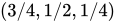
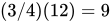
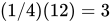
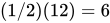
See subpage at components. Note that the components of a unit vector at (30°,45°,60°) are which square to . Here we use
A linear polarizer selects a component of the electric field. Also, the energy density of light is proportional to the square of the electric field. By what factor does a filter reduce the electric field if it is oriented 60° to that field?
-
-
+
-
-
See subpage at components. Note that the components of a unit vector at (30°,45°,60°) are which square to . Here we use
A linear polarizer selects a component of the electric field. Also, the energy density of light is proportional to the square of the electric field. A 12 mW laser strikes a polarizing filter oriented 30° to the incoming axis of polarization. How much power passes the filter?
- 3mW
- 4mW
- 6mW
- 8mW
+ 9mW
See subpage at components. Note that the components of a unit vector at (30°,45°,60°) are which square to . Here we use
A linear polarizer selects a component of the electric field. Also, the energy density of light is proportional to the square of the electric field.A 12 mW laser strikes a polarizing filter oriented 30° to the incoming axis of polarization. How much power is blocked by the filter?
A linear polarizer selects a component of the electric field. Also, the energy density of light is proportional to the square of the electric field.A 12 mW laser strikes a polarizing filter oriented 60° to the incoming axis of polarization. How much power is blocked by the filter?
A linear polarizer selects a component of the electric field. Also, the energy density of light is proportional to the square of the electric field.A 12 mW laser strikes a polarizing filter oriented 60° to the incoming axis of polarization. How much power is passed by the filter?
A linear polarizer selects a component of the electric field. Also, the energy density of light is proportional to the square of the electric field.A 12 mW laser strikes a polarizing filter oriented 45° to the incoming axis of polarization. How much power is passed by the filter?
A linear polarizer selects a component of the electric field. Also, the energy density of light is proportional to the square of the electric field. Unpolarized light impinges on three linear filters, each oriented 45° to the previous, as shown. What fraction of the power incident on the first filter emerges from the last?
- 1/32
- 1/16
- 3/32
+ 1/8
- 3/16
See subpage at components. The hardest one. The first filter blocks half, as do the second and third filters. With three filters, each blocking half, we have: (1/2)(1/2)(1/2)=1/8.
Hold a pendulum a moderate distance from equilibrium and release it by tossing it in a direction parallel to the displacement of the mass from equilibrium. The resulting polarization will be ____ (pick the best answer)
+ linearly
- circular
- circular or linear
- circular or elliptical
- linear or elliptical
See q2 above. This is perhaps a trick question and should be discussed in lecture if it will appear on any of the exams associated with a given course.
A linear polarizer selects a component of the electric field. Also, the energy density of light is proportional to the square of the electric field. Unpolarized light impinges on three linear filters. The second is oriented 30° from the first, and the third is rotated by an additional 60°, making it at right angles from the first filter. What fraction of the power incident on the first filter emerges from the last?
- 1/32
- 1/16
+ 3/32
- 1/8
- 3/16
See subpage at components. The hardest one. The first filter blocks half, as do the second and third filters. The first passes 1/2, the second passes 3/4 of that, and the final passes 1/4 of what's left. The net amount passed is (1/2)(3/4)(1/4)=3/32
? Hold a pendulum a moderate distance from equilibrium and release it by tossing it in a direction perpendicular to the displacement of the mass from equilibrium. The resulting polarization will be ____ (pick the best answer)
- linearly
- circular
- circular or linear
+ circular or elliptical
- linear or elliptical
$ We will do a lab on this. It will be circular only if you carefully select the initial speed. See also q15 below for a complementary question.
? A linear polarizer selects a component of the electric field. Also, the energy density of light is proportional to the square of the electric field. By what factor does a filter reduce the electric field if it is oriented 30° to that field?
-
-
-
+
-
$ See subpage at components. Note that the components of a unit vector at (30°,45°,60°) are which square to . Here we use
? A linear polarizer selects a component of the electric field. Also, the energy density of light is proportional to the square of the electric field. By what factor does a filter reduce the electric field if it is oriented 60° to that field?
-
-
+
-
-
$ See subpage at components. Note that the components of a unit vector at (30°,45°,60°) are which square to . Here we use
? A linear polarizer selects a component of the electric field. Also, the energy density of light is proportional to the square of the electric field. A 12 mW laser strikes a polarizing filter oriented 30° to the incoming axis of polarization. How much power passes the filter?
- 3mW
- 4mW
- 6mW
- 8mW
+ 9mW
$ See subpage at components. Note that the components of a unit vector at (30°,45°,60°) are which square to . Here we use
? A linear polarizer selects a component of the electric field. Also, the energy density of light is proportional to the square of the electric field.A 12 mW laser strikes a polarizing filter oriented 30° to the incoming axis of polarization. How much power is blocked by the filter?
+ 3mW
- 4mW
- 6mW
- 8mW
- 9mW
$ See subpage at components. Note that the components of a unit vector at (30°,45°,60°) are which square to . Here we use to get the amount blocked. Therefore 12−9=3 is passed.
? A linear polarizer selects a component of the electric field. Also, the energy density of light is proportional to the square of the electric field.A 12 mW laser strikes a polarizing filter oriented 60° to the incoming axis of polarization. How much power is blocked by the filter?
- 3mW
- 4mW
- 6mW
- 8mW
+ 9mW
$ See subpage at components. Note that the components of a unit vector at (30°,45°,60°) are which square to . Here, mw is passed so that 9mw is blocked
? A linear polarizer selects a component of the electric field. Also, the energy density of light is proportional to the square of the electric field.A 12 mW laser strikes a polarizing filter oriented 60° to the incoming axis of polarization. How much power is passed by the filter?
+ 3mW
- 4mW
- 6mW
- 8mW
- 9mW
$ See subpage at components. Note that the components of a unit vector at (30°,45°,60°) are which square to . Here, mw is passed.
? A linear polarizer selects a component of the electric field. Also, the energy density of light is proportional to the square of the electric field.A 12 mW laser strikes a polarizing filter oriented 45° to the incoming axis of polarization. How much power is passed by the filter?
- 3mW
- 4mW
+ 6mW
- 8mW
- 9mW
$ See subpage at components. Note that the components of a unit vector at (30°,45°,60°) are which square to . Here, mw is passed.
? A linear polarizer selects a component of the electric field. Also, the energy density of light is proportional to the square of the electric field. Unpolarized light impinges on three linear filters, each oriented 45° to the previous, as shown. What fraction of the power incident on the first filter emerges from the last?
- 1/32
- 1/16
- 3/32
+ 1/8
- 3/16
$ See subpage at components. The hardest one. The first filter blocks half, as do the second and third filters. With three filters, each blocking half, we have: (1/2)(1/2)(1/2)=1/8.
? Hold a pendulum a moderate distance from equilibrium and release it by tossing it in a direction parallel to the displacement of the mass from equilibrium. The resulting polarization will be ____ (pick the best answer)
+ linearly
- circular
- circular or linear
- circular or elliptical
- linear or elliptical
$ See q2 above. This is perhaps a trick question and should be discussed in lecture if it will appear on any of the exams associated with a given course.
? A linear polarizer selects a component of the electric field. Also, the energy density of light is proportional to the square of the electric field. Unpolarized light impinges on three linear filters. The second is oriented 30° from the first, and the third is rotated by an additional 60°, making it at right angles from the first filter. What fraction of the power incident on the first filter emerges from the last?
- 1/32
- 1/16
+ 3/32
- 1/8
- 3/16
$ See subpage at components. The hardest one. The first filter blocks half, as do the second and third filters. The first passes 1/2, the second passes 3/4 of that, and the final passes 1/4 of what's left. The net amount passed is (1/2)(3/4)(1/4)=3/32