

Mathematics for Applied Sciences (Osnabrück 2023-2024)/Part I/Lecture 14
- Differentiability

In this section, we consider functions

where is a subset of the real numbers. We want to explain what it means that such a function is differentiable in a point . The intuitive idea is to look at another point , and to consider the secant, given by the two points and , and then to let " move towards “. If this limiting process makes sense, the secants tend to become a tangent. However, this process only has a precise basis, if we use the concept of the limit of a function as defined earlier.


Let be a subset, a point, and

a function. For , , the number


is called the difference quotient of for
and .
The difference quotient is the slope of the secant at the graph, running through the two points and . For , this quotient is not defined. However, a useful limit might exist for . This limit represents, in the case of existence, the slope of the tangent for in the point .


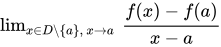

The derivative in a point is, if it exists, an element in . Quite often one takes the difference as the parameter for this limiting process, that is, one considers


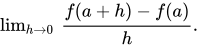
The condition translates then to , . If the Function describes a one-dimensional movement, meaning a time-dependent process on the real line, then the difference quotient is the average velocity between the (time) points and and is the instantaneous velocity in .


Let , and let


be an affine-linear function. To determine the derivative in a point , we consider the difference quotient


This is constant and equals , so that the limit of the difference quotient as tends to exists and equals as well. Hence, the derivative exists in every point and is just . The slope of the affine-linear function is also its derivative.

We consider the function

The difference quotient for and is


The limit of this, as tends to , is . The derivative of in is therefore .


- Linear approximation
We discuss a property which is equivalent with differentiability, the existence of a linear approximation. This formulation is important in many respects: It allows giving quite simple proofs of the rules for differentiable functions, one can use it to reduce differentiability to the continuity of an error function, it yields a model for approximation with polynomials of higher degree (quadratic approximation, Taylor expansion), and it allows a direct generalization to the higher-dimensional situation(in the second term)
Let be a subset, a point, and
a function. Then is differentiable in if and only if there exists some and a function


such that is continuous in , , and such that



If is differentiable, then we set

Then the only possibility to fulfill the conditions for is
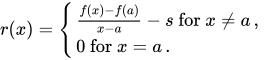
Because of differentiability, the limit

exists, and its value is . This means that is continuous in .
If
and
exist with the described properties, then for
the relation
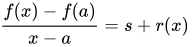
holds. Since is continuous in , the limit on the left-hand side, for , exists.

The affine-linear function

is called the affine-linear approximation. The constant function given by the value can be considered as the constant approximation.

This follows immediately from Theorem 14.5 .
- Rules for differentiable functions

Let be a subset, a point, and

functions which are differentiable
in . Then the following rules for differentiability holds.- The sum is differentiable in , with
- The product is differentiable in , with
- For
,
also is differentiable in , with
- If has no zero in , then is differentiable in , with
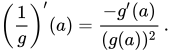
- If has no zero in , then is differentiable in , with











(1). We write and respectively with the objects which were formulated in Theorem 14.5 , that is

and

Summing up yields

Here, the sum is again continuous in , with value .
(2). We start again with

and

and multiply both equations. This yields

Due to
Lemma 10.11
for
limits,
the expression consisting of the last six summands is a continuous function, with value for
.
(3) follows from (2), since a constant function is differentiable with derivative .
(4). We have
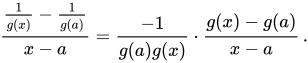
Since is continuous in , due to
Corollary 14.6
,
the left-hand factor converges for to , and because of the differentiability of in , the right-hand factor converges to .
(5) follows from (2) and (4).


These rules are called sum rule, product rule, quotient rule. The following statement is called chain rule.
Let denote subsets, and let

and

be functions with . Suppose that is differentiable in and that is differentiable in . Then also the composition



is differentiable in , and its derivative is

Due to Theorem 14.5 , one can write

and

Therefore,

The remainder function

is continuous in with value .

Let denote intervals, and let

be a bijective continuous function, with the inverse function
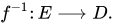
differentiable in with . Then also the inverse function is differentiable in , and



We consider the difference quotient

and have to show that the limit for exists, and obtains the value claimed. For this, let denote a sequence in , converging to . Because of Theorem 11.7 , the function is continuous. Therefore, also the sequence with the members converges to . Because of bijectivity, for all . Thus


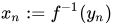



where the right-hand side exists, due to the condition, and the second equation follows from Lemma 8.1 (5).
The function

is the inverse function of the function , given by (restricted to ). The derivative of in a point is . Due to Theorem 14.9 , for , the relation



holds. In the zero point, however, is not differentiable.
The function

is the inverse function of the function , given by . The derivative of in is , which is different from for . Due to Theorem 14.9 , we have for the relation


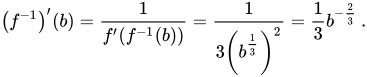
In the zero point, however, is not differentiable.
- The derivative function
So far, we have considered differentiability of a function in just one point, now we consider the derivative in general.
Let denote an interval, and let


be a function. We say that is differentiable, if for every point , the derivative of in exists. In this case, the mapping


| << | Mathematics for Applied Sciences (Osnabrück 2023-2024)/Part I | >> PDF-version of this lecture Exercise sheet for this lecture (PDF) |
|---|