- Exercises
Sketch the slope triangle and the secant for the function
-

in the points
 and
and  .
.
Determine the affine-linear map
-

whose graph passes through the two points
 and
and  .
.
Determine directly (without the use of derivation rules) the derivative of the function
-

at any point
 .
.
Prove that the real absolute value
-

is not differentiable at the point zero.
Let
 be an
even function,
and suppose that it is
differentiable
in the point
be an
even function,
and suppose that it is
differentiable
in the point  . Show that
  is also differentiable in the point
  and that the relation
-

holds.
Please try to solve the following exercise in a direct way aswell as with the help of derivation rules.
Determine the derivative of the functions
-

for all
 .
.
Prove that a polynomial
![{\displaystyle {}P\in \mathbb {R} [X]}](https://wikimedia.org/api/rest_v1/media/math/render/svg/9bf6bcf64e16c3ac6b30ecd6577e72648ab2325a) has degree
has degree  (or it is
 ), if and only if the
  -th derivative of
  is the zero poynomial.
Determine for a
polynomial
-

the
linear approximation
(including the remainder function  )
in the zero point.
)
in the zero point.
Show, using
limits of functions,
that a
function
 ,
which is
differentiable
in a point
,
which is
differentiable
in a point
 ,
is also
continuous
in this point.
,
is also
continuous
in this point.
Prove the product rule for
differentiable functions,
using
limits of functions,
applied to the
difference quotient.
Show that the
exponential function
 is
differentiable
in every point
,
and determine its
derivative.
is
differentiable
in every point
,
and determine its
derivative.
Hint: Apply the definition about the limit of functions to the fraction of differences. The function equation for the exponential function is helpful.
Determine the
linear approximation
(including the remainder function )
for the
exponential function
in the zero point.
Determine the derivative of the function
-

for all
 .
.
Determine the derivative of the function
-

Prove that the derivative of a rational function is also a rational function.
Let
-

denote
differentiable functions,
and set
-
 .
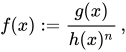
Show that the derivative of can be written as a fraction, with
.
Show that the derivative of can be written as a fraction, with  as denominator.
Let
-

denote
differentiable functions.
Prove, by induction over  , the relation
-

Consider
 and
and
 .
Determine the derivative of the composite function
.
Determine the derivative of the composite function
 directly and by the chain rule.
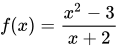
Let
 and
and
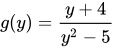 .
We consider the
composition
.
We consider the
composition
 .
.
- Compute
 (the result must be in the form of a rational function).
- Compute the
derivative
of , using part 1.
- Compute the derivative of , using
the chain rule.
Let
-

be two differentiable functions and consider
-

a) Determine the derivative  from the derivatives of and
  .
b) Let now
.
b) Let now
-

Compute

in two ways, one directly from

and the other by the formula of part

.
Determine the derivative of the function
-

for all
.
Let
-

be a bijective differentiable function with
 for all
 ,
and the inverse function
,
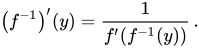
and the inverse function  . What is wrong in the following "Proof“ for the derivative of the inverse function?
We have
-

Using the chain rule, we get by differentiating on both sides the equality
-

Hence,
-
Give an example of a continuous, not differentiable function
-
fulfilling the property that the function  is differentiable.
- Hand-in-exercises
Determine the affine-linear map
-
whose graph passes through the two points
 and
and  .
.
Let
be an
odd
differentiable function.
Show that the
derivative
 is
even.
is
even.
Let
 be a subset and let
-

be differentiable functions. Prove the formula
-

Determine the tangents to the graph of the function
 ,
which are parallel to
,
which are parallel to
 .
.
Determine the derivative of the function
-

where  is the set where the denominator does not vanish.
Let
-
and
-
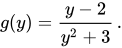
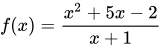
Determine the derivative of the composite
-

directly and by the chain rule.

