

Mathematics for Applied Sciences (Osnabrück 2023-2024)/Part I/Lecture 13/refcontrol
In this lecture, we introduce further important functions via their power series.
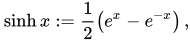
- The hyperbolic functions

The function defined for by

The function defined for by
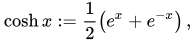


The functions hyperbolic sineMDLD/hyperbolic sine (R) and hyperbolic cosineMDLD/hyperbolic cosine (R)
have the following properties.


Proof

The function hyperbolic sineMDLD/hyperbolic sine (R) is strictly increasing,MDLD/strictly increasing (R) and the function hyperbolic cosineMDLD/hyperbolic cosine (R)
is strictly decreasing on and strictly increasing on .

See Exercise 13.3 and Exercise 13.29 .

The function

A functionMDLD/function is called even, if for all the identity

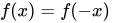
holds.
A function is called odd, if for all the identity

The hyperbolic cosine is an even and the hyperbolic sine is an odd function.
- The circle and the trigonometric functions
In , the distance between two points is a positive real number (or equals in case the points coincide). If for both points the coordinates are given, say and , then the distance equals



This equation rests on the Pythagorean theorems. In particular, the distance of every point to the zero point is


As the coordinates are real numbers, so are the distances. If a point and a positive real number are given, then the set of all points in the plane, which have to the distance , is the circle around with radius . Written in coordinates, the definition is as follows.


Let and . Then the set



We stress that we mean the circumference and not the full disk. All circles are essentially the same, for the most important properties neither the center nor the radius are relevant. From this perspective, the unit circle is the simplest circle.
The set


The unit circle has radius and center
.
In a naive approach, the trigonometric functions sine and cosine are defined with the help of the unit circle.


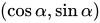
An "angle“ at the zero point (measured starting with the positive "-axis“ and going "counterclockwise“) defines a ray. Since this ray has a unique intersection point with the unit circle, the angle defines a unique point on the unit circle. The coordinates of this point are by definition


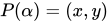

that is, the -coordinate is given by cosine, and the -coordinate is given by sine. Hence, many important properties are immediately clear:

- We have
- We have and .
- If the angle represents a quarter turn, then and .
- We have and . Here means the opposite angle and the opposite ray.
- The values of sine and cosine repeat themselves after a complete turn.







This definition of the trigonometric functions is intuitively clear, however, it is not satisfactory in several respects.
- It is not clear how to measure an angle.
- There is no analytic "computable“ expression how to calculate for a given angle the values of sine and cosine.
- Hence, there is no fundament to prove properties about these functions.
Related with these deficits, is that we do not yet have a precise definition for the number . This number equals the area of the unit circle and equals half of the length of the circumference. However, the concepts of an "area bounded by curves“ and of the "length of a curve“ are not easy. Hence, it is all in all better to define the trigonometric functions with the help of their power series, and then to prove step by step the relations with the circle. In this way, one can also introduce the number via these functions, and introduce the angle as the length of the circular arc, after we have established the length of a curve(what we will do in the second semester).

- Polar coordinates and cylindrical coordinates
We discuss several important applications of trigonometric functions like polar coordinates, understanding angles and the trigonometric functions in a naive way.
An angle and a positive real number define a unique point

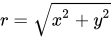
in the real plane . Here, is the distance between the point and the zero point and means the intersecting point of the ray through with the unit circle. Every point has a unique representation with and with an angle , which has to be chosen accordingly (the zero point is represented by and an arbitrary angle). The components are called the polar coordinates of .

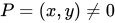


Every complex number , , can be written uniquely as



with a positive real number , which is the distance between and the zero point (thus, ) and an angle between and below degree, measured counterclockwise starting with the positive real axis. The pair constitutes the polar coordinates of the complex number.


Polar coordinates in the real plane and for complex numbers are the same. However, the polar coordinates allow a new interpretation of the multiplication of complex numbers: Because of

(where we have used the addition theorems for sine and cosine), one can multiply two complex numbers by multiplying their modulus and adding their angles.
This new way of looking at the multiplication of complex numbers, yields also a new understanding of roots of complex numbers, which exist, due to the fundamental theorem of algebra. If , then

![{\displaystyle {}w={\sqrt[{n}]{r}}\cos {\frac {\alpha }{n}}+{\sqrt[{n}]{r}}{\mathrm {i} }\sin {\frac {\alpha }{n}}\,}](https://wikimedia.org/api/rest_v1/media/math/render/svg/df838b71d068439091f6fd046c2dacf6025bf268)
is an -th root of . This means that one has to take the real -th root of the modulus of the complex number and one has to divide the angle by .


A spatial variant of the polar coordinates are the so-called cylindrical coordinates. A triple is sent to the Cartesian coordinatesMDLD/Cartesian coordinates


- The trigonometric series
We discuss now the analytic approach to the trigonometric functions.
For , the series
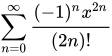
is called the cosine series, and the series
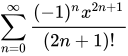
By comparing with the exponential series we see that these series converge absolutely for every . The corresponding functions

are called sine and cosine. Both functions are related to the exponential function, but we need the complex numbers to see this relation. The point is that one can also plug in complex numbers into power series (the convergence is then not on a real interval but on a disk). For the exponential series and (where might be real or complex) we get

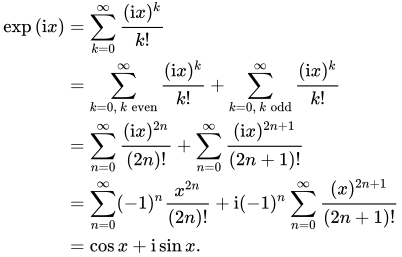
With this relation between the complex exponential function and the trigonometric functions (which is called Euler's formula), one can prove many properties quite easily. Special cases of this formula are

and

Sine and cosine are continuous functions, due to Theorem 12.2 . Further important properties are given in the following theorem.
The functions

and

have the following properties for
.
- We have and .
- We have and .
- The addition theorems
and
hold.
- We have





(1) and (2) follow directly from the definitions of the series.
(3). The -th summand
(the term which refers to the power with exponent )
in the cosine series
(the coefficients referring to , odd, are )
of is


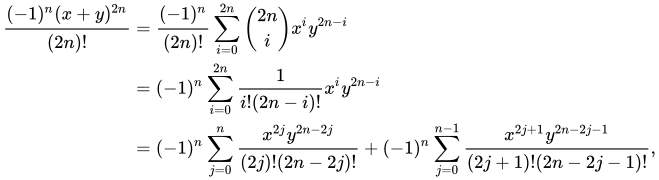
where in the last step we have split up the index set into even and odd numbers.
The -th summand in the Cauchy productMDLD/Cauchy product (R) of and is



and the -th summand in the Cauchy product of and is



Hence, both sides of the addition theorem coincide in the even case. For an odd index the left-hand side is . Since in the cosine series only even exponents occur, it follows that in the Cauchy product of the two cosine series only exponents of the form with even occur. Since in the sine series only odd exponents occur, it follows that in the Cauchy product of the two sine series only exponents of the form with even occur. Therefore terms of the form with odd occur neither on the left nor on the right-hand side.
The addition theorem for sine is proved in a similar way.
(4). From the addition theorem for cosine, applied to
,
and because of (2), we get


The last statement in this theorem means that the pair is a point on the unit circle . We will see later that every point of the unit circle might be written as , where is an angle. Here, encounters as a period length, where indeed we define via the trigonometric functions.


In the following definition for tangent and cotangent, we use already the number .
The function

is called tangent, and the function

is called
cotangent.
| << | Mathematics for Applied Sciences (Osnabrück 2023-2024)/Part I | >> PDF-version of this lecture Exercise sheet for this lecture (PDF) |
|---|