A topological vector space  over
over  is a vector space over the field that has a topology with which scalar multiplication and addition are continuous mappings.

In the following, for all topological vector spaces, we shall use the
Hausdorff property be assumed.
Let  be a topological space with a topology
  as a system of open sets
  and
and  , then denote
 the set of all neighbourhoods from the point
  ,
,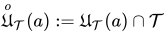 the set of all open Neighbourhoods from the point ,
 the set of all closed neighbourhoods of point .
If no misunderstanding about the underlying topological
space can occur, the index is not included as a designation of the topology used.
In convergence statements in the real numbers one usually considers only  neighbourhood. In doing so, one would actually have to consider in topological spaces for arbitrary neighbourhoods from
  find an index bound
  of a net
  above which all
  lie with
  . However, since the neighbourhoods are an neighbourhood basis, by the convergence definition one only needs to show the property for all neighbourhoods with
  .
.
Let be a topological space, ,  an index set (partial order) and
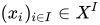 a mesh. The convergence of against is then defined as follows:
 .
.
(where " " for is the partial order on the index set).
Let be a topological space, and  the set of all neighbourhoods of .
  is called the neighbourhood basis of if for every :
 .
.
Let  be a normed space, then the spheres form

an ambient basis of the set of all environments of of  .
.
Let be a toplogic space with chaotic topology  .
.
- Determine for any .
- Show that any sequence
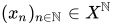 converges in against any limit .
Let  be a metric space with the discrete topology given by the metric:
 .
.
- Determine for any .
- How many sets make up minimal for any ?
- Formally state all sequences in that converge to a limit !
Let be a topological space and  be the system of open sets, that is:
 .
.
Let  be a topological space on the basic set of real numbers. However, the topology does not correspond to the Euclic topology over the set
  , but the open sets are defined as follows.

- Show that is a topological space.
- Show that the sequence
 does not converge to
  in the topological space .
Here  is the complement of
  in
in  .
.
By the system of open sets in a topology the closed sets of the topology are also defined at the same time as their complements.
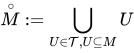
Let be a topological space and be the system of open sets.

Let  be a topological space and
  , then the open
kernel
, then the open
kernel  of
of  is the union of all open subsets of
.
is the union of all open subsets of
.
 .
.
Let be a topological space. The closed hull  of is the intersection over all closed subsets of
  containing and is open.

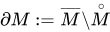
The topological edge  of is defined as follows:
In metric spaces, one can still work with the natural numbers as countable index sets. In arbitrary topological spaces one has to generalize the notion of sequences to the notion of nets.
Let  be a topological space and an index set (with partial order), then
  denotes the set of all families indexed by in :

Let  be a vector space, then
  denotes the set of all finite sequences with elements in :

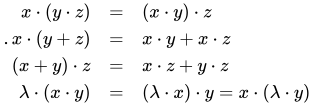
An algebra  over the field is a vector space over in which a multiplication is an inner join

is defined where for all  and
and  the following properties are satisfied:
A topological algebra  over the field is a topological vector space over , where also multiplication is
is a continuous inner knotting.
Continuity of multiplication means here:

The topology is called multiplicative if holds:

In describing topology, the Topologization Lemma for Algebras shows that the topology can also be described by a system of Gaugefunctionals
The algebra is called unital if it has a neutral element  of multiplication. In particular, one defines
  for all
 . The set of all invertible (regular) elements is denoted by
  . Non-invertible elements are called singular.
Consider the set of square  matrices with matrix multiplication and the maxmum norm of the components of the matrix. Try to prove individual properties of an algebra ( is a non-commutative unitary algebra). For the proof that with matrix multiplication is also a topological algebra, see Topologization Lemma for Algebras.
Let  be a topological algebra over the field ,
  and
and  be subsets of , then define

Draw the following set  of vectors as sets of points in the Cartesian coordinate system
  with
with  and
and  and the following intervals
 ![{\displaystyle [a,b]\in \mathbb {R} }](https://wikimedia.org/api/rest_v1/media/math/render/svg/72fef19f5d726e6d71a11d41a3d8d46d692d9e19) :
:
![{\displaystyle [1,4]\times [2,3]}](https://wikimedia.org/api/rest_v1/media/math/render/svg/c6585a8d0e432f91e70afd61157dea69ffdd7148) .
. .
.![{\displaystyle [1,2]\cdot M_{1}}](https://wikimedia.org/api/rest_v1/media/math/render/svg/f06955bef2577e496630ef6b95f570d006b4c63c) .
.
You can display this page as Wiki2Reveal slides
The Wiki2Reveal slides were created for the Inverse-producing extensions of Topological Algebras' and the Link for the Wiki2Reveal Slides was created with the link generator.

