

Mathematics for Applied Sciences (Osnabrück 2023-2024)/Part I/Lecture 5/refcontrol
- Ordering properties of the real numbers
It is known that the real number may be identified with the points on a line. If on the number line, a point is further on the right than another point, then its value is larger. We describe now these ordering properties of the real numbers.
A fieldMDLD/field is called an ordered field, if there is a relation (larger than) between the elements of , fulfilling the following properties ( means or ).


- For two elements , we have either or or .
- From and , one may deduce (for any ).
- implies (for any ).
- From and , one may deduce (for any ).





and are, with their natural orderings, ordered fields.


In an ordered field,MDLD/ordered field the following properties hold.
- .
- holds if and only if holds.
- holds if and only if holds.
- holds if and only if holds.
- and imply .
- and imply .
- and imply .
- and imply .
- and imply .
- and imply .





Proof

In an ordered field,MDLD/ordered field the following properties holds.
- From one can deduce .
- From one can deduce .
- For we have if and only if .
- From one can deduce .
- For positive elements the relation is equivalent with .


See Exercise 5.8 , Exercise 5.37 , Exercise 5.9 , Exercise 5.10 and Exercise 5.11 .
Let be an ordered field.MDLD/ordered field is called Archimedean, if the following Archimedean axiom holds, i.e. if for every there exists a natural number such that


- For with there exists such that .
- For there exists a natural number such that .
- For two real numbers
there exists a rational number (with
,
) such that


(1). We consider . Because of the Archimedean axiomMDLD/Archimedean axiom there exists some natural number with . Since is positive, due to Lemma 5.2 (6) also holds. For (2) and (3) see Exercise 5.21 .


For real numbers , , we call


- the closed interval.
- the open interval.
- the half-open interval (closed on the right).
- the half-open interval (closed on the left).
![{\displaystyle {}[a,b]={\left\{x\in \mathbb {R} \mid x\geq a{\text{ and }}x\leq b\right\}}}](https://wikimedia.org/api/rest_v1/media/math/render/svg/527085bb43c88d9d49559f105a9268740b897342)
![{\displaystyle {}]a,b[={\left\{x\in \mathbb {R} \mid x>a{\text{ and }}x<b\right\}}}](https://wikimedia.org/api/rest_v1/media/math/render/svg/d20bb8e8877b250e1c747523615c37c4796c2105)
![{\displaystyle {}]a,b]={\left\{x\in \mathbb {R} \mid x>a{\text{ and }}x\leq b\right\}}}](https://wikimedia.org/api/rest_v1/media/math/render/svg/30143282fcf8fbf33bf99a4850ec61d3ca8a1477)


For the real numbers, the intervals with bounds from , , form a disjoint union or a covering of . Therefore, the following definition makes sense.


For a real numberMDLD/real number , the floor is defined as


With the ordering properties, we can also define increasing and decreasing functions.
Let denote an intervalMDLD/interval (R) and let


denote a function.MDLD/function Then is called increasing if


strictly increasing if

decreasing if

strictly decreasing if

- The modulus

For a real number , the modulus is defined in the following way.


So the modulus (also called the absolute value) is never negative and has only at the value , elsewhere it is always positive. The mapping



is called the modulus function. Its graph consists of two half lines; such a function is called piecewisely linear.
The modulus functionMDLD/modulus function (R)
- .
- if and only if .
- if and only if or holds.
- .
- .
- For we have .
- We have (triangle inequality for the modulus).
- .





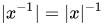


Proof
- Bernoulli's inequality


The following statement is called Bernoulli's inequality.
For every real number , and a natural number , the estimate


We do induction over . Suppose that the statement is already known for . Then
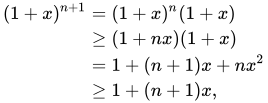
since squares in an ordered field are nonnegative.
- The complex numbers
We are going to introduce the complex numbers starting from the real numbers. It is not important for this construction that we have not completely listed all properties of the real numbers so far. We will use however that every positive real number has a unique real square root. With the construction of the complex numbers, we then have all number domains which are relevant for us.
The set with and , with componentwise addition and the multiplication defined by



is called the field of complex numbers. We denote it by

So the addition is just the vector addition in , but the multiplication is a new operation. We will see in Fact ***** a more geometric interpretation for the complex multiplication.
From now on we write

and in particular we put , this number is called the imaginary unit. It has the important property


From this property and the rules of a field, one can deduce all algebraic properties of the complex numbers. This also helps in memorizing the multiplication rule as we have

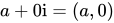
We consider a real number as the complex number . Hence . It does not make a difference whether we add or multiply real numbers as real numbers or as complex numbers.



However, one should not think that complex numbers are less real than real numbers. The construction of the complex numbers starting from the reals is by far easier than the construction of the real numbers starting from the rational numbers. On the other hand, it was a long historic process until complex numbers were accepted as numbers; they form a field, but not an ordered field, and so at first glance they are numbers which do not measure anything.

One should think of complex numbers as points of the plane; for the additive structure we have directly . The horizontal axis is called the real axis and the vertical axis is called the imaginary axis.

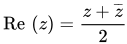
The real partMDLD/real part and the imaginary partMDLD/imaginary part of complex numbersMDLD/complex numbers fulfill the following properties (for
and in ).

- .
- .
- .
- For
we have
- holds if and only if holds, and this holds if and only if holds.





Proof

For , the number is called the complex-conjugated number of . Geometrically, the complex conjugation to is simple the reflection at the real axis.


For the complex conjugation,MDLD/complex conjugation the following rules hold (for arbitrary
).
- .
- .
- .
- For we have .
- .
- We have if and only if holds.



Proof

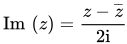
The square of a real number is always nonnegative, and the sum of two nonnegative real numbers is again nonnegative. For a nonnegative real number there exists a unique nonnegative square root , see
Exercise 8.9
Hence the following definition yields a well-defined real number.


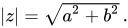
The modulus of a complex number is, due to the Pythagorean theorem, the distance of to the zero point . The modulus is a mapping


The set of all complex numbers with a certain modulus form a circle with the zero point as center and with the modulus as radius. In particular, all complex numbers with modulus form the complex unit circle. The numbers of the complex unit circle are by the formula of Euler in relation to the complex exponential function and to the trigonometric functions, see Fact ***** and Fact *****. We further mention that the product of two complex numbers of the unit circle may be computed by adding the angles starting from the positive real axis counter clockwise.

The modulusMDLD/modulus (C) of complex numbersMDLD/complex numbers
fulfils the following properties.- .
- For real the real and the complex modulus are the same.
- We have if and only if .
- .
- .
- For we have .
- .
- (triangle inequality).


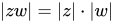
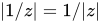


We only show the triangle inequality, for the other statements see Exercise 5.36 . Because of (7) we have for every complex number the estimate . Therefore,

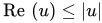

and hence
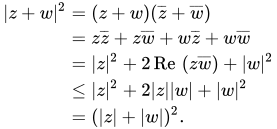
By taking the square root, we get the stated estimate.
| << | Mathematics for Applied Sciences (Osnabrück 2023-2024)/Part I | >> PDF-version of this lecture Exercise sheet for this lecture (PDF) |
|---|