Piano


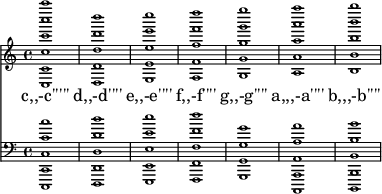
Figure 1 illustrates the bass (𝄢), alto (𝄡) , and treble (𝄞) clefs, using two conventions[1] for labeling the notes. Two mnemonics for remembering the treble and bass staff lines are:
Figure 1 is ideal for teaching the student to read slightly more than dozen notes typically played by the left hand (𝄢) and a dozen notes played by the right hand (𝄞). Figure 2 connects the piano's keys with note's letter-names.
Figure 3 combines features from Figures 1 and 2 by extending the diagram to all 88 notes on a standard piano keyboard. The figure's narrow dimensions permit it to be situated adjacent to the score on Wikiversity pages. In fact, I am currently using this figure to find the fingering and teach myself. To view this figure in action, visit:
Figure 4 strongly encourages you to guess the note. Without that guess, you need to scan each bar. If you go from left-to-right with "C", you need to scan all seven notes if the note was a "B". I don't know about other people, but forcing me to "guess" seems to help me memorize things. Piano teachers often encourage students not to look at the keyboard, perhaps because "guessing" the position of the note enhances the development of muscle memory.
Available sheetmusic[edit | edit source]
This collection of LilyPond scores are designed for the beginner. Each comes with with recommended fingering and audio output with adjustable tempo.
If you have a request for a short piece or exercise that is in the public domain leave a message on my talk page at:
- Current list of available study pieces (it is not to difficult to transpose versions of any score to another key)
- Piano/For beginners is a collection of scores appropriate for a beginners first few lessons.
- Sing free/Amazing Grace is a good first piece for someone interested in learning the piano, but who is hesitant to buy a conventional keyboard without first learning one piece. It can be played on a two octave keyboard (often sold at toy stores.) The current version requires that the highest and lowest notes are G (but that can be changed.)
- Read Wikipedia:Amazing grace
Listen to Prelude in C major
- Read Wikipedia:Amazing grace
- Piano/Prelude in C by Johann Sebastian Bach is in C major, but has enough accidentals to train the hand to hit black keys. It consists of 36 bars of arpeggios, with the vast majority played only once.
- Piano/Gymnopédie 1 by Erik Satie (Under construction)
- Read Wikipedia:Gymnopédies.
Resources[edit | edit source]
- 18 studies ranked by difficulty: designed to give you a few ideas of good pieces for beginning and intermediate piano students.
- How to read piano music and play scales using proper technique: A few words about proper technique accompanied by an introduction to the musical scale.
Links[edit | edit source]
See Basic Blues & Rock or Jazz if you are interested in playing piano, organ or keyboards within those Music genres.
- Musical Notation Article
- Mutopia, an online resource for free sheet music
- IMSLP, International Music Score Library Project, a resource containing many music scores, including some of the ones recommended in the article
- Fundamentals of Piano Practice, online textbook teaching the most efficient way to practice piano playing
- Useful links for "Wedding-day at Troldhaugen" by Edvard Grieg.
- Piano lessons in London, List of piano teachers in London and the UK
- Pianist, composer, and piano teacher in London, private piano teacher based in central London
- Listen to some classical piano recordings from a pianist in London
Appendix[edit | edit source]
An older version of this page is stored at Special:Permalink/2528573. Also, figure 4 was created using LilyPond. Editors interested in modifying figure 4 can edit the scripts used to make these two images:
Script that displays scientific pitch notation
|
|---|
 |
Script that displays Helmholtz pitch notation
|
|---|
 |