Wright State University Lake Campus/2019-9/Oil drop kinematics
- Youtube: Oil drop diagrams Note provocative comment about using videos instead of teachers.
- Pilot pages: Phy1010 . HTW
- Content moved here from:
- Wright State University Lake Campus/2019-9/Phy 1050/Notes How Things Work (HTW)
- Wright State University Lake Campus/2019-9/Phy 1110/Notes College Physics (CP1)
Initial effort by HTW
[edit | edit source]
08-28W
[edit | edit source]- Mozart D-minor piano 126-132 beats per minute. We got 150 beats/min. Is this a big deal? 150/129=1.16
- https://www.youtube.com/watch?v=7QgOBbKl0eY
Buzzwords (vocabulary):
inclined plane ...
rise and run ...
uniform sphere ...
Galileo's rule of 1, 3, 5, 7 ...
uncertainty/error
08-29R
[edit | edit source]Took data on solid sphere rolling down incline
At beat t=-1 ball was relased. Distances from release point shown shown in centmeters for three trials (a,b,c). We conducted four trials. The rise was 3.1±.1 cm, and the hypotenus was 138±1 cm. I am not sure where the ball was released: 0 cm or 0.5cm?
The accelerations are shown on the right, it seems to be the median suggests that it's 14 + or - 4 cm/s2.
| t | a | b | c | * | Dt (sec) | a | b | c | h | ell | frac 7/5 | a(med) | g(meas) |
|---|---|---|---|---|---|---|---|---|---|---|---|---|---|
| 0 | 2 | 2 | 2 | * | 1.6 | ||||||||
| 1 | 32 | 30 | 33 | * | 1.6 | 10 | 13.75 | 23.125 | 3 | 138 | 1.4 | 13.75 | 885.5 |
| 2 | 78 | 80 | 101 | * | 1.6 | 13.125 | 20 | 2.5 | 3 | 138 | 1.4 | 13.125 | 845.25 |
| 3 | 145 | 162 | 173 | * | 1.6 | cm/s/s | cm/s/s | cm/s/s | a(ave) is: | 13.75 | |||
08-30F
[edit | edit source]Same Mozart. From this we conclude that the syncopation error will probably be small. In other words, why switch to more boring music if it doesn't get us better results?
| bars | sec | bars/sec | beats/min | sec/bar | |
|---|---|---|---|---|---|
| 15 | 26 | 0.576923077 | 138.4615385 | 1.7333 | |
| 29 | 45 | 0.644444444 | 154.6666667 | 1.5517 | |
| 3 | 4.97 | 0.60362173 | 144.8692153 | 1.6567 | |
| 15 | 23 | 0.652173913 | 156.5217391 | 1.5333 | |
| 15 | 26.3 | 0.570342205 | 136.8821293 | 1.7533 | |
| 0.609501074 | 146.2802578 | ave | 1.6457 | ||
| 0.037654083 | 9.036979948 | sddev | 0.101 | ||
| 6% | 6% | sd/ave | |||
| 25% | 25% | off by 1 beat | |||
| 13% | 13% | half beat | |||
| 6% | 6% | sd/ave | |||
| 25% | 25% | off by 1 beat | |||
| 13% | 13% | half beat |
Data by 1110
[edit | edit source]https://tools.wmflabs.org/excel2wiki/
| 0 | a1 | a2 | a3 | c1 | c1 | c1 | b1 | b2 | b3 |
|---|---|---|---|---|---|---|---|---|---|
| 1 | 40 | 50 | 46 | 25 | 30 | 32 | 4.5 | 4 | 4 |
| 2 | 90 | 125 | 122 | 85 | 79 | 97 | 62 | 53 | 45 |
| 3 | 182 | 200 | 200 | 151 | 163 | 179 | 152 | 158 | 131 |
Formulas
[edit | edit source]Accelerated motion
[edit | edit source]
where the moment of inertia of a solid sphere is , and,
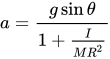

is the ratio of height to track-length. A good way to evaluate our accuracy is to solve this for g and see how close it is to the accepted result of approximately 980 cm/s2. For the exact value of g at your location, visit https://www.sensorsone.com/local-gravity-calculator/.

In "How-things-word" we did the algebra to get:

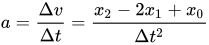
Calculating acceleration
[edit | edit source]It can be shown that for three consecutive locations along straight line: