The balance of mass can be expressed as:

where  is the current mass density,
  is
the material time derivative of
is
the material time derivative of  , and
, and  is the
velocity of physical particles in the body
is the
velocity of physical particles in the body  bounded by
the surface
bounded by
the surface  .
.
We can show how this relation is derived by recalling that the general equation for the balance of a physical quantity
 is given by
![{\displaystyle {\cfrac {d}{dt}}\left[\int _{\Omega }f(\mathbf {x} ,t)~{\text{dV}}\right]=\int _{\partial {\Omega }}f(\mathbf {x} ,t)[u_{n}(\mathbf {x} ,t)-\mathbf {v} (\mathbf {x} ,t)\cdot \mathbf {n} (\mathbf {x} ,t)]~{\text{dA}}+\int _{\partial {\Omega }}g(\mathbf {x} ,t)~{\text{dA}}+\int _{\Omega }h(\mathbf {x} ,t)~{\text{dV}}~.}](https://wikimedia.org/api/rest_v1/media/math/render/svg/fcb120ab19e9001d85370ccb115c509cec72cf33)
To derive the equation for the balance of mass, we assume that the
physical quantity of interest is the mass density .
Since mass is neither created or destroyed, the surface and interior
sources are zero, i.e.,  . Therefore, we have
![{\displaystyle {\cfrac {d}{dt}}\left[\int _{\Omega }\rho (\mathbf {x} ,t)~{\text{dV}}\right]=\int _{\partial {\Omega }}\rho (\mathbf {x} ,t)[u_{n}(\mathbf {x} ,t)-\mathbf {v} (\mathbf {x} ,t)\cdot \mathbf {n} (\mathbf {x} ,t)]~{\text{dA}}~.}](https://wikimedia.org/api/rest_v1/media/math/render/svg/03f94d594114f237d5c144e08d373bc8cc993585)
Let us assume that the volume is a control volume (i.e., it
does not change with time). Then the surface has a zero
velocity ( ) and we get

Using the divergence theorem
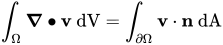
we get

or,
![{\displaystyle \int _{\Omega }\left[{\frac {\partial \rho }{\partial t}}+{\boldsymbol {\nabla }}\bullet (\rho ~\mathbf {v} )\right]~{\text{dV}}=0~.}](https://wikimedia.org/api/rest_v1/media/math/render/svg/991491fdad14216d8c35799c2f7deb776e4a3089)
Since is arbitrary, we must have
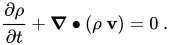
Using the identity

we have

Now, the material time derivative of is defined as
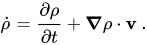
Therefore,


