The balance of linear momentum can be expressed as:

where  is the mass density,
  is the velocity,
 is the Cauchy stress, and
  is the body force
density.
is the body force
density.
Recall the general equation for the balance of a physical quantity
![{\displaystyle {\cfrac {d}{dt}}\left[\int _{\Omega }f(\mathbf {x} ,t)~{\text{dV}}\right]=\int _{\partial {\Omega }}f(\mathbf {x} ,t)[u_{n}(\mathbf {x} ,t)-\mathbf {v} (\mathbf {x} ,t)\cdot \mathbf {n} (\mathbf {x} ,t)]~{\text{dA}}+\int _{\partial {\Omega }}g(\mathbf {x} ,t)~{\text{dA}}+\int _{\Omega }h(\mathbf {x} ,t)~{\text{dV}}~.}](https://wikimedia.org/api/rest_v1/media/math/render/svg/fcb120ab19e9001d85370ccb115c509cec72cf33)
In this case the physical quantity of interest is the momentum density,
i.e.,  . The source of momentum flux
at the surface is the surface traction, i.e.,
. The source of momentum flux
at the surface is the surface traction, i.e.,  . The
source of momentum inside the body is the body force, i.e.,
. The
source of momentum inside the body is the body force, i.e.,
 . Therefore, we have
![{\displaystyle {\cfrac {d}{dt}}\left[\int _{\Omega }\rho ~\mathbf {v} ~{\text{dV}}\right]=\int _{\partial {\Omega }}\rho ~\mathbf {v} [u_{n}-\mathbf {v} \cdot \mathbf {n} ]~{\text{dA}}+\int _{\partial {\Omega }}\mathbf {t} ~{\text{dA}}+\int _{\Omega }\rho ~\mathbf {b} ~{\text{dV}}~.}](https://wikimedia.org/api/rest_v1/media/math/render/svg/a46f11b5cfa9b04cb07575c7f4e042233fcce4d6)
The surface tractions are related to the Cauchy stress by

Therefore,
![{\displaystyle {\cfrac {d}{dt}}\left[\int _{\Omega }\rho ~\mathbf {v} ~{\text{dV}}\right]=\int _{\partial {\Omega }}\rho ~\mathbf {v} [u_{n}-\mathbf {v} \cdot \mathbf {n} ]~{\text{dA}}+\int _{\partial {\Omega }}{\boldsymbol {\sigma }}\cdot \mathbf {n} ~{\text{dA}}+\int _{\Omega }\rho ~\mathbf {b} ~{\text{dV}}~.}](https://wikimedia.org/api/rest_v1/media/math/render/svg/adc3ef27ffa5e65209e677c035ea62b0e9cf1bb4)
Let us assume that  is an arbitrary fixed control volume. Then,

Now, from the definition of the tensor product we have (for all vectors
 )
)

Therefore,

Using the divergence theorem
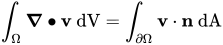
we have
![{\displaystyle \int _{\Omega }{\frac {\partial }{\partial t}}(\rho ~\mathbf {v} )~{\text{dV}}=-\int _{\Omega }{\boldsymbol {\nabla }}\bullet [\rho ~(\mathbf {v} \otimes \mathbf {v} )]~{\text{dV}}+\int _{\Omega }{\boldsymbol {\nabla }}\bullet {\boldsymbol {\sigma }}~{\text{dV}}+\int _{\Omega }\rho ~\mathbf {b} ~{\text{dV}}}](https://wikimedia.org/api/rest_v1/media/math/render/svg/34f59a0faa78bd490f4b097fe1846bee54252d62)
or,
![{\displaystyle \int _{\Omega }\left[{\frac {\partial }{\partial t}}(\rho ~\mathbf {v} )+{\boldsymbol {\nabla }}\bullet [(\rho ~\mathbf {v} )\otimes \mathbf {v} )]-{\boldsymbol {\nabla }}\bullet {\boldsymbol {\sigma }}-\rho ~\mathbf {b} \right]~{\text{dV}}=0~.}](https://wikimedia.org/api/rest_v1/media/math/render/svg/03c321bc67c81041e73677bfadbe98c206a18988)
Since is arbitrary, we have
![{\displaystyle {\frac {\partial }{\partial t}}(\rho ~\mathbf {v} )+{\boldsymbol {\nabla }}\bullet [(\rho ~\mathbf {v} )\otimes \mathbf {v} )]-{\boldsymbol {\nabla }}\bullet {\boldsymbol {\sigma }}-\rho ~\mathbf {b} =0~.}](https://wikimedia.org/api/rest_v1/media/math/render/svg/615dfb89380d7157ae3c429c3eff733eacf30c58)
Using the identity

we get

or,
![{\displaystyle \left[{\frac {\partial \rho }{\partial t}}+\rho ~{\boldsymbol {\nabla }}\bullet \mathbf {v} \right]\mathbf {v} +\rho ~{\frac {\partial \mathbf {v} }{\partial t}}+{\boldsymbol {\nabla }}(\rho ~\mathbf {v} )\cdot \mathbf {v} -{\boldsymbol {\nabla }}\bullet {\boldsymbol {\sigma }}-\rho ~\mathbf {b} =0}](https://wikimedia.org/api/rest_v1/media/math/render/svg/1c6a6d133032adf207945ec955ca922476fa4de2)
Using the identity

we get
![{\displaystyle \left[{\frac {\partial \rho }{\partial t}}+\rho ~{\boldsymbol {\nabla }}\bullet \mathbf {v} \right]\mathbf {v} +\rho ~{\frac {\partial \mathbf {v} }{\partial t}}+\left[\rho ~{\boldsymbol {\nabla }}\mathbf {v} +\mathbf {v} \otimes ({\boldsymbol {\nabla }}\rho )\right]\cdot \mathbf {v} -{\boldsymbol {\nabla }}\bullet {\boldsymbol {\sigma }}-\rho ~\mathbf {b} =0}](https://wikimedia.org/api/rest_v1/media/math/render/svg/d8f4634efd67549ed2d10b81b08fc879960a230b)
From the definition

we have
![{\displaystyle [\mathbf {v} \otimes ({\boldsymbol {\nabla }}\rho )]\cdot \mathbf {v} =[\mathbf {v} \cdot ({\boldsymbol {\nabla }}\rho )]~\mathbf {v} ~.}](https://wikimedia.org/api/rest_v1/media/math/render/svg/d51ffdfa1c0eef65a6d11cc792f7e0c9195e9412)
Hence,
![{\displaystyle \left[{\frac {\partial \rho }{\partial t}}+\rho ~{\boldsymbol {\nabla }}\bullet \mathbf {v} \right]\mathbf {v} +\rho ~{\frac {\partial \mathbf {v} }{\partial t}}+\rho ~{\boldsymbol {\nabla }}\mathbf {v} \cdot \mathbf {v} +[\mathbf {v} \cdot ({\boldsymbol {\nabla }}\rho )]~\mathbf {v} -{\boldsymbol {\nabla }}\bullet {\boldsymbol {\sigma }}-\rho ~\mathbf {b} =0}](https://wikimedia.org/api/rest_v1/media/math/render/svg/9020d02391b4cbf5edfcfc6c8ab79644a13835de)
or,
![{\displaystyle \left[{\frac {\partial \rho }{\partial t}}+{\boldsymbol {\nabla }}\rho \cdot \mathbf {v} +\rho ~{\boldsymbol {\nabla }}\bullet \mathbf {v} \right]\mathbf {v} +\rho ~{\frac {\partial \mathbf {v} }{\partial t}}+\rho ~{\boldsymbol {\nabla }}\mathbf {v} \cdot \mathbf {v} -{\boldsymbol {\nabla }}\bullet {\boldsymbol {\sigma }}-\rho ~\mathbf {b} =0~.}](https://wikimedia.org/api/rest_v1/media/math/render/svg/13599a24b1ac883c0ed676882f088c9209f86b41)
The material time derivative of  is defined as
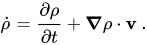
Therefore,
![{\displaystyle \left[{\dot {\rho }}+\rho ~{\boldsymbol {\nabla }}\bullet \mathbf {v} \right]\mathbf {v} +\rho ~{\frac {\partial \mathbf {v} }{\partial t}}+\rho ~{\boldsymbol {\nabla }}\mathbf {v} \cdot \mathbf {v} -{\boldsymbol {\nabla }}\bullet {\boldsymbol {\sigma }}-\rho ~\mathbf {b} =0~.}](https://wikimedia.org/api/rest_v1/media/math/render/svg/c4484bb80e35493fc3a7c3978fc27e937c0c2aeb)
From the balance of mass, we have

Therefore,

The material time derivative of  is defined as
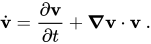
Hence,


