

Mathematics for Applied Sciences (Osnabrück 2023-2024)/Part I/Exercise sheet 20
- Exercises
Show by induction over , using integration by parts, that


holds.
The following exercises are about determining primitive functions. This includes the choice of suitable domains for the functions.
Determine an antiderivative (primitive function) of the function

Determine an antiderivative (primitive function) of the function

Determine an antiderivative (primitive function) of the function

Determine an antiderivative (primitive function) of the function
![{\displaystyle {\frac {x^{3}}{\sqrt[{5}]{x^{4}+2}}}.}](https://wikimedia.org/api/rest_v1/media/math/render/svg/13b969fa7d568a8e81e850009f7ff93f372f23a2)
Determine an antiderivative (primitive function) of the function

Determine an antiderivative (primitive function) of the function
![{\displaystyle {\frac {1+3{\sqrt[{6}]{x-2}}}{{\sqrt[{3}]{(x-2)^{2}}}-{\sqrt {x-2}}}}.}](https://wikimedia.org/api/rest_v1/media/math/render/svg/27c0f023a69c051c4362bfdc775c56e0c62b0c55)
Determine an antiderivative (primitive function) of the function

Let be a real interval and let


be a continuous function with antiderivative . Let be an antiderivative of and let . Determine an antiderivative of the function


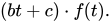
Let . Determine an antiderivative of the function


using the antiderivative of and the theorem about integration of inverse function.

Determine an antiderivative of the natural logarithm function using the antiderivative of its inverse function.
Let
![{\displaystyle f\colon [a,b]\longrightarrow [c,d]}](https://wikimedia.org/api/rest_v1/media/math/render/svg/0e0bb24836a42c93b9d118cddbc7528646cd6ae1)
be a bijective, continuous differentiable function. Prove the formula for the antiderivative of the inverse function by the integral
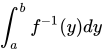
using the substitution and then integration by parts.

Compute the definite integral
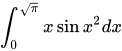
Compute the definite integral of the function

on .
![{\displaystyle {}[1,4]}](https://wikimedia.org/api/rest_v1/media/math/render/svg/e1aa329024219cda380773d0f4815acce3e3ccf5)
Compute by an appropriate substitution an antiderivative of
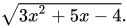
Prove the relationship

for , only using rules for integration.


Determine the areas of the regions, surrounded by the blue curves, sketched on the right.
- Hand-in-exercises
Exercise (3 marks)
Determine an antiderivative (primitive function) of the function

Exercise (2 marks)
Determine an antiderivative (primitive function) of the function

Exercise (3 marks)
Determine an antiderivative (primitive function) of the function

Exercise (4 marks)
Determine an antiderivative (primitive function) of the function
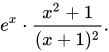
Hint: Write the numerator polynomial using the denominator polynomial.
Exercise (4 marks)
Let be a real interval and let
be a continuous function with antiderivative . Let be an antiderivative of and an antiderivative of . Let . Determine an antiderivative of the function



Exercise (5 marks)

Let
![{\displaystyle f\colon [0,1]\longrightarrow \mathbb {R} _{+}}](https://wikimedia.org/api/rest_v1/media/math/render/svg/a067e7604dcf329f7bf33c77065533c7df3621ec)
be a differentiable function with for all . For what points does the area of the hatched surface have a local extremum? Is it a minimum or a maximum?


![{\displaystyle {}t\in [0,1]}](https://wikimedia.org/api/rest_v1/media/math/render/svg/95b82d90b07769530e83a657ede98f1649efa31f)
| << | Mathematics for Applied Sciences (Osnabrück 2023-2024)/Part I | >> PDF-version of this exercise sheet Lecture for this exercise sheet (PDF) |
|---|