|
|
 Triangle of possible inversions of 8-element permutations Triangle of possible inversions of 8-element permutations
|
 Permutation Permutation  from the array below from the array below
|
These are some examples of similar permutations ordered in arrays.
Each permutation is represented by its:
- place-based inversion set
- Rothe diagram (including the matrix representation as dots)
- left-inversion vector (0s represented by dots, the leading 0s omitted)
- reverse colexicographic index, i.e. the left-inversion vector interpreted as a little-endian factorial number
For the last permutation in each array the corresponding permutation matrix is also shown.
|
|
 

|
  A211366 A211366
|
 

|
|
|
 

|
 A211368 Rows of transpositions A211368 Rows of transpositions
|
 

|
 A211369 Transpositions This array corrsponds to the inverted array of 2-element subsets: In place A211369 Transpositions This array corrsponds to the inverted array of 2-element subsets: In place  is the cycle is the cycle  , e.g. , e.g.  in place in place  . . |
 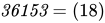
 In place is the set In place is the set  . .
|
 A100630 Nested transpositions A100630 Nested transpositions
|
 

|
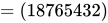
 A211370 Circular shifts to the left in an interval A211370 Circular shifts to the left in an interval |
 
|
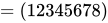
 A051683 Circular shifts to the right in an interval A051683 Circular shifts to the right in an interval
|
 
|
|
Circular shifts to the left,
i.e. permutations whose cycle notation is of the form  : :
A007489 = 0, 1, 3, 9, 33, 153, 873, 5913...
|
Circular shifts to the right,
i.e. permutations whose cycle notation is of the form  : :
A001563 = 0, 1, 4, 18, 96, 600, 4320, 35280...
|





 A211366


