Stars/Sun/Solar binary

A solar binary of the Sun and Jupiter may serve to establish an upper limit for interstellar cometary capture. The basic problem even with a passage through a molecular cloud of some 10 million years is the low relative velocity (~0.5 km s-1) required between the solar system and the cometary medium. Some of the captured bodies may localize in the Oort cloud, while others localize near the Sun or Jupiter.
As stars often occur as binaries or multiple star systems, it is likely that the Sun may have been a member of a binary system or even a multiple star system at some time in the past.
Solar twins[edit | edit source]
Solar twins have the following qualities:[1]
- Temperature within 50 K Solar (roughly 5720 to 5830 K)
- Metallicity of 89—112% (± 0.05 dex) Solar, meaning the star's proplyd would have had almost exactly the same amount of dust for planetary formation
- No stellar companion, because the Sun itself is solitary
- An age within 1 billion years Solar (roughly 3.5 to 5.6 Ga)
| Identifier | Coordinates[2] | Distance[2] (ly) |
Stellar Class[2] |
Temperature (K) |
Metallicity (dex) |
Age (Gyr) |
Notes | |
|---|---|---|---|---|---|---|---|---|
| Right ascension | Declination | |||||||
| Sun | — | — | 0.00 | G2V | 5,778 | +0.00 | 4.6 | [3] |
| 18 Scorpii | 16h 15m 37.3s | –08° 22′ 06″ | 45.1 | G2Va | 5,835 | +0.04 | 4.2 | [4] |
| HD 44594 | 06h 20m 06.1s | -48° 44′ 29″ | 84 | G3V | 5,840 | +0.15 | 4.1 | [5] |
| HD 195034 | 20h 28m 11.8s | +22° 07′ 44″ | 92 | G5 | 5,760 | -0.04 | 5.1 | [6] |
| HD 138573 | 15h 32m 43.7s | +10° 58′ 06″ | 101 | G5IV-V | 5,710 | –0.03 | 7.8 | [7] |
| HD 142093 | 15h 52m 00.6s | +15° 14′ 09″ | 103 | G2V | 5,841 | –0.15 | 5.0 | [7] |
| HD 98618 | 11h 21m 29.1s | +58° 29′ 04″ | 126 | G5V | 5,851 | +0.03 | 4.7 | [4] |
| HD 143436 | 16h 00m 18.8s | +00° 08′ 13″ | 141 | G0 | 5,768 | +0.00 | 3.8 | [7] |
| HD 129357 | 14h 41m 22.4s | +29° 03′ 32″ | 154 | G2V | 5,749 | –0.02 | 8.2 | [7] |
| HD 133600 | 15h 05m 13.2s | +06° 17′ 24″ | 171 | G0 | 5,808 | +0.02 | 6.3 | [4] |
| HD 101364 | 11h 40m 28.5s | +69° 00′ 31″ | 208 | G5V | 5,795 | +0.02 | 3.5 | [4][8] |
A solar twin is more similar to the Sun than a solar analog.
Solar analogs[edit | edit source]
Solar analogs "are photometrically similar to the Sun, having the following qualities:"[1]
- Temperature within 500 K Solar (roughly 5200 to 6300 K)
- Metallicity of 50—200% (± 0.3 dex) Solar, meaning the star's protoplanetary disk would have had similar amounts of dust from which planets could form
- No close companion (orbital period of ten days or less), as such a companion stimulates stellar activity
Solar analog stars would have an effective surface temperature of ~5800 K.
Solar analogs not meeting the stricter solar twin criteria include, within 50 light years and in order of increasing distance:
| Identifier | Coordinates[2] | Distance[2] (ly) |
Stellar Class[2] |
Temperature (K) |
Metallicity (dex) |
Notes | |
|---|---|---|---|---|---|---|---|
| Right ascension | Declination | ||||||
| Alpha Centauri A | 14h 39m 36.5s | -60° 50′ 02″ | 4.37 | G2V | 5,847 | +0.24 | [9] |
| Alpha Centauri B | 14h 39m 35.0s | -60° 50′ 14″ | 4.37 | K1V | 5,316 | +0.25 | [9] |
| 70 Ophiuchi A | 18h 05m 27.3s | +02° 30′ 00″ | 16.6 | K0V | 5,314 | –0.02 | [10] |
| Sigma Draconis | 19h 32m 21.6s | +69° 39′ 40″ | 18.8 | K0V | 5,297 | –0.20 | [11] |
| Eta Cassiopeiae A | 00h 49m 06.3s | +57° 48′ 55″ | 19.4 | G0V | 5,941 | –0.17 | [12] |
| 107 Piscium | 01h 42m 29.8s | +20° 16′ 07″ | 24.4 | K1V | 5,242 | –0.04 | [13][14] |
| Beta Canum Venaticorum | 12h 33m 44.5s | +41° 21′ 27″ | 27.4 | G0V | 5,930 | -0.30 | [13] |
| 61 Virginis | 13h 18m 24.3s | -18° 18′ 40″ | 27.8 | G5V | 5,558 | –0.02 | [15] |
| Zeta Tucanae | 00h 20m 04.3s | –64° 52′ 29″ | 28.0 | F9.5V | 5,956 | –0.14 | [16] |
| Chi¹ Orionis A | 05h 54m 23.0s | +20° 16′ 34″ | 28.3 | G0V | 5,902 | –0.16 | [13] |
| Beta Comae Berenices | 13h 11m 52.4s | +27° 52′ 41″ | 29.8 | G0V | 5,970 | –0.06 | [13] |
| HR 4523 A | 11h 46m 31.1s | –40° 30′ 01″ | 30.1 | G5V | 5,629 | –0.29 | [15] |
| 61 Ursae Majoris | 11h 41m 03.0s | +34° 12′ 06″ | 31.1 | G8V | 5,483 | –0.12 | [13] |
| HR 4458 A | 11h 34m 29.5s | –32° 49′ 53″ | 31.1 | K0V | 5,629 | –0.29 | [15] |
| HR 511 | 01h 47m 44.8s | +63° 51′ 09″ | 32.8 | K0V | 5,333 | +0.05 | [13] |
| Alpha Mensae | 06h 10m 14.5s | –74° 45′ 11″ | 33.1 | G5V | 5,594 | +0.10 | [16] |
| Zeta Reticuli1 | 03h 17m 46.2s | -62° 34′ 31″ | 39.5 | G3-5V | 5,733 | -0.22 | [16] |
| Zeta Reticuli2 Reticuli | 03h 18m 12.8s | -62° 30′ 23″ | 39.5 | G2V | 5,843 | -0.23 | [16] |
| 55 Cancri | 08h 52m 35.81s | +28° 19′ 51″ | 40.3 | G8V | 5,235 | +0.25 | [12] |
| HD 69830 | 08h 18m 23.9s | -12° 37′ 56″ | 40.6 | K0V | 5,410 | -0.03 | [16] |
| HD 10307 | 01h 41m 47.1s | +42° 36′ 48″ | 41.2 | G1.5V | 5,848 | -0.05 | [13] |
| HD 147513 | 16h 24m 01.3s | -39° 11′ 35″ | 42.0 | G1V | 5,858 | +0.03 | [15] |
| 58 Eridani | 04h 47m 36.3s | -16° 56′ 04″ | 43.3 | G3V | 5,868 | +0.02 | [16] |
| Upsilon Andromedae A | 01h 36m 47.8s | +41° 24′ 20″ | 44.0 | F8V | 6,212 | +0.13 | [16] |
| HD 211415 A | 22h 18m 15.6s | –53° 37′ 37″ | 44.4 | G1-3V | 5,890 | -0.17 | [16] |
| 47 Ursae Majoris | 10h 59m 28.0s | +40° 25′ 49″ | 45.9 | G1V | 5,954 | +0.06 | [16] |
| Alpha Fornacis A | 03h 12m 04.3s | -28° 59′ 21″ | 46.0 | F8IV | 6,275 | -0.19 | [16] |
| Psi Serpentis A | 15h 44m 01.8s | +02° 30′ 55″ | 47.9 | G5V | 5,636 | -0.03 | [13] |
| HD 84117 | 09h 42m 14.4s | –23° 54′ 56″ | 48.5 | F8V | 6,167 | –0.03 | [16] |
| HD 4391 | 00h 45m 45.6s | –47° 33′ 07″ | 48.6 | G3V | 5,878 | –0.03 | [16] |
| 20 Leonis Minoris | 10h 01m 00.7s | +31° 55′ 25″ | 49.1 | G3 V | 5,741 | +0.20 | [13] |
| Nu Phoenicis | 01h 15m 11.1s | –45° 31′ 54″ | 49.3 | F8V | 6,140 | +0.18 | [16] |
| 51 Pegasi | 22h 57m 28.0s | +20° 46′ 08″ | 50.9 | G2.5IVa | 5,804 | +0.20 | [16] |
Solar types[edit | edit source]
A solar-type star is less similar to the Sun than a solar analog star.
Solar-type stars "are main-sequence stars with a B-V color between 0.48 and 0.80, the Sun having a B-V color of 0.65. Alternatively, a definition based on spectral type can be used, such as F8 V through K2 V, which would correspond to B-V color of 0.50 to 1.00.[1] This definition fits approximately 10% of stars".
"Solar-type stars show highly correlated behavior between their rotation rates and their chromospheric activity (e.g. Calcium H & K line emission) and coronal activity (e.g. X-ray emission). As solar-type stars spin-down during their main-sequence lifetimes due to magnetic braking, these correlations allow rough ages to be derived.[17]
The following table shows a sample of solar-type stars within 50 light years that nearly satisfy the criteria for solar analogs, based on current measurements.
| Identifier | Coordinates[2] | Distance[2] (ly) |
Stellar Class[2] |
Temperature (K) |
Metallicity (dex) |
Notes | |
|---|---|---|---|---|---|---|---|
| Right ascension | Declination | ||||||
| Tau Ceti | 01h 44m 04.1s | -15° 56′ 15″ | 11.9 | G8V | 5,344 | –0.52 | [16] |
| 40 Eridani A | 04h 15m 16.3s | -07° 39′ 10″ | 16.5 | K1V | 5,126 | –0.31 | [16] |
| 82 Eridani | 03h 19m 55.7s | -43° 04′ 11.2″ | 19.8 | G8V | 5,338 | –0.54 | [13] |
| Delta Pavonis | 20h 08m 43.6s | -66° 10′ 55″ | 19.9 | G8IV | 5,604 | +0.33 | [15] |
| HR 7722 | 20h 15m 17.4s | -27° 01′ 59″ | 28.8 | K0V | 5,166 | –0.04 | [15] |
| Gliese 86 A | 02h 10m 25.9s | -50° 49′ 25″ | 35.2 | K1V | 5,163 | -0.24 | [16] |
| 54 Piscium | 00h 39m 21.8s | +21° 15′ 02″ | 36.1 | K0V | 5,129 | +0.19 | [13] |
| V538 Aurigae | 05h 41m 20.3s | +53° 28′ 51.8″ | 39.9 | K1V | 3,500-5,000 | -0.20 | [13] |
| HD 14412 | 02h 18m 58.5s | -25° 56′ 45″ | 41.3 | G5V | 5,432 | -0.46 | [13] |
| HR 4587 | 12h 00m 44.3s | -10° 26′ 45.7″ | 42.1 | G8IV | 5,538 | 0.18 | [13] |
| HD 172051 | 18h 38m 53.4s | -21° 03′ 07″ | 42.7 | G5V | 5,610 | -0.32 | [13] |
| 72 Herculis | 17h 20m 39.6s | +32° 28′ 04″ | 46.9 | G0V | 5,662 | -0.37 | [13] |
| HD 196761 | 20h 40m 11.8s | -23° 46′ 26″ | 46.9 | G8V | 5,415 | -0.31 | [15] |
| Nu² Lupi | 15h 21m 48.1s | -48° 19′ 03″ | 47.5 | G4V | 5,664 | -0.34 | [15] |
Solar binary theory[edit | edit source]
Uranus is named after the ancient Greek deity of the sky Uranus, the father of Cronus (Saturn) and grandfather of Zeus (Jupiter). Though it is visible to the naked eye like the five classical planets, it was never recognized as a planet by ancient observers because of its dimness and slow orbit.[18]
Binary stars[edit | edit source]
Def. "[t]wo stars that appear to be one when seen with the naked eye, either because they orbit one another (binary stars) or happen to be in the same line of sight even though they are separated by a great distance> is called a double star.
Def. "[a] star that appears as a double due to an optical illusion; in reality, the stars may be far apart from each other> is called an optical double.
Def. two stars which form a stellar system, such that they orbit the point of equilibrium of their gravitational fields is called a double star.
Def. a stellar system that has two stars orbiting around each other is called a binary star.
A binary star is a star system consisting of two stars orbiting around their common center of mass. The brighter star is called the primary and the other is its companion star, ... or secondary. Many visual binaries have long orbital periods of several centuries or millennia and therefore have orbits which are uncertain or poorly known.
Def. a binary star whose components can be visually resolved is called a visual binary.
Astrometric binaries[edit | edit source]
Astrometric binaries are relatively nearby stars which can be seen to wobble around a point in space, with no visible companion. The same mathematics used for ordinary binaries can be applied to infer the mass of the missing companion. The companion could be very dim, so that it is currently undetectable or masked by the glare of its primary, or it could be an object that emits little or no electromagnetic radiation.
The visible star's position is carefully measured and detected to vary, due to the gravitational influence from its counterpart. The position of the star is repeatedly measured relative to more distant stars, and then checked for periodic shifts in position. Typically this type of measurement can only be performed on nearby stars, such as those within 10 parsecs. Nearby stars often have a relatively high proper motion, so astrometric binaries will appear to follow a sinusoidal path across the sky.
Spectroscopic binaries[edit | edit source]
Sometimes, the only evidence of a binary star comes from the Doppler effect on its emitted light. In these cases, the binary consists of a pair of stars where the spectral lines in the light emitted from each star shifts first toward the blue, then toward the red, as each moves first toward us, and then away from us, during its motion about their common center of mass, with the period of their common orbit.
In these systems, the separation between the stars is usually very small, and the orbital velocity very high. Unless the plane of the orbit happens to be perpendicular to the line of sight, the orbital velocities will have components in the line of sight and the observed radial velocity of the system will vary periodically. Since radial velocity can be measured with a spectrometer by observing the Doppler shift of the stars' spectral lines, the binaries detected in this manner are known as spectroscopic binaries. Most of these cannot be resolved as a visual binary, even with telescopes of the highest existing resolving power.
Eclipsing binaries[edit | edit source]

An eclipsing binary star is a binary star in which the orbit plane of the two stars lies so nearly in the line of sight of the observer that the components undergo mutual eclipses. In the case where the binary is also a spectroscopic binary and the parallax of the system is known, the binary is quite valuable for stellar analysis.[21] Algol is the best-known example of an eclipsing binary.[21]
Eclipsing binary with matter transfer[edit | edit source]

Matter may transfer from one star to another through a process known as Roche Lobe overflow (RLOF) through an accretion disc. The mathematical point through which this transfer happens is called the first Lagrangian point.[22] It is not uncommon that the accretion disc is the brightest (and thus sometimes the only visible) element of a binary star.
Detached binaries[edit | edit source]
For detached binaries each component is within its Roche lobe, i.e. the area where the gravitational pull of the star itself is larger than that of the other component. The stars have no major effect on each other, and essentially evolve separately. Most binaries belong to this class.
Semidetached binaries[edit | edit source]
A semidetached binary has “one of the components [filling] the binary star's Roche lobe and the other does not. Gas from the surface of the Roche-lobe-filling component (donor) is transferred to the other, accreting star. The mass transfer dominates the evolution of the system. In many cases, the inflowing gas forms an accretion disc around the accretor.
Contact binaries[edit | edit source]
In a contact binary both components fill their Roche lobes; i.e., they “are so close that they touch each other or have merged to share their gaseous envelopes.
When stars share an envelope the pair may be called an overcontact binary.[23][24][25] “As the friction of the envelope brakes the orbital motion, the stars may eventually merge.[26] A contact binary is a stable configuration [where the two stars touch,] with a typical lifetime of millions to billions of years. Almost all known contact binary systems are eclipsing binaries[27]
Common envelope binaries[edit | edit source]
A common envelope (CE) binary refers to a short-lived (months to years) phase in the evolution of a binary star in which the largest of the two stars (the donor star) has initiated unstable mass transfer to its companion star. This [may become a run-away process in which] the [donor star’s] envelope [expands to] engulf the companion star. ... The [loss] of orbital energy [may] heat up and expand the envelope. The whole common-envelope phase ends when either the envelope is expelled into space, or the two objects inside the envelope merge and no more energy is available to expand or even expel the envelope. This phase of the shrinking of the orbit inside the common envelope is known as a spiral-in.
Chaos assisted capture[edit | edit source]
In a mechanism of chaos assisted capture (CAC), particles such as comets or those of sizes in the range of the irregular moons of Jupiter become entangled in chaotic layers which temporarily “extend the lifetimes of [these] particles within the Hill sphere, thereby providing the breathing space necessary for relatively weak dissipative forces (eg gas-drag) to effect permanent capture.”[28] These objects of the Sun-Jupiter binary system may localize near Jupiter and become satellites, specifically the irregular moons.[28]
Solar antapexes[edit | edit source]
In 1917 the solar antapex has an equatorial location of right ascension (RA) 6h declination (Dec) -34°.[29]
Star fission[edit | edit source]
"Zero-age contact must be a consequence of star fission under critical angular momentum."[30] When the angular momentum is too large, the star brakes into a detached binary.[30] When the angular momentum is too small, the star remains as a single star.[30] BH Centauri and V1010 Ophiuchi have zero-age radii and are zero-age contact systems.[30] BH Centauri is an overcontact system.[30]
Fragmentation of the molecular cloud during the formation of protostars is an acceptable explanation for the formation of a binary or multiple star system.[31][32]
With respect to low-mass star formation, "fragmentation to form a binary star [may be] most simply achieved if collapse is initiated by an external impulse."[33] "On its own, [the] process under which a dense molecular cloud core can collapse to form a binary, or multiple, star system would produce wide binaries".[33] "[C]lose binaries [may be] formed because of mutual interactions between the protostellar discs surrounding the various fragments."[33] "[T]he most likely collision which has an effect on the core is the one for which [the velocity change imparted by the impulse,] Δv ~ cs [(the internal sound speed),] induced by a clump of mass ~0.1Mʘ."[33] "[T]he impulsive collapse of the cloud cores [requires] that they are not primarily magnetically supported in their central regions."[33]
Electromagnetics[edit | edit source]
Consider an object of mass (m = 0.1M⊙) passing through the heliosphere of the Sun at a velocity of 20 km s-1 from a galactic location originally outside the heliosphere. There are no other large objects in orbit around the Sun at the time of this object's entry. Jupiter, Saturn, Uranus, and Neptune are not present.
The object has a surface negative charge of 0.2Q⊙ and an intrinsic magnetic field of 100 Gauss (G) directed vertically. A current of 5 e- per second is following along magnetic field lines toward the Sun from the object. A comparable number of protons are following magnetic field lines from the Sun to the object.
At t0 the object is at 1,000 AU. Its RA is 14h 30m Dec +46° 30'.
Let the Sun have a magnetic field of 1 G directed vertically. The charge on the Sun (Q⊙) is -3 x 1027 e.s.u.
Electrostatics[edit | edit source]
Coulomb's law states that the electrostatic force experienced by a charge, at position , in the vicinity of another charge, at position , in vacuum is equal to:


where is the electric constant or the permittivity of free space and is the distance between the two charges and the constant is in SI units of C2 m−2 N−1, where C is Coulombs.


ε0 ≈ 8.854 x 10⁻¹² C2 m−2 N−1, or
ε0 ≈ 8.854 x 10⁻¹² C2 10-6 km−2 N−1, then
ε0 ≈ 8.854 x 10⁻¹⁸ C2 km−2 N−1.
1 e.s.u. ≈ 3.34 x 10⁻¹⁰ C.
![{\displaystyle F_{q}={\frac {0.2}{4\pi }}{\frac {[(-3\times 10^{27}e.s.u.)(3.34\times 10^{-10}C/e.s.u.)]^{2}}{(8.854\times 10^{-18}C^{2}km^{-2}N^{-1})[(1.5\times 10^{8})10^{3}km]^{2}}},}](https://wikimedia.org/api/rest_v1/media/math/render/svg/108cd1d630123fd15dbcb35e526d3418333b0da2)
![{\displaystyle F_{q}={\frac {0.2(-3)^{2}(3.34)^{2}}{4\pi (8.854)(1.5)^{2}}}{\frac {(10^{27}\times 10^{-10})^{2}}{10^{-18}(10^{8}\times 10^{3})^{2}}}{\frac {[(e.s.u.)(C/e.s.u.)]^{2}}{C^{2}km^{-2}N^{-1}km^{2}}},}](https://wikimedia.org/api/rest_v1/media/math/render/svg/7de2f373ae65a3e1dd25ff771d3e2170537037b7)

Each of the constants used are approximates so Fq ≈ 8.02 x 1028 N.
Statuses[edit | edit source]
“The ... Larmor radius ... is the radius of the circular motion of a charged particle in the presence of a uniform magnetic field. “[F]or a particle of energy E in EeV and charge Z in a magnetic field B in µG [the Larmor radius (RL)] is roughly”[34]
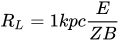
where
- is the Larmor radius,
- is the energy of the particle in EeV
- is the charge of the particle, and
- is the constant magnetic field.


Or,
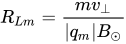
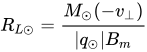
where
- is the Lamor or gyroradius,
- is the mass of the charged particle,
- is the velocity component perpendicular to the direction of the magnetic field,
- is the charge of the particle, and
- is the constant magnetic field for the Sun.


Larmor radii[edit | edit source]
For the object, as deflected by the Sun,

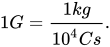



Or,

For the Sun, as deflected by the object,



Or,

Electric orbits[edit | edit source]
In order for the object to have an orbit around the Sun, its approach velocity of 20 km/s must be reduced to below the Sun's escape velocity of 1.33 km/s.
The electrostatic force is the major available force of repulsion to slow down the object. As it continues to travel closer to the Sun, the forces increase. But, an estimate can be calculated of how much time is required to reduce the object's velocity to below the Sun's escape velocity.



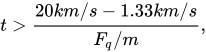



Or,

Weak forces[edit | edit source]
"Some of the oddly skewed orbits of many alien worlds may be due to the twin stars they are often found circling [...] many of the exoplanets astronomers have discovered in the past two decades or so have mysteriously skewed orbits. They may be eccentric — that is, oval-shaped. They could also be inclined — tilted at an angle from the equators of their stars. One potential explanation for these skewed orbits might be the gravitational influence of a companion star near the host stars of those exoplanets. [...] most stars form in binary pairs, with both stars orbiting each other. In fact, there are many three-star systems as well, and even some that harbor up to seven stars."[35]
For a solitary star, "the orbits of most planets are nearly circular, orbiting [their star']s equator."[35]
X-rays[edit | edit source]
According to SIMBAD, Vega (alpha Lyrae) (delta Sct type variable) is an X-ray source in the first Einstein catalog (1E) and an ultraviolet source from the CEL, EUVE, and TD1 catalogs. It has not been detected as a gamma-ray source.
At one time (1932), Vega was listed as a double star.[36] Also in 1963, Vega is listed as a visual double star.[37] Again in 1983, it was listed as a double star.[38] This was repeated in 1994.[39] It is still listed as a double star in 1996.[40] The update in 2001 also lists it.[41] The star with Vega is 56.41 arcsec away and is designated as BD+38 3238D of unknown spectral class. That these two stars are undifferentiated between double star or binary star for some 70 years at only 25 lyrs away is remarkable.
Vega[edit | edit source]
The X-ray "counts observed from [...] Vega in the HRI are very likely to be due entirely to UV contamination from the photospheric emission, and hence the X-ray luminosities for [...] Vega [...] should be replaced by upper limits at least one order of magnitude lower, i.e., log LX, Vega < 26.6 [...] Thus the HRI observation of Vega is completely consistent with the upper limit obtained in the IPC, and the only remaining inconsistency concerning the X-ray emission from Vega is the rocket experiment by Topka et al. (1979), who report a detection of Vega in a 5 s pointing yielding 7 counts; however, in our opinion these authors do not convincingly rule out the possibility of UV contamination. Note in this context that the IPC's used for Topka et al.s' (1979) rocket flight and for the Einstein Observatory were not identical."[42]
"Many types of main sequence stars emit in the X-ray portion of the spectra. In massive stars, strong stellar winds ripping through the extended atmosphere of the star create X-ray photons. On lower mass stars, magnetic fields twisting through the photosphere heat it sufficiently to produce X-rays. But between these two mechanisms, in the late B to mid A classes of stars, neither of these mechanisms should be sufficient to produce X-rays. Yet when X-ray telescopes examined these stars, many were found to produce X-rays just the same."[43]
"The first exploration into the X-ray emission of this class of stars was the Einstein Observatory, launched in 1978 and deorbited in 1982. While the telescoped confirmed that these B and A stars had significantly less X-ray emission overall, seven of the 35 A type stars still had some emission. Four of these were confirmed as being in binary systems in which the secondary stars could be the source of the emission, leaving three of seven with unaccounted for X-rays."[43]
"The German ROSAT satellite found similar results, detecting 232 X-ray stars in this range. Studies explored connections with irregularities in the spectra of these stars and rotational velocities, but found no correlation with either. The suspicion was that these stars simply hid undetected, lower mass companions."[43]
Either "the main star truly is the source, or there are even more elusive, sub-arcsecond binaries skewing the data."[43]
On July 27, 1977, at 05:41:48.1 UTC, an Aerobee 350 or boosted Black Brant launched from White Sands Missile Range using Vega as a reference by its star tracker to update its position while maneuvering between X-ray targets automatically observed Vega with its X-ray telescope for 4.8 s.[44]
The quantity of detected photons (7) in the band 0.2-0.80 keV corresponds to an X-ray luminosity LX ≈ 3 x 1028 erg s-1.[44]
"The ANS 3 σ upper limit for Vega (2.5 x 1028 ergs s-1) is only slightly lower than our flux measurement."[44]
"Because the X-ray [luminosity] of Vega [is] much closer to that of the Sun than to the typical galactic X-ray sources which have been detected to date, it is natural to consider processes analogous to solar coronal activity as the explanation for the X-ray activity."[44]
"Vega is thought to be a solitary star, and therefore noncoronal X-ray-producing mechanisms seem to be excluded".[44]
"Vega is the first solitary main-sequence star beyond the Sun known to be an X-ray emitter".[44]
Vega's "computed X-ray surface luminosity [...] is comparable to that of the quiet Sun [...] Note, however, that because of our very short exposure, the average level of coronal emission may vary significantly from our single measurement."[44]
"Using estimates of the stellar [radius] derived from stelar structure calculations, we obtain [a] surface X-ray [luminosity] of ~6.4 x 10⁴ ergs cm-2 s-1 for Vega [that falls] within the range of solar coronal X-ray emission, which can vary between ~8 x 10³ ergs cm-2 s-1 in coronal holes and ~3 x 10⁶ ergs cm-2 s-1 in active regions".[44]
Magnetic "field activity, leading to coronal heating, may account for Vega's X-ray emission because of inhomogeneous distribution of surface magnetic flux and associated coronal activity."[44]
That Vega is regarded as an X-ray source rests on one 4.8 s star-tracking observation by one sounding rocket flight carrying an X-ray detector flown on many flights that yields trustworthy results.
"Vega is a pole-on, highly oblate, rapid rotator [...] the star exhibits extreme limb darkening and a large decrement in effective temperature from pole to equator. [...] the best fittingmodel (Teff pole=10150 K, Teff eq = 7900 K, θ = 3.329 mas) has the pole inclined 5° to line of sight and rotates at 91% of the angular speed of break-up, resulting in a temperature drop of 2250 K from center to limb. [...] the total luminosity [...] is emitted in a highly non-homogeneous manner with five times more UV flux being emitted from the pole as is emitted in the equatorial plane, while the visible through near-IR flux is some 70% greater at the pole than that of the equatorial plane and 54% greater than that expected from a slow or non-rotating A0 V star."[45]
A 'polar coronal hole' is a coronal hole that occurs above one or both rotational poles of a star that has a coronal cloud around it.
"The radiant emission from coronal holes is greatly diminished relative to other coronal regions".[46]
The "emission is proportional to the integral of the square of the electron density along the line of sight [...] Data of this type are therefore heavily influenced by regions of high density along the line of sight--the low corona for disk observations, and denser structures surrounding coronal holes for limb observations."[46]
An "analysis of the northern polar region during the period 1973 June 29 to July 13 [...] can be summarized as follows. The boundary of the hole is essentially axisymmetrc about the polar axis and is nearly radial from 3 to 6 R⊙. The boundary at these heights is located at 25° ± 5° latitude, although it is of much smaller extent (boundary ~65° latitude) as observed near the solar surface with the American Science and Engineering (AS&E) X-ray experiment on Skylab [...] the increase of the polar hole's cross sectional area from the surface to 3 R⊙ is approximately 7 times greater than for a purely radial boundary."[46]
For α Lyr, log FX/FV = -6.79 (variable X-ray source), log LX 27.6 erg s-1 (variable X-ray source).[47] Upper limits were log FX/FV = -7.4 and log LX 27.0 erg s-1.[47]
A coronal cloud is not a diffuse, homogeneous hot atmosphere, but one or more strongly structured topologically closed features dominated by magnetic confinement.
Magnetic field of Vega[edit | edit source]
An extensive convection zone is not required, and any star with magnetic field strengths and geometry similar to the Sun's will possess a corona.[44]
Magnetic fields on the order of ~30 gauss have been reported for Vega (~1 gauss for the Sun), so perhaps these substantially higher average field strengths compensate for the expected reduced convective activity, resulting in surface X-ray luminosities comparable to the quiet Sun.[44]
Using spectropolarimetry, a magnetic field has been detected on the surface of Vega by a team of astronomers at the Observatoire du Pic du Midi.[48] They "report the detection of a magnetic field on Vega and argue that Vega is probably the first member of a new class of yet undetected magnetic A-type stars."[48]
The "polarization [is] a Zeeman signature [that] leads to a value of [Bl =] -0.6 ± 0.3 G for the disk-averaged line-of-sight component of the surface magnetic field."[48]
"The strength of Vega magnetic field is about 50 micro-tesla, which is close to that of the mean field on Earth and on the Sun."[49]
Rotational velocity of Vega[edit | edit source]
"Vega rotates in less than a day, while the Sun's rotation period is 27 days."[49]
Infrared analysis[edit | edit source]


"The infrared excesses are well modeled by two components, a warm belt close to the star, and a cooler belt farther out. The clear separation of the belts could be explained by the presence of planets clearing the gap."[50]
The graph at left shows the clear separation of infrared belts for Vega. This separation may "be explained by the presence of planets clearing the gap."[50]
Sun as an X-ray source[edit | edit source]
The photosphere of the Sun does not emit X-rays. The chromosphere and the transition region either emit ultraviolet, extreme ultraviolet, or X-rays (most likely soft X-rays). The coronal clouds around the Sun emit X-rays and sometimes gamma-rays, neutrinos, neutrals, protons, positrons, and electrons, among other solar cosmic-rays.
The X-ray characteristics of the Sun have been studied since the 1940s. The may be considered an X-ray variable star as its intensity corresponds to the sunspot cycle. This cycle may have its origins in the mechanisms that heat the photosphere and the coronal clouds around the Sun. An analysis of the X-ray characteristics of Vega suggest that it is a Sun-like X-ray star.
It has taken a number of decades to observe and describe the X-ray properties of Vega. Associated with these properties are a magnetic field comparable to the Sun and the possibility of a coronal hole over the pole facing Earth.
By scanning the available literature to ascertain the X-ray properties of Vega, several apparent conclusions may be drawn. The X-ray output of Vega falls between that of the Sun. The X-ray output of the Sun minimizes during the solar cycle quiet period and maximizes at the sunspot maximum.
Vega is considered an X-ray variable star with a corona and an X-ray output comparable to the Sun.
Vega characteristics[edit | edit source]
Vega is considered to be Sun-like in its X-ray output and variability. The peak of X-ray output may not be directly observable as the star has a pole facing Earth.
The photosphere of Vega has a diameter five times that of the Sun. Its apparent stellar system has similarities to the solar system but is scaled as approximately four times larger. Even with a pole temperature above 10,000 K Vega produces no detectable X-ray output from its photosphere, just like the Sun at 5,778 K. Vega is a visual spectral type A0V star which means it is transparent. The Sun is not considered transparent at visual wavelengths.
The physical size of the photosphere of Vega and its transparency may reflect more the cloud it formed from than anything else.
The above surface fusion that is occurring on the Sun may not be happening above the photosphere of Vega as no flares or gamma rays have been detected.
Vega is a Sun-like X-ray source.
The characteristics that allow Vega to be seen as a Sun-like X-ray source suggests that if the Sun's X-ray characteristics have not changed over time it may have been in a wide-orbit binary with any star whose X-ray characteristics allow the Sun to remain much as it is.
Sun[edit | edit source]
For comparison with other stars, the Sun has the following properties:
- The effective temperature of the surface of the Sun's photosphere is 5,778 K.[51]
- Metallicity, Z = 0.0122[52], "lowest seismic estimate of solar metallicity is Z = 0.0187 [to the] highest is Z = 0.0239, with uncertainties in the range of 12%-19%."[53]
- Stellar companion: Jupiter at present, perhaps Uranus in some larger form previously
- Age: 4.57 billion years[54]
- B-V = 0.656 ± 0.005[55]
- Rotation rate: 7.189 x 10³ km h-1 (at the equator), equatorial circumference of 4,379,000 kilometres divided by sidereal rotation period of 609.12 hours[56]
Metallicity[edit | edit source]
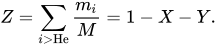
The hydrogen mass fraction is generally expressed as where is the total mass of the system and the mass of the hydrogen it contains.


"[T]he helium mass fraction is denoted as .

The metallicity—the mass fraction of elements heavier than helium—can be calculated as


Sun-Jupiter binary[edit | edit source]
The Sun-Jupiter binary may serve to establish an upper limit for interstellar cometary capture when three bodies are extremely unequal in mass, such as the Sun, Jupiter, and a third body (potential comet) at a large distance from the binary.[57] The basic problem with a capture scenario even from passage through “a cloud of some 10 million years, or from a medium enveloping the solar system, is the low relative velocity [~0.5 km s-1] required between the solar system and the cometary medium.”[58] The capture of interstellar comets by Saturn, Uranus, and Neptune together cause about as many captures as Jupiter alone.[58]
Saturn[edit | edit source]
"There is one God, greatest among gods and men, neither in shape nor in thought like unto mortals ... He abides ever in the same place motionless, and it befits him not to wander hither and thither."[59]
"Saturn, the old man who lives at the north pole, and brings with him to the children of men a sprig of evergreen (the Christmas tree), is familiar to the little folks under the name Santa Claus, for he brings each winter the gift of a new year."[60]
"The religions of all ancient nations ... associate the abode of the supreme God with the North Pole, the centre of heaven; or with the celestial space immediately surrounding it."[61]
"Lenormant, speaking of Rome and Olympia, remarks, "It is impossible not to note that the Capitoline was first of all the Mount of Saturn, and that the Roman archaeologists established a complete affinity between the Capitoline and Mount Cronios in Olympia, from the standpoint of their traditions and religious origin (Dionysius Halicarn., i., 34). This Mount Cronios is, as it were, the Omphalos of the sacred city of Elis, the primitive centre of its worship. It sometimes receives the name Olympos."1 Here is not only symbolism in general, but also a symbolism pointing to the Arctic Eden, already shown to be the primeval mount of Kronos, the Omphalos of the whole earth.2"[61]
"As an offshoot of these Hellenistic speculations we should place Tacitus, Histories V,2: "Iudaeos Creta insula profugos novissima Libyae insedisse memorant, qua tempestate Saturnus vi Jovis pulsus cesserit regnis" (quoted from Loeb Classical Library)."[62] i.e., "Jews were fugitives from the island of Crete and settled in Libya recorded the time when Saturn was driven from his throne by force of Jupiter".
"The motif of Saturn handing over power to Jupiter derives, of course, from Hesiod's account of the succession of the gods in his Theogony, and his story of the five successive ages of men -- the first, or golden, age being under the reign of Kronos (Saturn) and the following ages being under the reign of Zeus (Jupiter) -- in his Works and Days (110ff.). These stories were often retold. Ovid, for example, combines in his Metamorphoses the stories in the Theogony and Works and Days, telling us how, "when Saturn was consigned to the darkness of Tartarus, and the world passed under the rule of Jove, the age of silver replaced that of gold."8"[63]
Much of the legend surrounding this early Saturn suggests that it may have been in a binary star system with the Sun.
Pole stars[edit | edit source]


At the present time, the northern pole star, or North Star, is a moderately bright star with an apparent magnitude of 1.97 (variable), the brightest star in the Ursa Minor constellation (at the end of the or "handle" of the "Little Dipper" asterism).[64] Its current (October 2012) declination is +89°19'8" (as per epoch J2000 it was +89°15'51.2"). Therefore it always appears due north in the sky to a precision better than one degree, and the angle it makes with respect to the horizon is equal to the latitude of the observer. It is consequently known as Polaris (from Latin stella polaris "pole star"). It also retains its older name, Cynosura, from a time before it was the pole star, from its Greek name meaning "dog's tail" (as the constellation of Ursa Minor was interpreted as a dog, not a bear, in antiquity).
Due to the precession of the equinoxes (as well as the stars' proper motions), the role of North Star passes from one star to another. The name stella polaris has been given to α Ursae Minoris since at least the 16th century, even though at that time it was still several degrees away from the celestial pole. Gemma Frisius determined this distance as 3°7' in the year 1547.[65]
In the Roman era, the celestial pole was about equally distant from α Ursae Minoris (Cynosura) and β Ursae Minoris (Kochab). Before this, during the 1st millennium BC, β Ursae Minoris was the bright star closest to the celestial pole, but it was never close enough to be taken as marking the pole, and the Greek navigator Pytheas in ca. 320 BC described the celestial pole as devoid of stars. Polaris was described as αει φανης "always visible" by Stobaeus in the 5th century, when it was still removed from the celestial pole by about 8°. It was known as scip-steorra ("ship-star") in 10th-century Anglo-Saxon England, reflecting its use in navigation.
The precession of the equinoxes takes about 25,770 years to complete a cycle. Polaris' mean position (taking account of precession and proper motion) will reach a maximum declination of +89°32'23", so 1657" or 0.4603° from the celestial north pole, in February 2102. Its maximum apparent declination (taking account of nutation and aberration) will be +89°32'50.62", so 1629" or 0.4526° from the celestial north pole, on 24 March 2100.[66]
In 3000 BC the faint star Thuban in the constellation Draco was the North Star. At magnitude 3.67 (fourth magnitude) it is only one-fifth as bright as Polaris, and today it is invisible in light-polluted urban skies.
The Celestial south pole is moving toward the Southern Cross, which has pointed to the south pole for the last 2,000 years or so. As a consequence, the constellation is no longer visible from subtropical northern latitudes, as it was in the time of the ancient Greeks.
There have been many pole stars throughout the millennia. Around 2000 BC, the star Eta Hydri was the nearest bright star to the Celestial south pole. Around 2800 BC, Achernar was only 8 degrees from the south pole.
Orbital poles[edit | edit source]

An orbital pole is either end of an imaginary line running through the center of an orbit perpendicular to the orbital plane, projected onto the celestial sphere. It is similar in concept to a celestial pole but based on the planet's orbit instead of the planet's rotation.
The north orbital pole of a celestial body is defined by the right-hand rule: If you curve the fingers of your right hand along the direction of orbital motion, with your thumb extended parallel to the orbital axis, the direction your thumb points is defined to be north.
At right is a snapshot of the planetary orbital poles.[67] The field of view is about 30°. The yellow dot in the centre is the Sun's North pole. Off to the side, the orange dot is Jupiter's orbital pole. Clustered around it are the other planets: Mercury in pale blue (closer to the Sun than to Jupiter), Venus in green, the Earth in blue, Mars in red, Saturn in violet, Uranus in grey partly underneath Earth and Neptune in lavender. Dwarf planet Pluto is the dotless cross off in Cepheus.
Uranus[edit | edit source]
In the Chinese, Japanese, Korean, and Vietnamese languages, the planet's name is literally translated as the sky king star[68][69].
Uranus is named after the ancient Greek deity of the sky Uranus, the father of Cronus (Saturn) and grandfather of Zeus (Jupiter). Though it is visible to the naked eye like the five classical planets, it was never recognized as a planet by ancient observers because of its dimness and slow orbit.[18]
Ouranos[edit | edit source]
“Uranus was the Sky in Greek mythology, which was thought to be dominated by the combined powers of the Sun and Mars.[70]
“Uranus ... , Ouranos meaning "sky" or "heaven") was the primal Greek god personifying the sky. His equivalent in Roman mythology was Caelus. In Ancient Greek literature, Uranus or Father Sky was the son and husband of Gaia, Mother Earth. According to Hesiod's Theogony, Uranus was conceived by Gaia alone, but other sources cite Aether as his father.[71]
Caelus[edit | edit source]

Caelus or Coelus was a primal god of the sky in Roman myth and theology, iconography, and literature (compare caelum, the Latin word for "sky" or "the heavens", hence English "celestial").
“The name of Caelus indicates that he was the Roman counterpart of the Greek god Uranus, who was of major importance in the theogonies of the Greeks. Varro couples him with Terra (Earth) as pater and mater (father and mother), and says that they are "great deities" (dei magni) in the theology of the mysteries at Samothrace.[72]
According to Cicero and Hyginus, Caelus was the son of Aether and Dies ("Day" or "Daylight").[73] Caelus and Dies were in this tradition the parents of Mercury.[74] Caelus was the father with Hecate of the distinctively Roman god Janus, as well as of Saturn and Ops.[75] Caelus was also the father of one of the three forms of Jupiter, the other two fathers being Aether and Saturn.[76]
Solar-like binaries[edit | edit source]

For a solar-like binary system, the primary has Teff ≲ 6000 K.[77]
"TYC 4410-01037-1 [has] a mass of 1.07 ± 0.08 M⊙ and radius of 0.99 ± 0.18 R⊙. ... Teff = 5879 ± 29 K [and] [Fe/H] = -0.01 ± 0.05".[77]
At right is a Keck adaptive optics image of TYC 4110-01037-1 in K′. A faint candidate tertiary companion (indicated by the arrow) with red colors is separated by 986 ± 4 mas from the primary star. If it is physically associated with the primary, it is most likely a dM3-dM4 star. The companion is designated MARVELS-3B.
Its "low-mass stellar companion [has a] small mass ratio [ q ≥ 0.087 ± 0.003] and short orbital period [78.994 ± 0.012 days, which] are atypical amongst solar-like ... binary systems. [The orbit has] an eccentricity of 0.1095 ± 0.0023, and a semi-amplitude of 4199 ± 11 m s-1. ... the minimum companion mass (if sin i = 1) [is] 97.7 ± 5.8 MJup."[77]
"One possible way to create such a system would be if a triple-component stellar multiple broke up into a short period, low q binary during the cluster dispersal phase of its lifetime. A candidate tertiary body has been identified in the system via single-epoch, high contrast imagery. If this object is confirmed to be co-moving, ... it [may] be a dM4 star."[77]
Binary twins[edit | edit source]
16 Cyg A and B are binary solar twins.[78]
"16 Cygni or 16 Cyg is a triple star system approximately 69 light-years away from Earth in the constellation of Cygnus. It consists of two Sun-like yellow dwarf stars, 16 Cygni A and 16 Cygni B, together with a red dwarf, 16 Cygni C. In 1996 an extrasolar planet was discovered in an eccentric orbit around 16 Cygni B.
16 Cygni is a hierarchal triple system. Stars A and C form a close binary with a projected separation of 73 AU.[79] The orbital elements of the A–C binary are currently unknown. At a distance of 860 AU from A is a third component designated 16 Cygni B.
"B orbits between 100 and 160 degrees inclination, that is against the A–C pole such that 90 degrees would be ecliptical.[80]
"Both 16 Cygni A and 16 Cygni B are yellow dwarf stars like our Sun. According to data from the Geneva–Copenhagen survey, both stars have masses similar to the Sun.[81][82] Age estimates for the two stars vary slightly, but 16 Cygni is likely to be much older than the Solar System, at around 10,000 million years old. 16 Cygni C is much fainter than either of these stars, and may be a red dwarf.[79]
"Despite differing in Teff by only 35-40 K, the Li abundances of 16 Cyg A and B differ by a factor of ≥ 4.5. The solar photospheric abundance is intermediate to the two values. This intermediacy indicates that the Sun, whose highly depleted photospheric Li abundance is in gross conflict with standard stellar models, is not an isolated anomaly in its Li abundance evolution."[78]
"In 1996 an extrasolar planet in an eccentric orbit was announced around the star 16 Cygni B.[83] The planet's orbit takes 798.5 days to complete, with a semimajor axis of 1.68 AU.[84]
""For the 16 Cyg B system, only particles inside of about 0.3 AU remained stable [within a million years of formation], leaving open the possibility of short-period planets". For them, observation rules out any such planet of over a Neptune mass.[85]
Binary analogs[edit | edit source]
α Cen A and B are binary solar analogs.[78]
"The two components α Cen A and B are separated by roughly 25 AU, with an orbital period of 80 years. The age of the system is thought to be slightly larger than that of the Sun, correspondingly both stars are also slow rotators (periods are 29 (A) and 42 (B) days) with a rather inactive corona."[86]
"[F]ive XMM-Newton observations of the binary system α Centauri ... observed in snapshot like exposures of roughly two hours each during the last two years [has found that] the X-ray emission of the system is dominated by α Cen B, a K1 star. ... the optically brighter component α Cen A, a [G2V] star very similar to our Sun, [has] fainted in X-rays by at least an order of magnitude during the observation program, a behaviour never observed before on α Cen A, but rather similar to the X-ray behaviour observed with XMM-Newton on HD 81809."[86]
Interstellar cometary captures[edit | edit source]
"NASA's Hubble Space Telescope has detected several comets diving toward a young star about 95 light-years from Earth."[87]
"HD 172555 [...] represents the third extrasolar system where astronomers have detected such comets, [...] known as "exocomets" because they're outside Earth's solar system."[87]
"The presence of comets falling toward HD 172555 was determined based on observations of nearby gases, which [...] are the vaporized remnants of disintegrated comets after they have ricocheted off unseen Jupiter-size planets. The massive planet's gravity catapults the comets into the star in a process known as "gravitational stirring." Similar processes can be seen in our own solar system when sungrazing comets plunge into the sun."[87]
"Seeing these sun-grazing comets in our solar system and in three extrasolar systems means that this activity may be common in young star systems."[88]
"This activity at its peak represents a star's active teenage years. Watching these events gives us insight into what probably went on in the early days of our solar system, when comets were pelting the inner solar system bodies, including Earth. In fact, these star-grazing comets may make life possible, because they carry water and other life-forming elements, such as carbon, to terrestrial planets."[88]
"HD 172555 is part of a collection of stars known as the Beta Pictoris Moving Group. Another one of the stars, Beta Pictoris, is known to have a young gas-giant planet forming in its protoplanetary disk of dust and gas. This collection of stars is the closest star system to Earth and could be a breeding ground for terrestrial planets."[88]
"Silicon and carbon-gas signatures were detected in the vicinity of HD 172555 using Hubble's Space Telescope Imaging Spectrograph (STIS) and the Cosmic Origins Spectrograph (COS)."[87]
"The gas was moving at about 360,000 miles per hour across the face of the star. The most likely explanation for the speedy gas is that Hubble is seeing material from comet-like objects that broke apart after streaking across the star's disk."[88]
"Hubble shows that these star-grazers look and move like comets, but until we determine their composition, we cannot confirm they are comets. We need additional data to establish whether our star-grazers are icy like comets or more rocky like asteroids."[88]
"Nightly changes in the absorption strength of the Ca II K-line near the stellar radial velocity were observed in four of the stars (HD 21620, HD 110411, HD 145964 and HD 183324). This type of absorption variability indicates the presence of a circumstellar gas disk around these stars."[89]
Weak "absorption features that sporadically appear with velocities in the range ± 100 km s-1 of the main circumstellar K-line in the spectra of HD 21620, HD 42111, HD 110411 and HD 145964 [plus] the known presence of both gas and dust disks surrounding these four stars, these transient absorption features are most probably associated with the presence of Falling Evaporated Bodies (FEBs, or exocomets) that are thought to liberate gas on their grazing trajectory toward and around the central star."[89]
"This now [2013] brings the total number of A-type stars in which the evaporation of Ca II gas from protoplanetary bodies (i.e., exocomets) has been observed to vary on a nightly basis to 10 systems [including HD 256 (HR 10), HD 9672 (49 Ceti), HD 39060 (Beta Pictoris), HD 85905, HD 182919 (5 Vulpeculae), HD 217782 (2 Andromedae)]. A statistical analysis of the 10 A-stars showing FEB-activity near the Ca II K-line compared to 21 A-type stars that exhibit no measurable variability reveals that FEB-activity occurs in significantly younger stellar systems that also exhibit chemical peculiarities. The presence of FEB-activity does not appear to be associated with a strong mid-IR excess. This is probably linked to the disk inclination angle, since unless the viewing angle is favorable the detection of time-variable absorption may be unlikely. Additionally, if the systems are more evolved then the evaporation of gas due to FEB activity could have ceased, whereas the circumstellar dust disk may still remain."[89]
Interstellar planet captures[edit | edit source]
The "hypothetical Planet Nine could have been lost by another solar system and then poached from the intergalactic wastes by our sun's gravity."[90]
The "mysterious planet, if it does exist in the outermost reaches of the solar system, may have been a "rogue" that was captured by the sun's gravity."[90]
Certain "gravitational anomalies in the outer solar system could be explained by a massive planet lurking beyond the observed reaches of the solar system, around 20 times farther than Neptune's average distance from the sun."[90]
"A rogue planet is an object that formed like a planet from a disk around a star, like the planets in our own solar system. However, if the planet passed nearby a much more massive planet early in its formation, before the orbits in its home system settled down, it could get slingshot out of its solar system, and would now be wandering through interstellar space in the Milky Way among the stars."[91]
The "rogue planet got tossed out of the system by gravitational forces in 60 percent of the simulations – but in the other 40 percent, it got captured by the sun."[90]
"Imagine that the Sun was the size of an orange or an apple. Imagine the planets as maybe fruit flies buzzing around the apple-sized Sun. On this scale, the next closest star to the Sun, Proxima Centauri, would be another apple roughly 1,400 miles away! That's roughly Chicago to Tucson. Now imagine the chance of a fruit fly in Chicago making its way 1,400 miles and finding the apple in Tucson. It could happen, but it's not the way to bet."[92]
"The 'classical' planets, Mercury, Venus, Mars, Jupiter, and Saturn are all easily visible to the naked eye and have been known for thousands and thousands of years. Because these objects changed their positions in the sky night after night compared to the background stars (which never seemed to change), god-like attributes were given to the planets. In fact, the name 'planet' comes from the Greek word for 'wanderer.'"[92]
"Those [discoveries of later planets] served to show people how expansive the universe was and how much there was to learn. But it generally did not change the worldview of the civilizations that discovered them because those discoveries did not fundamentally change the picture of the universe they had, the way Copernicus and Galileo changed our understanding of the place of the Earth in the solar system, or the way Einstein changed our perceptions of space and time."[91]
"If [Planet Nine] really exists, and is confirmed and observed, it will likely tell us that the process of planet formation is more violent, and chaotic, than previously thought. And it would tell us that there is still a lot of space to explore where new discoveries may be lurking."[91]
Hypotheses[edit | edit source]
- At some point, perhaps around 40,000 b2k, the Sun-Earth system was in a binary with a smaller star that was a pole star for the north geographic/rotational pole of the Earth.
For a solar binary, proof of concept is that the Sun and Jupiter together can act in some way like a stellar binary.
See also[edit | edit source]
References[edit | edit source]
- ↑ 1.0 1.1 1.2 D. R. Soderblom; J. R. King (1998). "Solar-Type Stars: Basic Information on Their Classification and Characterization". Solar Analogs : Characteristics and Optimum Candidates. http://www.lowell.edu/users/jch/workshop/drs/drs-p1.html. Retrieved 2008-02-26.
- ↑ 2.0 2.1 2.2 2.3 2.4 2.5 2.6 2.7 2.8 SIMBAD Astronomical Database. Centre de Données astronomiques de Strasbourg. http://simbad.u-strasbg.fr/simbad/. Retrieved 2009-01-14.
- ↑ Williams, D.R. (2004). Sun Fact Sheet. NASA. http://nssdc.gsfc.nasa.gov/planetary/factsheet/sunfact.html. Retrieved 2009-06-23.
- ↑ 4.0 4.1 4.2 4.3 Meléndez, Jorge; Ramírez, Iván (November 2007). "HIP 56948: A Solar Twin with a Low Lithium Abundance". The Astrophysical Journal 669 (2): L89–L92. doi:10.1086/523942.
- ↑ Sousa, S. G.; Fernandes, J.; Israelian, G.; Santos, N. C. (March 2010). "Higher depletion of lithium in planet host stars: no age and mass effect". Astronomy and Astrophysics 512: L5. doi:10.1051/0004-6361/201014125.
- ↑ Takeda, Y.; Tajitsu (2009). "High-Dispersion Spectroscopic Study of Solar Twins: HIP 56948, HIP 79672, and HIP 100963". Publications of the Astronomical Society of Japan 61: 471.
- ↑ 7.0 7.1 7.2 7.3 King, Jeremy R.; Boesgaard, Ann M.; Schuler, Simon C. (November 2005). "Keck HIRES Spectroscopy of Four Candidate Solar Twins". The Astronomical Journal 130 (5): 2318–25. doi:10.1086/452640.
- ↑ Vázquez, M.; Pallé, E.; Rodríguez, P. Montañés (2010). Is Our Environment Special?, In: The Earth as a Distant Planet: A Rosetta Stone for the Search of Earth-Like Worlds. Springer New York. pp. 391–418. doi:10.1007/978-1-4419-1684-6. ISBN 978-1-4419-1683-9.
- ↑ 9.0 9.1 Porto de Mello, G. F.; Lyra, W.; Keller, G. R. (September 2008). "The Alpha Centauri binary system. Atmospheric parameters and element abundances". Astronomy and Astrophysics 488 (2): 653–66. doi:10.1051/0004-6361:200810031.
- ↑ Casagrande, Luca; Flynn, Chris; Portinari, Laura; Girardi, Leo; Jimenez, Raul (December 2007). "The helium abundance and ?Y/?Z in lower main-sequence stars". Monthly Notices of the Royal Astronomical Society 382 (4): 1516–40. doi:10.1111/j.1365-2966.2007.12512.x.
- ↑ Tabetha S. Boyajian; Harold A. McAlister; Ellyn K. Baines; Douglas R. Gies; Todd Henry; Wei-Chun Jao; David O’Brien; Deepak Raghavan et al. (August 2008). "Angular Diameters of the G Subdwarf µ Cassiopeiae A and the K Dwarfs s Draconis and HR 511 from Interferometric Measurements with the CHARA Array". The Astrophysical Journal 683 (1): 424–32. doi:10.1086/589554.
- ↑ 12.0 12.1 Valenti, Jeff A.; Fischer, Debra A. (July 2005). "Spectroscopic Properties of Cool Stars (SPOCS). I. 1040 F, G, and K Dwarfs from Keck, Lick, and AAT Planet Search Programs". The Astrophysical Journal Supplement Series 159 (1): 141–66. doi:10.1086/430500. See VizieR catalogue J/ApJS/159/141.
- ↑ 13.00 13.01 13.02 13.03 13.04 13.05 13.06 13.07 13.08 13.09 13.10 13.11 13.12 13.13 13.14 13.15 Holmberg J.; Nordstrom B.; Andersen J. (July 2009). "The Geneva-Copenhagen survey of the solar neighbourhood. III. Improved distances, ages, and kinematics". Astronomy and Astrophysics 501 (3): 941–7. doi:10.1051/0004-6361/200811191. See Vizier catalogue V/130.
- ↑ Kovtyukh, V. V.; Soubiran, C.; Belik, S. I.; Gorlova, N. I. (2003). "High precision effective temperatures for 181 F-K dwarfs from line-depth ratios". Astronomy and Astrophysics 411 (3): 559–64. doi:10.1051/0004-6361:20031378.
- ↑ 15.0 15.1 15.2 15.3 15.4 15.5 15.6 15.7 Sousa; S. G.; N. C. Santos; M. Mayor; S. Udry; L. Casagrande; G. Israelian; F. Pepe et al. (August 2008). "Spectroscopic parameters for 451 stars in the HARPS GTO planet search program. Stellar [Fe/H] and the frequency of exo-Neptunes". Astronomy and Astrophysics 487 (1): 373–81. doi:10.1051/0004-6361:200809698. See VizieR catalogue J/A+A/487/373.
- ↑ 16.00 16.01 16.02 16.03 16.04 16.05 16.06 16.07 16.08 16.09 16.10 16.11 16.12 16.13 16.14 16.15 16.16 Santos, N. C.; Israelian, G.; Randich, S.; García López, R. J.; Rebolo, R. (October 2004). "Beryllium anomalies in solar-type field stars". Astronomy and Astrophysics 425 (3): 1013–1027. doi:10.1051/0004-6361:20040510.
- ↑ E. E. Mamajek; L. A. Hillenbrand (2008). "Improved Age Estimation for Solar-Type Dwarfs Using Activity-Rotation Diagnostics". Astrophysical Journal 687 (2): 1264. doi:10.1086/591785.
- ↑ 18.0 18.1 MIRA's Field Trips to the Stars Internet Education Program, In: Monterey Institute for Research in Astronomy. http://www.mira.org/fts0/planets/101/text/txt001x.htm. Retrieved August 27, 2007.
- ↑ D. Gossman (October 1989). "Light Curves and Their Secrets". Sky & Telescope: 410.
- ↑ Eclipsing Binary Simulation. Cornell Astronomy. http://www.astro.cornell.edu/academics/courses/astro101/java/eclipse/eclipse.htm.
- ↑ 21.0 21.1 D. Bruton. Eclipsing Binary Stars. Stephen F. Austin State University. http://www.physics.sfasu.edu/astro/ebstar/ebstar.html.
- ↑ Jeff Bryant. Contact Binary Star Envelopes. Wolfram Demonstrations Project. http://demonstrations.wolfram.com/ContactBinaryStarEnvelopes/.
- ↑ contact binary, David Darling, The Internet Encyclopedia of Science. Accessed on line November 4, 2007.
- ↑ David Darling. Overcontact binary In: The Internet Encyclopedia of Science. http://www.daviddarling.info/encyclopedia/O/overcontact_binary.html. Retrieved November 4, 2007.
- ↑ pp. 51–53, An Introduction to Astrophysical Fluid Dynamics, Michael J. Thompson, London: Imperial College Press, 2006. ISBN 1-86094-615-1.
- ↑ R. Voss, T.M. Tauris (2003). "Galactic distribution of merging neutron stars and black holes". Monthly Notices of the Royal Astronomical Society 342 (4): 1169–84. doi:10.1046/j.1365-8711.2003.06616.x.
- ↑ p. 231, Stellar Rotation, Jean Louis Tassoul, Andrew King, Douglas Lin, Stephen P. Maran, Jim Pringle, and Martin Ward, Cambridge, UK, New York: Cambridge University Press, 2000 |ISBN=0-521-77218-4 |accessdate=2012-07-10 }}
- ↑ 28.0 28.1 Sergey A. Astakhov; David Farrelly (November 2004). "Capture and escape in the elliptic restricted three?body problem". Monthly Notices of the Royal Astronomical Society 354 (4): 971-9. doi:10.1111/j.1365-2966.2004.08280.x. http://arxiv.org/pdf/astro-ph/0408271. Retrieved 2012-03-12.
- ↑ Oliver Justin Lee (1917). Yerkes Observatory. ed. Zone +45° of Kapteyn’s Selected Areas: Parallaxes and Proper Motions of 1041 Stars, In: Publications of the Yerkes observatory of the University of Chicago, Volume 4 Part IV. Chicago, Illinois: University of Chicago Press. pp. 123-89. http://books.google.com/books?id=64_nAAAAMAAJ&printsec=frontcover&source=gbs_ge_summary_r&cad=0#v=onepage&q&f=false. Retrieved 2012-07-10.
- ↑ 30.0 30.1 30.2 30.3 30.4 Kam-Ching Leung; Donald P. Schneider (February 1977). "Eclipsing systems in star clusters. III. Early-type contact system BH Centauri.". The Astrophysical Journal 211 (2): 844-52. doi:10.1086/154993.
- ↑ A.P. Boss (1992). J. Sahade. ed. Formation of Binary Stars, In: The Realm of Interacting Binary Stars. Dordrecht: Kluwer Academic. pp. 355. ISBN 0-7923-1675-4.
- ↑ J.E. Tohline; J.E. Cazes; H.S. Cohl. The Formation of Common-Envelope, Pre-Main-Sequence Binary Stars. Louisiana State University.
- ↑ 33.0 33.1 33.2 33.3 33.4 J. E. Pringle (July 1989). "On the formation of binary stars". Royal Astronomical Society, Monthly Notices 239 (7): 361-70.
- ↑ P Sommers; S Westerhoff (May 12, 2009). "Cosmic ray astronomy". New Journal of Physics 11 (5): 055004. doi:10.1088/1367-2630/11/5/055004. http://arxiv.org/pdf/0802.1267. Retrieved 2012-03-28.
- ↑ 35.0 35.1 Charles Q. Choi (July 30, 2014). Weird Orbits of Alien Planets May Be Due to Twin Stars. Space.com. http://www.space.com/26686-weird-alien-planets-orbits-twin-stars.html. Retrieved 2014-09-06.
- ↑ Robert Grant Aitken; Eric Doolittle (1932). New general catalogue of double stars within 120 of the North pole. Publication 417. Washington, D.C.: Carnegie institution of Washington. Bibcode: 1932ADS...C......0A. http://cdsbib.u-strasbg.fr/cgi-bin/cdsbib?1932ADS...C......0A. Retrieved 2014-04-02.
- ↑ H. M. Jeffers; W. H. Van Den Bos; F. M. Greeby (1963). "Index catalogue of visual double stars, 1961.0". Publications of the Lick Observatory 21 (1). http://cdsbib.u-strasbg.fr/cgi-bin/cdsbib?1963IDS...C......0J. Retrieved 2014-04-04.
- ↑ J. Dommanget (March 1983). "Un catalogue des composantes d'etoiles doubles et multiples (C.C.D.M.)". Bulletin d'Information du Centre de Donnees Stellaires (24): 83-90. http://cdsbib.u-strasbg.fr/cgi-bin/cdsbib?1983BICDS..24...83D. Retrieved 2014-04-04.
- ↑ J. Dommanget; O. Nys (1994). "Catalogue des composantes d'etoiles doubles et multiples (CCDM) premiere edition - Catalogue of the components of double and multiple stars (CCDM) first edition". Com. de l'Observ. Royal de Belgique (115): 1. http://cdsbib.u-strasbg.fr/cgi-bin/cdsbib?1994CoORB.115....1D. Retrieved 2014-04-04.
- ↑ C. E. Worley; G. G. Douglass (November 1997). "The Washington Double Star Catalog (WDS, 1996.0)". Astronomy & Astrophysics, Supplement Series 125 (1): 523. doi:10.1051/aas:1997239. http://cdsbib.u-strasbg.fr/cgi-bin/cdsbib?1997A%26AS..125..523W. Retrieved 2014-04-04.
- ↑ Brian D. Mason; Gary L. Wycoff. William I. Hartkopf; Geoffrey G. Douglass; Charles E. Worley (December 2001). "The 2001 US Naval Observatory double star CD-ROM. I. The Washington double star catalog". Journal of Astronomy 122 (6): 3466-71. http://cdsbib.u-strasbg.fr/cgi-bin/cdsbib?2001AJ....122.3466M. Retrieved 2014-04-04.
- ↑ J. H. M. M. Schmitt; L. Golub; F. R. Harnden; Jr.; C. W. Maxson; R. Rosner; G. S. Vaiana (March 1, 1985). "An Einstein Observatory X-ray Survey of Main-Sequence Stars with Shallow Convection Zones". The Astrophysical Journal 290 (03): 307-20. doi:10.1086/162986. http://adsabs.harvard.edu/abs/1985ApJ...290..307S. Retrieved 2014-04-04.
- ↑ 43.0 43.1 43.2 43.3 Jon Voisey (2011). Companion Stars Could Cause Unexpected X-Rays. Universe Today. http://www.universetoday.com/84388/companion-stars-could-cause-x-rays/. Retrieved 2014-04-04.
- ↑ 44.00 44.01 44.02 44.03 44.04 44.05 44.06 44.07 44.08 44.09 44.10 K. Topka; D. Fabricant; F. R. Harnden Jr. (April 15, 1979). "Detection of Soft X-rays from α Lyrae and η Bootis with an Imaging X-ray Telescope". The Astrophysical Journal 229 (04): 661-8. doi:10.1086/157000. http://adsabs.harvard.edu/abs/1979ApJ...229..661T. Retrieved 2014-04-04.
- ↑ Charles W. Engelke; Stephan D. Price; Kathleen E. Kraemer (December 2010). "Spectral Irradiance Calibration in the Infrared. XVII. Zero-Magnitude Broadband Flux Reference for Visible-to-Infrared Photometry". The Astronomical Journal 140 (6): 1919-28. doi:10.1088/0004-6256/140/6/1919. http://adsabs.harvard.edu/abs/2010AJ....140.1919E. Retrieved 2014-04-05.
- ↑ 46.0 46.1 46.2 Richard H. Munro; Bernard V. Jackson (May 1, 1977). "Physical Properties of a Polar Coronal Hole from 2 to 5 R⊙". The Astrophysical Journal 213 (05): 874-5, 877-86. doi:10.1086/155220. http://adsabs.harvard.edu/abs/1977ApJ...213..874M. Retrieved 2014-04-05.
- ↑ 47.0 47.1 G. S. Vaiana; J. P. Cassinelli; G. Fabbiano; R. Giacconi; L. Golub; P. Gorenstein; B. M. Haisch; F.R. Harnden Jr. et al. (April 1, 1981). "Results from an extensive Einstein stellar survey". The Astrophysical Journal 244 (04): 163-82. doi:10.1086/158797. http://adsabs.harvard.edu/abs/1981ApJ...245..163V. Retrieved 2014-04-06.
- ↑ 48.0 48.1 48.2 F. Lignières; P. Petit; T. Böhm; M. Aurière (June 2009). "First evidence of a magnetic field on Vega. Towards a new class of magnetic A-type stars". Astronomy and Astrophysics 500 (3): L41-4. doi:10.1051/0004-6361/200911996. http://adsabs.harvard.edu/abs/2009A%26A...500L..41L. Retrieved 2014-04-06.
- ↑ 49.0 49.1 Pascal Petit (2009). Magnetic Field On Bright Star Vega. Science Daily. http://www.sciencedaily.com/releases/2009/06/090623111947.htm. Retrieved 2014-04-06.
- ↑ 50.0 50.1 Jessica Donaldson (January 20, 2013). Asteroid belt found in the Vega System. Astrobites. http://astrobites.com/2013/01/20/asteroid-belt-found-in-the-vega-system/figure1-8/. Retrieved 2014-04-04.
- ↑ David R. Williams (September 2004). Sun Fact Sheet. Greenbelt, MD: NASA Goddard Space Flight Center. http://nssdc.gsfc.nasa.gov/planetary/factsheet/sunfact.html. Retrieved 2011-12-20.
- ↑ 52.0 52.1 52.2 M. Asplund; N. Grevesse; A. J. Sauval (January 2006). "The new solar abundances - Part I: the observations". Communications in Asteroseismology 147 (01): 76-9. doi:10.1553/cia147s76. http://adsabs.harvard.edu/abs/2006CoAst.147...76A. Retrieved 2013-08-08.
- ↑ William J. Chaplin; Aldo M. Serenelli; Sarbani Basu; Yvonne Elsworth; Roger New; Graham A. Verner (November 20, 2007). "Solar Heavy-Element Abundance: Constraints from Frequency Separation Ratios of Low-Degree p-Modes". The Astrophysical Journal 670 (1): 872-84. doi:10.1086/522578. http://adsabs.harvard.edu/abs/2007ApJ...670..872C. Retrieved 2013-08-08.
- ↑ A. Bonanno; H. Schlattl; L. Paternò (2008). "The age of the Sun and the relativistic corrections in the EOS". Astronomy and Astrophysics 390 (3): 1115–1118. doi:10.1051/0004-6361:20020749.
- ↑ David F. Gray (November 1992). "The Inferred Color Index of the Sun". Publications of the Astronomical Society of the Pacific 104 (681): 1035-8.
- ↑ Samantha Harvey (April 26, 2007). Solar System Exploration. Washington, DC USA: National Aeronautics and Space Administration. http://web.archive.org/web/20080102034758/http://solarsystem.nasa.gov/planets/profile.cfm?Object=Sun&Display=Facts&System=Metric. Retrieved 2013-08-08.
- ↑ MJ Valtonen (February 1983). "On the capture of comets into the Solar System". The Observatory 103 (2): 1-4.
- ↑ 58.0 58.1 M. J. Valtonen; K. A. Innanen (April 1982). "The capture of interstellar comets". The Astrophysical Journal 255 (4): 307-15. doi:10.1086/159830.
- ↑ Joseph Campbell (June 26, 2008). The Masks of God: Occidental Mythology. Paw Prints. pp. 564. ISBN 1439508925. http://books.google.com/books?id=fqGdPwAACAAJ&hl=en. Retrieved 2013-01-06.
- ↑ Manly Palmer Hall (1928). Secret Teachings of All Ages. San Francisco: Hall Publishing Company. pp. 648. http://books.google.com/books?id=FDSab8rWZScC&pg=PR1&source=gbs_selected_pages&cad=3. Retrieved 2013-01-06.
- ↑ 61.0 61.1 William Fairfield Warren (1885). Paradise Found The Cradle of the Human Races at the North Pole. Boston: Houghton, Mifflin and Company. http://books.google.com/books?id=Nj4RTbq_xyYC&printsec=frontcover&hl=en#v=onepage&f=false. Retrieved 2013-01-06.
- ↑ John Strange (1980). Caphtor/Keftiu: A New Investigation. Brill Archive. pp. 227. ISBN 9004062564. http://books.google.com/books?id=c9QUAAAAIAAJ&pg=PA123&hl=en#v=onepage&f=false. Retrieved 2013-01-11.
- ↑ David Ulansey (1989). The Origins of the Mithraic Mysteries: Cosmology and Salvation in the Ancient World. Oxford, England: Oxford University Press. ISBN 0-19-505402-4. http://books.google.com/books?id=25_SOWldSUUC&pg=PA100&lpg=PA100&source=bl&ots=N3diINc8CU&sig=uJ5kxBfQDieM0pVdttM_ZRvs3tw&hl=en#v=onepage&f=false. Retrieved 2013-01-13.
- ↑ van Leeuwen, F. (2007). HIP 11767, In: Hipparcos, the New Reduction. http://webviz.u-strasbg.fr/viz-bin/VizieR-5?-out.add=.&-source=I/311/hip2&recno=11739. Retrieved 2011-03-01.
- ↑ Steelsius (1556). Gemmae Frisii de astrolabo catholico liber: quo latissime patentis instrumenti multiplex usus explicatur, & quicquid uspiam rerum mathematicarum tradi possit continetur. http://books.google.com/books?id=8XE6AAAAcAAJ&pg=PT62.
- ↑ Jean Meeus, Mathematical Astronomy Morsels Ch.50; Willmann-Bell 1997
- ↑ J. Herschel (June 1918). "The poles of planetary orbits". The Observatory 41: 255-7. http://adsabs.harvard.edu/full/1918Obs....41..255H. Retrieved 2013-07-10.
- ↑ Sailormoon Terms and Information. The Sailor Senshi Page. http://www.eternalsailormoon.org/help.html#myth. Retrieved March 5, 2006.
- ↑ "Asian Astronomy 101". Hamilton Amateur Astronomers 4 (11). 1997. http://amateurastronomy.org/EH/Oct97.txt. Retrieved August 5, 2007.
- ↑ Planet symbols, In: NASA Solar System exploration. http://solarsystem.nasa.gov/multimedia/display.cfm?IM_ID=167. Retrieved August 4, 2007.
- ↑ AETHER: Greek protogenos god of upper air & light ; mythology : AETHER. Theoi.com. http://www.theoi.com/Protogenos/Aither.html. Retrieved 2013-01-14.
- ↑ Varro, De lingua Latina 5.58.
- ↑ Cicero, De natura deorum 3.44, as cited by E.J. Kenney, Apuleius: Cupid and Psyche (Cambridge University Press, 1990, 2001), note to 6.6.4, p. 198; Hyginus, preface. This is not the theogony that Hesiod presents.
- ↑ Cicero, De natura Deorum 3.56; also Arnobius, Adversus Nationes 4.14.
- ↑ Ennius, Annales 27 (edition of Vahlen); Varro, as cited by Nonius Marcellus, p. 197M; Cicero, Timaeus XI; Arnobius, Adversus Nationes 2.71, 3.29.
- ↑ Arnobius, Adversus Nationes 4.14.
- ↑ 77.0 77.1 77.2 77.3 John P. Wisniewski; Jian Ge; Justin R. Crepp; Nathan De Lee; Jason Eastman; Massimiliano Esposito; Scott W. Fleming; B. Scott Gaudi et al. (May 2012). "Very Low-Mass Stellar and Substellar Companions to Solar-like Stars from MARVELS I: a Low Ratio Stellar Companion to TYC 4110-01037-1 in a 79-day Orbit". Astronomical Journal 143 (5): 107-18. doi:10.1088/0004-6256/143/5/107. http://iopscience.iop.org/1538-3881/143/5/107. Retrieved 2013-08-05.
- ↑ 78.0 78.1 78.2 Jeremy R. King; Constantine P. Deliyannis; Daniel D. Hiltgen; Alex Stephens; Katia Cunha; Ann Merchant Boesgaard (05 1997). "Lithium Abundances in the Solar Twins 16 Cyg A and B and the Solar Analog α Cen A, Calibration of the 6707 Å Li Region Linelist, and Implications". The Astronomical Journal 113 (5): 1871-83. doi:10.1086/118399. http://adsabs.harvard.edu/abs/1997AJ....113.1871K. Retrieved 2013-08-06.
- ↑ 79.0 79.1 Deepak Raghavan; Todd J. Henry; Brian D. Mason; John P. Subasavage; Wei‐Chun Jao; Thom D. Beaulieu; Nigel C. Hambly (2006). "Two Suns in The Sky: Stellar Multiplicity in Exoplanet Systems". The Astrophysical Journal 646 (1): 523–542. doi:10.1086/504823. http://www.iop.org/EJ/article/0004-637X/646/1/523/64035.html.
- ↑ H. Hauser; G. Marcy (1999). "The Orbit of 16 Cygni AB". Publications of the Astronomical Society of the Pacific 111 (757): 321–34. doi:10.1086/316328. http://www.journals.uchicago.edu/doi/full/10.1086/316328.
- ↑ Holmberg (2007). Record 13627, In: Geneva-Copenhagen Survey of Solar neighbourhood. http://vizier.u-strasbg.fr/viz-bin/VizieR-5?-out.add=.&-source=V/117A/newcat&recno=13627. Retrieved 19 November 2008.
- ↑ Holmberg (2007). Record 13631, In: Geneva-Copenhagen Survey of Solar neighbourhood. http://vizier.u-strasbg.fr/viz-bin/VizieR-5?-out.add=.&-source=V/117A/newcat&recno=13631. Retrieved 19 November 2008.
- ↑ Cochran; Artie P. Hatzes; R. Paul Butler; Geoffrey W.Marcy (1997). "The Discovery of a Planetary Companion to 16 Cygni B". The Astrophysical Journal 483 (1): 457–63. doi:10.1086/304245. http://www.iop.org/EJ/article/0004-637X/483/1/457/35587.html.
- ↑ ButlerExpression error: Unrecognized word "etal". (2006). "Catalog of Nearby Exoplanets". The Astrophysical Journal 646 (1): 505–22. doi:10.1086/504701. http://www.iop.org/EJ/article/0004-637X/646/1/505/64046.html.
- ↑ WittenmyerExpression error: Unrecognized word "etal". (2007). "Dynamical and Observational Constraints on Additional Planets in Highly Eccentric Planetary Systems". The Astronomical Journal 134 (3): 1276–84. doi:10.1086/520880. http://www.iop.org/EJ/article/1538-3881/134/3/1276/205882.html.
- ↑ 86.0 86.1 J. Robrade; J.H.M.M. Schmitt; F. Favata (October 4, 2005). "X-rays from α Centauri - The darkening of the solar twin". Astronomy & Astrophysics 442 (1): 315-21. doi:10.1051/0004-6361:20053314. http://arxiv.org/abs/astro-ph/0508260. Retrieved 2013-08-07.
- ↑ 87.0 87.1 87.2 87.3 Samantha Mathewson (10 January 2017). Hubble Spies Exocomets Diving into Young Star. Space.com. http://www.space.com/35280-exocomets-take-dive-into-young-star.html. Retrieved 2017-01-13.
- ↑ 88.0 88.1 88.2 88.3 88.4 Carol Grady (10 January 2017). Hubble Spies Exocomets Diving into Young Star. Space.com. http://www.space.com/35280-exocomets-take-dive-into-young-star.html. Retrieved 2017-01-13.
- ↑ 89.0 89.1 89.2 Barry Y. Welsh; Sharon Montgomery (July 2013). "Circumstellar Gas-Disk Variability Around A-Type Stars: The Detection of Exocomets?". Publications of the Astronomical Society of Pacific 125 (929): 759-774. doi:10.1086/671757. http://adsabs.harvard.edu/abs/2013PASP..125..759W. Retrieved 2017-01-13.
- ↑ 90.0 90.1 90.2 90.3 Weston Williams (12 January 2017). Could 'Planet Nine' be a rogue planet?. CSMonitor. http://www.csmonitor.com/Science/2017/0112/Could-Planet-Nine-be-a-rogue-planet. Retrieved 2017-01-13.
- ↑ 91.0 91.1 91.2 Joshua Pepper (12 January 2017). Could 'Planet Nine' be a rogue planet?. The Christian Science Monitor. http://www.csmonitor.com/Science/2017/0112/Could-Planet-Nine-be-a-rogue-planet. Retrieved 2017-01-13.
- ↑ 92.0 92.1 Michael Smutko (12 January 2017). Could 'Planet Nine' be a rogue planet?. The Christian Science Monitor. http://www.csmonitor.com/Science/2017/0112/Could-Planet-Nine-be-a-rogue-planet. Retrieved 2017-01-13.
Further reading[edit | edit source]
- MJ Valtonen (February 1983). "On the capture of comets into the Solar System". The Observatory 103 (2): 1-4.
External links[edit | edit source]
- Bing Advanced search
- Google Books
- Google scholar Advanced Scholar Search
- International Astronomical Union
- JSTOR
- Lycos search
- NASA/IPAC Extragalactic Database - NED
- NASA's National Space Science Data Center
- NCBI All Databases Search
- Office of Scientific & Technical Information
- PubChem Public Chemical Database
- Questia - The Online Library of Books and Journals
- SAGE journals online
- The SAO/NASA Astrophysics Data System
- Scirus for scientific information only advanced search
- SDSS Quick Look tool: SkyServer
- SIMBAD Astronomical Database
- Spacecraft Query at NASA.
- SpringerLink
- Taylor & Francis Online
- Universal coordinate converter
- Wiley Online Library Advanced Search
- Yahoo Advanced Web Search
{{Radiation astronomy resources}}{{Charge ontology}}
Learn more about Solar binary |


