The Legendre differential equation is the second order ordinary differential equation (ODE) which can be written as:

which when rearranged to:
![{\displaystyle {d \over dx}[(1-x^{2}){dy \over dx}]+l(l+1)y=0\,}](https://wikimedia.org/api/rest_v1/media/math/render/svg/0a8e76d6efc608a326291373338b2924e0fec336) is called Legendre differential equation of order
is called Legendre differential equation of order  , where the quantity is a constant.

where  is the Legendre operator:
![{\displaystyle L={d \over dx}[(1-x^{2}){d \over dx}]+l(l+1)\,}](https://wikimedia.org/api/rest_v1/media/math/render/svg/d34364604dcad9d6c0c11cfa5f1f279fd5990cdb)
In principle, can be any number, but it is usually an integer.
We use the Frobenius method to solve the equation in the region  . We start by setting the parameter p in Frobenius method zero.
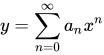 ,
,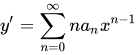 ,
,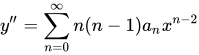 .
.
Substituting these terms into the original equation, one obtains

|

|
|
|

|
|
|
![{\displaystyle =\sum _{n=0}^{\infty }\left[-n(n-1)-2n+l(l+1)\right]a_{n}x^{n}+\sum _{n=0}^{\infty }n(n-1)a_{n}x^{n-2}}](https://wikimedia.org/api/rest_v1/media/math/render/svg/c31ba876004083425770fac7840fed7a82f62cde)
|
|
|
![{\displaystyle =\sum _{n=0}^{\infty }\left[l^{2}-n^{2}+l-n\right]a_{n}x^{n}+\sum _{n=-2}^{\infty }(n+2)(n+1)a_{n+2}x^{n}}](https://wikimedia.org/api/rest_v1/media/math/render/svg/ae5e6b2d625a90ce9152fe2c09e352f1d6c64a2b)
|
|
|
![{\displaystyle =\sum _{n=0}^{\infty }\left[(l+n+1)(l-n)a_{n}+(n+2)(n+1)a_{n+2}\right]x^{n}}](https://wikimedia.org/api/rest_v1/media/math/render/svg/df7e93c21921a6b5765cf9b4376575447853ea22) . .
|
Thus
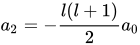 ,
,
and in general,
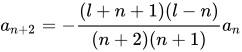 .
.
This series converges when
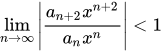 .
.
Therefore the series solution has to be cut by choosing:
 .
.
The series cut in specific integers and  produce polynomials called Legendre polynomials.
Mathematics resources |
|---|
| Activities | |
|---|
| Articles | |
|---|
| Categories | |
|---|
| Courses | |
|---|
| Glossaries | |
|---|
| Lectures | |
|---|
| Lessons | |
|---|
| Lists | |
|---|
| Portals | |
|---|
| Problem sets | |
|---|
| Projects | |
|---|
| Quizzes | |
|---|
| Schools | |
|---|


