The Real and Complex Number System
 |
Completion status: this resource is ~25% complete. |
 |
Subject classification: this is a mathematics resource. |
 |
Educational level: this is a secondary education resource. |
 |
Educational level: this is a tertiary (university) resource. |
Introduction[edit | edit source]
Real Analysis[edit | edit source]
The Real analysis is a branch of mathematical analysis dealing with the set of real numbers. In particular, it deals with the analytic properties of real functions and sequences, including convergence and limits of sequences of real numbers, the calculus of the real numbers, and continuity, smoothness and related properties of real-valued functions.
The goal of this course is to prepare a student to acquire skills on the foundations of the basic theorems and results that shape the mechanisms of calculus and real analysis, and to progress towards a deeper understanding of mathematical ideas that will be a basis for further courses including linear algebra, advanced real analysis, complex analysis, functional analysis, partial differential equations, Lebesgue theory, calculus on manifolds, and the integration of differential forms.
Our course begins with some fundamental observations about other number systems that we have dealt with in the past.
The Natural Numbers[edit | edit source]
The natural numbers arise as the simplest abstraction for the notion of quantity. They are usually conceived of as "counting numbers" and for the purposes of this course (and unless otherwise stated), begin with 1. If we try to abstract a little further, we can observe that as "counting numbers," they have the property of always having a successor. That is, if you have a natural number, you can always find a new natural number, its successor, such that no other natural number lies between that number and the former.
For example, if I give you the natural number 1729, then the only possible successor would be 1730. On the other hand, not every natural number is the successor of some other natural number. If I say that 2008 is the successor of a number, then the original number would be 2007; however there is no natural number such that 1 is the successor of .

The existence of a "successor property" implies (as you should verify) that there is a least natural number: 1. Also, this property implies the existence of an algorithm for creating a new natural number from any given natural number.
When talking about systems of numbers, it is helpful to write instead the set that describes all of the numbers within the system. For example, what happens if we somehow "group" all natural numbers? We will not talk -- for the moment -- about "how many" natural numbers one can have. Intuitively, you might say that this number is infinite, but we must be a little more precise and rigorous about the mathematical concept of "infinity." We can certainly assume, however, that it is possible to talk about the set that contains all of the natural numbers (since the property constructs all of them). We give that set a distinctive character: . Using proper mathematical notation, we write this as


We will continue developing more concepts of as we move forward, such as what it means for to be a partially ordered set or a countable set, but we will not deal with their formal construction here since they deal with Set Theory, a totally different course.
The Integers[edit | edit source]
The integers can be thought of as an "extension" of the natural numbers, to include negative numbers as well as the number zero. We call the set of all integers . In the language of set theory, we say that is a subset of and write this as .


Many properties of the integers are inherited from the natural numbers, but for the sake of this introduction we will not develop their formal construction, which belongs to a more rigorous course on set theory and foundations of mathematics. On the other hand, the existence of negative integers implies that unlike the natural numbers, there is no smallest integer (it is left to the student to demonstrate this).
The Rational Numbers[edit | edit source]
In the same way that the integers may be thought of as an extension of the natural numbers, the rational numbers may be considered an "extension" of integers. They are formally constructed as equivalence classes of pairs of integers, and represent all the fractions that we know from basic arithmetic. The set of all rational numbers is called , and consists of all pairs of integers in the form .


One would think that, by adjusting the numerator and denominator of a rational number, any conceivable number could be expressed, and indeed . But from our knowledge of solutions to algebraic equations, there are situations in which is not sufficient to express a solution to a given equation. Take the question leading to the famous "Pythagorean catastrophe"[1], to wit:

Is there a rational number such that ?


The Incompleteness of the Rational Numbers[edit | edit source]
We are now going to tackle the question of the "completeness" (without actually defining what it means to be complete) of the rational numbers. Intuitively speaking, we want to find out if there exists any number that cannot be expressed using . Take the unit square, for instance (a square that measures one unit on each side). Isn´t it natural for us to wonder about the number that represents the "length" of the diagonal of this square?
Pythagoras' theorem tells us that this number is . But what the symbol tells us is "find a number x such that its square equals 2" In other words,

.

Let us show how no rational number can solve this equation (equivalent to saying: "let us show that the square root of two is not a rational number"). The proof is by contradiction.


.
Or, equivalently, , which shows that is an even number. Then m is an even number, since the square of an even number is even and the square of an odd number is odd (justification left to student). Then write for some integer , which shows that is even and so therefore is . Now we have and both even numbers, contradicting the assumption that is written in lowest terms. Hence is not a rational number.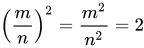





Set Theory Conventions[edit | edit source]
Ordered Sets[edit | edit source]
Fields[edit | edit source]
The Real Field[edit | edit source]
See Real Numbers
The Extended Real Number System[edit | edit source]
The Complex Field[edit | edit source]
See Complex Numbers
There is no real number that is the square root of a negative real number. That is, no real number, multiplied by itself, can yield a negative number, as a result of the field axioms of the real number system. But if we define the square root of -1 as a non-real number ỉ, a new number field is created. This is the Complex number field.
Advanced Topics[edit | edit source]
Euclidean Spaces[edit | edit source]
Dedekind Cuts[edit | edit source]
See Dedekind Cut.
References[edit | edit source]
- ↑ Bell, John L. (2005), Oppositions and Paradoxes in Mathematics and Philosophy, in journal Axiomathes, Springer Netherlands, pp. 165-180, ISSN 1122-1151