Energy Methods/Variational Principles[edit | edit source]
Examples:
- Principle of Virtual Work.
- Principle of Minimum Potential Energy.
- Principle of Minimum Complementary Energy.
- Hu-Washizu Variational Principle.
- Hellinger-Reissner Variational Principle.
Why ?
- Powerful way of approaching problems in linear elasticity.
- Can be used to derive the governing equations and boundary conditions for special classes of problems.
- Used as the basis of approximate solutions of elasticity problem, e.g., finite element method.
- Can be used to obtain rigorous bounds on the stiffness of elastic structures/solids.
Some definitions from Variational Calculus[edit | edit source]
A functional is basically a function of some other functions.
Let  be the displacement. Then the local strain energy density
![{\displaystyle U[u(x)]}](https://wikimedia.org/api/rest_v1/media/math/render/svg/a5452fd6334fe107df1a259b345932923efa4613) is a functional.
is a functional.
Find such that
![{\displaystyle U[u(x)]=\int _{x_{0}}^{x_{1}}F(x,u,u')dx}](https://wikimedia.org/api/rest_v1/media/math/render/svg/1f67a44ac97b0bfb0a7d6fcdaac827405c1231b1)
is a minimum.
Suppose
![{\displaystyle U[u(x)+\delta u(x)]\geq U[u(x)]~\forall ~|\delta u(x)|<h~{\text{and}}~x\in (x_{0},x_{1})}](https://wikimedia.org/api/rest_v1/media/math/render/svg/435894fb4468f89814c88585bab91fc8c124b157)
and equality holds only when  . Then
  is the
variation of
is the
variation of  .
.
Necessary Condition : Euler Equation[edit | edit source]
A necessary condition that minimizes is that the
Euler equation
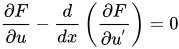
is satisfied and
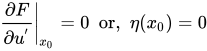
and,
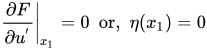
where
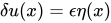
and  is small and
  is arbitrary.
The imposed BCs are the conditions

These are automatically satisfied.
The natural BCs are the conditions
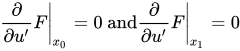
Any that satisfies the necessary conditions make the functional
stationary and is said to be a stationary function
of the functional.
Suppose that  is a functional with
Suppose that  is a small variation of
  that satisfies

Then the variation of  is
is

or,
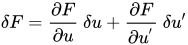
The variation of is
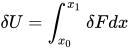
or,
![{\displaystyle \delta U=\left.{\frac {\partial F}{\partial u'}}~\delta u\right|_{x_{0}}^{x_{1}}+\int _{x_{0}}^{x_{1}}\left[{\frac {\partial F}{\partial u}}~\delta u-{\frac {d}{dx}}\left({\frac {\partial F}{\partial u'}}\right)\delta u\right]dx}](https://wikimedia.org/api/rest_v1/media/math/render/svg/9329a9cbf05c9faf5b57ab2628d26eefcd3f3d3b)
Assuming that  is a necessary condition to minimize
![{\displaystyle U[u(x)]\,}](https://wikimedia.org/api/rest_v1/media/math/render/svg/571a6d679d1e9fe10df86a8bcaba0ecfaf1b45c3) , we get the same necessary conditions as before.
, we get the same necessary conditions as before.
If there are additional constraints on minimization, we usually use
Lagrange Multipliers.
Suppose the additional constraint is that  .
Then, we define a function,
.
Then, we define a function,
![{\displaystyle {\tilde {F}}(x,u,u',\lambda )=F(x,u,u')-\lambda \left[x+u+u'-C\right]}](https://wikimedia.org/api/rest_v1/media/math/render/svg/ad379ca93cb501d66414dfda2857dc0a8374d3e3)
where  is the Lagrange multiplier.
Then,

Then, the values that minimize the function subject to the
given constraint are given by the equations

More on Strain Energy Density[edit | edit source]
Recall that the strain energy density is defined as
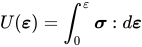
If the strain energy density is path independent, then it acts
as a potential for stress, i.e.,
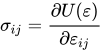
For adiabatic processes, is equal to the change in internal energy per unit volume.
For isothermal processes, is equal to the Helmholtz free energy per unit volume.
The natural state of a body is defined as the state in which the body is in stable thermal equilibrium with no external loads and zero stress and strain.
When we apply energy methods in linear elasticity, we implicitly assume that a body returns to its natural state after loads are removed. This implies that the Gibbs condition is satisfied :

The Principle of Virtual Work[edit | edit source]
This principle is used in the derivation of several minimization principles
and states that:
If  is a state of stress satisfying equilibrium

and the traction boundary condition

Also, if  is a displacement field on
  such that the strain
field
such that the strain
field  is given by

then

The converse also holds - and is usually more interesting because it
gives us a different way of thinking about equilibrium.
If there are jump discontinuities in a body, then what does equilibrium
imply ?
Suppose that  has a jump discontinuity across a body
along the surface
has a jump discontinuity across a body
along the surface  with normal
  because the materials
on the two sides are different.
because the materials
on the two sides are different.
We define the equilibrium state to be one that satisfies the principle
of virtual work for all displacement fields.
Now, if the spin tensor is zero, then

If we use the above, and apply the divergence theorem to the virtual
work equation we get

For the stress jump to satisfy this equation, we must have

Hence, equilibrium is satisfied when

which means that even though a jump can exist in the stresses, the
tractions have to be continuous across the discontinuity.
The work done by external forces on a body can be represented
as a functional
![{\displaystyle W[\mathbf {u} ]=\int _{\partial B}\left(\int _{0}^{\mathbf {u} }\mathbf {t} \bullet d\mathbf {u} \right)dA+\int _{B}\left(\int _{0}^{\mathbf {u} }\mathbf {f} \bullet d\mathbf {u} \right)dV}](https://wikimedia.org/api/rest_v1/media/math/render/svg/cd1714b19e42e2fd164a9b0fc3190448dcd4d986)
Taking the variation of  , we get
![{\displaystyle \delta W=\int _{\partial B}{\frac {\partial }{\partial \mathbf {u} }}\left[\left(\int _{0}^{\mathbf {u} }\mathbf {t} \bullet d\mathbf {u} \right)\right]dA+\int _{B}{\frac {\partial }{\partial \mathbf {u} }}\left[\left(\int _{0}^{\mathbf {u} }\mathbf {f} \bullet d\mathbf {u} \right)\right]dV}](https://wikimedia.org/api/rest_v1/media/math/render/svg/5b9f667fef4b8bd3137aa37ab89584dc11bc54a1)
In index notation,
![{\displaystyle \delta W=\int _{\partial B}{\frac {\partial }{\partial u_{j}}}\left[\left(\int _{0}^{\mathbf {u} }t_{i}~du_{i}\right)\right]\delta u_{j}~dA+\int _{B}{\frac {\partial }{\partial u_{j}}}\left[\left(\int _{0}^{\mathbf {u} }f_{i}~du_{i}\right)\right]\delta u_{j}~dV}](https://wikimedia.org/api/rest_v1/media/math/render/svg/31bd09b534e21b51d614c092fb1427c71980b9d2)
Noting that the external forces and body forces are not functions
of  , the above equation reduces to

The above expression is called the external virtual work.
If we apply the principle of virtual work, with

we get
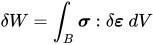
or,
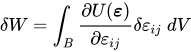
This is the expression for the internal virtual work.
Thus, another form of the principle of virtual work is

Doing the reverse operation, it can be shown that
![{\displaystyle W[{\boldsymbol {\varepsilon }}(\mathbf {x} )]=\int _{R}U({\boldsymbol {\varepsilon }})~dV}](https://wikimedia.org/api/rest_v1/media/math/render/svg/a49815915e11855ec47f6285527b305fde050aec)
which relates the strain energy density () to the functional
that represents the work done by external forces.
Energy Minimization Principles[edit | edit source]
Developed and explored by Green (1839), Haughton(1849), Kirchhoff (1850),
Love (1906), Trefftz (1928) and others.
The Principle of Stationary Potential Energy[edit | edit source]
This principle states that:
- Among all possible kinematically admissible displacement fields
- the potential energy functional is rendered stationary
- by only those that are actual displacement fields.
The Principle of Minimum Potential Energy[edit | edit source]
This principle states that
- If the prescribed traction and body force fields are independent of the deformation
- then the actual displacement field makes the potential energy functional an absolute minimum.
Kinematically Admissible Displacement Fields[edit | edit source]
Consider a body with a boundary  with an applied
body force field
with an applied
body force field  .
.
Suppose that
displacement BCs  are prescribed on the part of
the boundary
are prescribed on the part of
the boundary  .
.
Suppose also that traction BCs
 are applied on the portion of the
boundary
are applied on the portion of the
boundary  .
.
A displacement field  is kinematically admissible if
 satisfies the displacement boundary conditions
  on .
on .- is continuously differentiable, i.e.,
 and
and  .
.
Potential Energy Functional[edit | edit source]
The potential energy functional associated with the
kinematically admissible displacement field is defined as
![{\displaystyle \Pi [\mathbf {v} ,{\boldsymbol {\varepsilon }},{\boldsymbol {\sigma }}]=\int _{B}U({\boldsymbol {\varepsilon }})~dV-\int _{B}{\tilde {\mathbf {f} }}\bullet \mathbf {v} ~dV-\int _{\partial B^{t}}{\tilde {\mathbf {t} }}\bullet \mathbf {v} ~dA}](https://wikimedia.org/api/rest_v1/media/math/render/svg/6b08b104b015bb5d194d70745117d8e2d8941edc)
or,
![{\displaystyle \Pi [\mathbf {v} ]={\frac {1}{2}}\int _{B}{\boldsymbol {\nabla }}{\mathbf {v} }:\mathbf {C} :{\boldsymbol {\nabla }}{\mathbf {v} }~dV-\int _{B}{\tilde {\mathbf {f} }}\bullet \mathbf {v} ~dV-\int _{\partial B^{t}}{\tilde {\mathbf {t} }}\bullet \mathbf {v} ~dA}](https://wikimedia.org/api/rest_v1/media/math/render/svg/e8a774ec7f954ac37d9d67ddb5507e8cecdc6ea4)
In index notation,
![{\displaystyle \Pi [\mathbf {v} ]={\frac {1}{2}}\int _{B}C_{ijkl}~v_{k,l}~v_{i,j}~dV-\int _{B}{\tilde {f}}_{i}~v_{i}~dV-\int _{\partial B^{t}}{\tilde {t}}_{i}~v_{i}~dA}](https://wikimedia.org/api/rest_v1/media/math/render/svg/2a5f228c6cdbd97f1872150e4aa3a48de851c1c9)
Stationary Points and Minimum of the Potential Energy Functional[edit | edit source]
What do we mean when we say that we "render the potential energy
functional stationary" or "minimum"? Note that the potential energy
is a functional of a vector field.
Suppose that the actual displacement field (one that satisfies equilibrium,
compatibility and the boundary conditions) is .
Let be a kinematically admissible variation of , i.e.,

where  is a constant.
Then  must be a displacement field that is continuously
differentiable and satisfies the boundary conditions
must be a displacement field that is continuously
differentiable and satisfies the boundary conditions

The potential energy functional for is
![{\displaystyle {\begin{aligned}\Pi [\mathbf {u} +k~\delta \mathbf {u} ]=&{\frac {1}{2}}\int _{B}{\boldsymbol {\nabla }}{(\mathbf {u} +k~\delta \mathbf {u} )}:\mathbf {C} :{\boldsymbol {\nabla }}{(\mathbf {u} +k~\delta \mathbf {u} )}~dV\\&-\int _{B}{\tilde {\mathbf {f} }}\bullet (\mathbf {u} +k~\delta \mathbf {u} )~dV-\int _{\partial B^{t}}{\tilde {\mathbf {t} }}\bullet (\mathbf {u} +k~\delta \mathbf {u} )~dA\end{aligned}}}](https://wikimedia.org/api/rest_v1/media/math/render/svg/2996866217e8f28604e11ac4bb4cf4728f5969a1)
In index notation,
![{\displaystyle {\begin{aligned}\Pi [\mathbf {u} +k~\delta \mathbf {u} ]=&{\frac {1}{2}}\int _{B}C_{ijkl}(u_{i,j}+k~\delta u_{i,j})(u_{k,l}+k~\delta u_{k,l})~dV\\&-\int _{B}{\tilde {f}}_{i}(u_{i}+k~\delta u_{i})~dV-\int _{\partial B^{t}}{\tilde {t}}_{i}(u_{i}+k~\delta u_{i})~dA\end{aligned}}}](https://wikimedia.org/api/rest_v1/media/math/render/svg/0024baa86078dc66f071ab56216260c2ecdf9d93)
Expanding and rearranging,
![{\displaystyle {\begin{aligned}\Pi [\mathbf {u} +k~\delta \mathbf {u} ]=&{\frac {1}{2}}\int _{B}C_{ijkl}~u_{i,j}~u_{k,l}~dV-\int _{B}{\tilde {f}}_{i}~u_{i}~dV-\int _{\partial B^{t}}{\tilde {t}}_{i}~u_{i}~dA\\&+k\left[{\frac {1}{2}}\int _{B}C_{ijkl}~u_{i,j}~\delta u_{k,l}~dV+{\frac {1}{2}}\int _{B}C_{ijkl}~\delta u_{i,j}~u_{k,l}~dV\right]{\text{(1)}}\qquad \\&-k\left[\int _{B}{\tilde {f}}_{i}~\delta u_{i}~dV+\int _{\partial B^{t}}{\tilde {t}}_{i}~\delta u_{i}~dA\right]\\&+{\frac {k^{2}}{2}}\int _{B}C_{ijkl}~\delta u_{i,j}~\delta u_{k,l}~dV\end{aligned}}}](https://wikimedia.org/api/rest_v1/media/math/render/svg/6d289f7af6b5c254bec26f109ce593dde07ae166)
Using the symmetry of the stiffness tensor, we can simplify the above
expression and write it it terms of variations of  . Thus,
![{\displaystyle \Pi [\mathbf {u} +k~\delta \mathbf {u} ]=\Pi [\mathbf {u} ]+k~\delta \Pi [\mathbf {u} ,\delta \mathbf {u} ]+{\frac {1}{2}}k^{2}~\delta ^{2}\Pi (\mathbf {u} ,\delta \mathbf {u} )}](https://wikimedia.org/api/rest_v1/media/math/render/svg/b81f32dc0f0978f23d754dc3e841c6b289f7c3aa)
You can check that the first and second variations of turn out to
be equal to the expanded terms in equation (1).
If

for all admissible variations , then is a { stationary
point} of the functional .
If
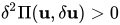
for all admissible variations , then is makes the
functional a minimum.
Observations on Uniqueness and Existence of Solutions[edit | edit source]
- The potential energy functional is a global minimum if and only if the displacement field satisfies traction BCs, equilibrium and the displacement BCs.
- Thus, if the potential energy functional actually has a global mininum, then a solution exists and must be unique.
- Displacement boundary value problems do not face the problem of rigid body motions. Therefore, a global minimum always exists for such problems and is unique.
- Traction boundary value problems may not have unique solutions, nor might solutions always exist unless the external loads are in static equilibrium.
Example: Approximate Solutions of Torsion Problems[edit | edit source]
Suppose that we have a cylindrical body of length  and an arbitrary cross-section that is subject to equal and opposite torques at the two ends. The displacement field is given by

The traction-free boundary conditions on the lateral surfaces can be
given as

The torque BC at the ends can be replaced with displacement BCs

and

Thus, we change the problem from a purely traction boundary value
problem to one in which the twist per unit length ( ) is prescribed instead of the applied torque (
 ).
).
The modified problem is one with zero body force and zero tractions.
Therefore, the potential energy functional reduces to
![{\displaystyle \Pi [\mathbf {v} ,{\boldsymbol {\varepsilon }},{\boldsymbol {\sigma }}]=\int _{B}U({\boldsymbol {\varepsilon }})~dV}](https://wikimedia.org/api/rest_v1/media/math/render/svg/c33d7a52c3d15eb03bdc66b7e5272992b0771331)
The stresses and strains for the torsion problem are given by

Therefore, the internal energy is
![{\displaystyle U({\boldsymbol {\varepsilon }})={\frac {1}{2}}\sigma _{ij}\varepsilon _{ij}={\frac {1}{2}}\mu \alpha ^{2}\left[(\psi _{,1}-x_{2})^{2}+(\psi _{,2}+x_{1})^{2}\right]}](https://wikimedia.org/api/rest_v1/media/math/render/svg/7323c7738c55268f107b45f93a49fe51bb174fc8)
The potential energy per unit length ( ) is
) is
![{\displaystyle {\bar {\Pi }}[\psi (x_{1},x_{2})]={\frac {1}{2}}\mu \alpha ^{2}\int _{\mathcal {S}}\left[(\psi _{,1}-x_{2})^{2}+(\psi _{,2}+x_{1})^{2}\right]dA}](https://wikimedia.org/api/rest_v1/media/math/render/svg/809aab8affb4eb992705f3a3f9873493cffb8c76)
According to the principle of minimum potential energy, the actual
warping function is the one that makes an absolute minimum.
Suppose we are given a warping function of the form

Then, the potential energy per unit length is
![{\displaystyle {\begin{aligned}{\bar {\Pi }}[\psi (x_{1},x_{2})]={\frac {1}{2}}\mu \alpha ^{2}&\left[\int _{\mathcal {S}}\left[4A^{2}+(B+1)^{2}\right]x_{1}^{2}~dA+\int _{\mathcal {S}}\left[4C^{2}+(B-1)^{2}\right]x_{2}^{2}~dA+\right.\\&\left.\int _{\mathcal {S}}4\left[A(B-1)+C(B+1)\right]x_{1}~x_{2}~dA\right]\end{aligned}}}](https://wikimedia.org/api/rest_v1/media/math/render/svg/abbace2ec8bac3779ec23ef19ebecd378aa18bbb)
If  and
and  are the principal axes of inertia, then we have

Hence,
![{\displaystyle {\begin{aligned}{\bar {\Pi }}[\psi (x_{1},x_{2})]=&{\frac {1}{2}}\mu \alpha ^{2}\left[\left[4A^{2}+(B+1)^{2}\right]I_{1}+\left[4C^{2}+(B-1)^{2}\right]I_{2}\right]\end{aligned}}}](https://wikimedia.org/api/rest_v1/media/math/render/svg/75e70fd4f92491adde57d06c9fa00780ed3a92f7)
The stationary points of the potential energy functional are given by
![{\displaystyle {\begin{aligned}{\frac {\partial {\bar {\Pi }}}{\partial A}}&=4\mu \alpha ^{2}~I_{2}~A=0\\{\frac {\partial {\bar {\Pi }}}{\partial B}}&=\mu \alpha ^{2}\left[(B+1)I_{2}+(B-1)I_{1}\right]=0\\{\frac {\partial {\bar {\Pi }}}{\partial C}}&=4\mu \alpha ^{2}~I_{2}~A=0\end{aligned}}}](https://wikimedia.org/api/rest_v1/media/math/render/svg/10757bdcabe92a851723ed9886e78c47d7d01439)
Thus, we have,

Thus the best approximation to the warping function is

The above technique is called the Rayleigh-Ritz method.
An important observation that should be made at this stage is about the approximate nature of the solution.
For cross-sections in which  , (e.g., circular or square sections) the best approximation for
  is
is  . This gives us the exact result for circular cross-sections.
However, for square cross-sections we have an error of nearly 20%.
Introduction to Elasticity