

Vector space/Introduction/Section


The central concept of linear algebra is a vector space.











The binary operation in is called (vector-)addition, and the operation is called scalar multiplication. The elements in a vector space are called vectors, and the elements are called scalars. The null element is called null vector, and for , the inverse element, with respect to the addition, is called the negative of , denoted by .


The field that occurs in the definition of a vector space is called the base field. All the concepts of linear algebra refer to such a base field. In case , we talk about a real vector space, and in case , we talk about a complex vector space. For real and complex vector spaces, there exist further structures like length, angle, inner product. But first we develop the algebraic theory of vector spaces over an arbitrary field.


Let denote a field, and let . Then the product set


with componentwise addition and with scalar multiplication given by

is a vector space. This space is called the -dimensional standard space. In particular, is a vector space.


The null space , consisting of just one element , is a vector space. It might be considered as .


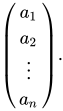
The vectors in the standard space can be written as row vectors


or as column vectors
The vector
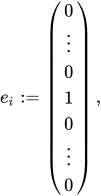
where the is at the -th position, is called -th standard vector.


The complex numbers form a field, and therefore they form also a vector space over the field itself. However, the set of complex numbers equals as an additive group. The multiplication of a complex number with a real number is componentwise, so this multiplication coincides with the scalar multiplication on . Hence, the set of complex numbers is also a real vector space.


For a field , and given natural numbers , the set


of all -matrices, endowed with componentwise addition and componentwise scalar multiplication, is a -vector space. The null element in this vector space is the null matrix


Let be the polynomial ring in one variable over the field , consisting of all polynomials, that is, expressions of the form
![{\displaystyle {}R=K[X]}](https://wikimedia.org/api/rest_v1/media/math/render/svg/5b50496860d93ccc94f4c23024c22f00d5bdf8fe)

with . Using componentwise addition and componentwise multiplication with a scalar (this is also multiplication with the constant polynomial ), the polynomial ring is a -vector space.


We consider the inclusion of the rational numbers inside the real numbers. Using the real addition and the multiplication of rational numbers with real numbers, we see that is a -vector space, as follows directly from the field axioms. This is a quite crazy vector space.


Let be a field, and let be a -vector space. Then the following properties hold (for
and ).- We have .
- We have .
- We have .
- If and , then .


Proof

- ↑ The first four axioms, which are independent of , mean that is a commutative group.
- ↑ Also for vector spaces, there is the convention that multiplication binds stronger than addition.
