Report 2
Egm3520.s13.team1.stevenchiu (discuss • contribs ) 15:28, 6 February 2013 (UTC)
Egm 3520.s13.team1.wcs (discuss • contribs ) 15:52, 6 February 2013 (UTC)
Text can be viewed here
Solve for the reactions at B and at A in the Example 2.04 (see p.9-1) with the stress-strain relation (1) p.9-5.
Diagram
Figure from Lecture Notes via textbook Mechanics of Materials - Authors: Beer, Johnston, DeWolf, Mazurek
Given
Applied Forces
Area
Length
Young's Modulus
F
D
=
300
k
N
{\displaystyle F_{D}=300kN}
A
C
K
=
A
K
B
=
A
C
B
=
400
m
m
2
=
A
1
{\displaystyle A_{CK}=A_{KB}=A_{CB}=400mm^{2}={\color {red}A_{1}}}
L
A
D
=
L
D
C
=
L
C
K
=
L
K
B
=
L
=
150
m
m
{\displaystyle L_{AD}=L_{DC}=L_{CK}=L_{KB}=L=150mm}
E
A
D
=
E
D
C
=
E
C
K
=
E
K
B
=
E
{\displaystyle E_{AD}=E_{DC}=E_{CK}=E_{KB}=E}
F
K
=
600
k
N
{\displaystyle F_{K}=600kN}
A
A
D
=
A
D
C
=
A
A
C
=
250
m
m
2
=
A
2
{\displaystyle A_{AD}=A_{DC}=A_{AC}=250mm^{2}={\color {red}A_{2}}}
σ
=
E
ϵ
1
/
2
{\displaystyle \sigma =E\epsilon ^{1/2}}
⟹
δ
=
ϵ
L
=
σ
2
E
2
L
=
P
2
L
A
2
E
2
{\displaystyle \implies \delta =\epsilon L={\frac {\sigma ^{2}}{E^{2}}}L={\frac {P^{2}L}{A^{2}E^{2}}}}
FBD from Section 9 Lecture notes. Author Professor Loc Vu-Quoc FBD 3:
∑
F
=
−
P
C
K
−
F
K
+
R
B
=
0
{\displaystyle \sum F=-P_{CK}-F_{K}+R_{B}=0}
⟹
P
C
K
=
P
1
=
R
B
−
F
K
{\displaystyle \implies P_{CK}={\color {red}P_{1}}=R_{B}-F_{K}}
FBD 4:
∑
F
=
−
P
D
C
−
F
K
=
0
{\displaystyle \sum F=-P_{DC}-F_{K}=0}
⟹
P
D
C
=
P
2
=
R
B
−
F
K
{\displaystyle \implies P_{DC}={\color {red}P_{2}}=R_{B}-F_{K}}
FBD 5:
∑
F
=
−
P
A
D
−
F
D
−
F
K
+
R
B
=
0
{\displaystyle \sum F=-P_{AD}-F_{D}-F_{K}+R_{B}=0}
⟹
P
A
D
=
P
3
=
R
B
−
F
D
−
F
K
{\displaystyle \implies P_{AD}={\color {red}P_{3}}=R_{B}-F_{D}-F_{K}}
Left
δ
L
=
∑
P
i
2
L
i
A
i
2
E
i
2
=
(
0
+
P
1
2
L
A
1
2
E
2
+
P
2
2
L
A
2
2
E
2
+
P
3
2
L
A
2
2
E
2
)
{\displaystyle \delta _{L}=\sum {\frac {P_{i}^{2}L_{i}}{A_{i}^{2}E_{i}^{2}}}=\left(0+{\frac {P_{1}^{2}L}{A_{1}^{2}E^{2}}}+{\frac {P_{2}^{2}L}{A_{2}^{2}E^{2}}}+{\frac {P_{3}^{2}L}{A_{2}^{2}E^{2}}}\right)}
Sub:
P
1
=
P
2
{\displaystyle {\color {blue}P_{1}=P_{2}}}
Right
δ
R
=
P
1
2
L
A
1
2
E
2
+
P
2
2
L
A
1
2
E
2
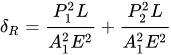
{\displaystyle \delta _{R}={\frac {P_{1}^{2}L}{A_{1}^{2}E^{2}}}+{\frac {P_{2}^{2}L}{A_{1}^{2}E^{2}}}}
Sub:
P
1
=
P
2
=
−
R
B
{\displaystyle {\color {blue}P_{1}=P_{2}=-R_{B}}}
Total
δ
Total
=
δ
L
+
δ
R
=
P
1
2
L
A
1
2
E
2
+
P
2
2
L
A
2
2
E
2
+
P
3
2
L
A
2
2
E
2
−
R
B
2
L
A
1
2
E
2
−
R
B
2
L
A
2
2
E
2
=
0
{\displaystyle \delta _{\text{Total}}=\delta _{L}+\delta _{R}={\frac {P_{1}^{2}L}{A_{1}^{2}E^{2}}}+{\frac {P_{2}^{2}L}{A_{2}^{2}E^{2}}}+{\frac {P_{3}^{2}L}{A_{2}^{2}E^{2}}}-{\frac {R_{B}^{2}L}{A_{1}^{2}E^{2}}}-{\frac {R_{B}^{2}L}{A_{2}^{2}E^{2}}}=0}
ALL E's and L's cancel out
⟹
P
1
2
A
1
2
+
P
1
2
A
1
2
+
P
3
2
A
2
2
−
R
B
2
A
1
2
−
R
B
2
A
2
2
=
0
{\displaystyle \implies {\frac {P_{1}^{2}}{A_{1}^{2}}}+{\frac {P_{1}^{2}}{A_{1}^{2}}}+{\frac {P_{3}^{2}}{A_{2}^{2}}}-{\frac {R_{B}^{2}}{A_{1}^{2}}}-{\frac {R_{B}^{2}}{A_{2}^{2}}}=0}
⟹
−
1
A
1
2
R
B
2
+
1
A
1
2
(
1.2
∗
10
6
)
R
B
+
(
6
∗
10
6
)
2
A
1
2
−
1
A
2
2
R
B
2
+
1
A
2
2
(
1.2
∗
10
6
)
R
B
+
(
9
∗
10
6
)
2
A
2
2
−
1
A
2
2
R
B
2
+
1
A
2
2
(
1.8
∗
10
6
)
R
B
+
(
9
∗
10
6
)
2
A
2
2
−
1
A
1
2
R
B
2
−
1
A
2
2
R
B
2
{\displaystyle \implies -{\frac {1}{A_{1}^{2}}}R_{B}^{2}+{\frac {1}{A_{1}^{2}}}(1.2*10^{6})R_{B}+{\frac {(6*10^{6})^{2}}{A_{1}^{2}}}-{\frac {1}{A_{2}^{2}}}R_{B}^{2}+{\frac {1}{A_{2}^{2}}}(1.2*10^{6})R_{B}+{\frac {(9*10^{6})^{2}}{A_{2}^{2}}}-{\frac {1}{A_{2}^{2}}}R_{B}^{2}+{\frac {1}{A_{2}^{2}}}(1.8*10^{6})R_{B}+{\frac {(9*10^{6})^{2}}{A_{2}^{2}}}-{\frac {1}{A_{1}^{2}}}R_{B}^{2}-{\frac {1}{A_{2}^{2}}}R_{B}^{2}}
⟹
(
−
2
A
1
2
−
3
A
2
2
)
R
B
2
+
(
4
∗
10
6
)
(
1
A
2
2
+
2
A
2
2
)
R
B
+
(
6
∗
10
6
)
2
A
1
2
+
(
9
∗
10
6
)
2
A
2
2
+
(
9
∗
10
6
)
2
A
2
2
{\displaystyle \implies \left(-{\frac {2}{A_{1}^{2}}}-{\frac {3}{A_{2}^{2}}}\right)R_{B}^{2}+(4*10^{6})\left({\frac {1}{A_{2}^{2}}}+{\frac {2}{A_{2}^{2}}}\right)R_{B}+{\frac {(6*10^{6})^{2}}{A_{1}^{2}}}+{\frac {(9*10^{6})^{2}}{A_{2}^{2}}}+{(9*10^{6})^{2}}{A_{2}^{2}}}
⟹
−
6.05
∗
10
7
R
B
2
+
1.6065
∗
10
14
R
B
+
2.097
∗
10
21
{\displaystyle \implies -6.05*10^{7}R_{B}^{2}+1.6065*10^{14}R_{B}+2.097*10^{21}}
R
B
≈
200
k
N
{\displaystyle R_{B}\approx {\color {blue}200kN}}
∑
F
=
R
A
−
F
D
−
F
K
+
R
B
=
0
{\displaystyle \sum F=R_{A}-F_{D}-F_{K}+R_{B}=0}
⟹
R
A
=
300
+
600
−
200
=
0
{\displaystyle \implies R_{A}=300+600-200=0}
⟹
R
A
=
700
k
N
{\displaystyle \implies R_{A}={\color {blue}700kN}}
Do the results depend on the length of each segment and the Young's modulus?
Solution 2 While working to determine
δ
T
o
t
a
l
{\displaystyle \delta _{Total}}
Problem Number 2.12, p.73. Contents taken from Mechanics of Materials Textbook 6th edition. Authors: F.P BEER, E.R. JOHNSTON, J.T. DEWOLF AND D.F. MAZUREK ISBN:9780077565664
A nylon thread is to be subjected to a 10-N tension. Knowing that E=3.2 GPa,that the maximum allowable normal stress is 40 MPa, and the length of the thread must not increase by more than 1%, determine the required diameter thread.
Determine maximum stress allowable with the limit in displacement being
δ
=
L
100
{\displaystyle \displaystyle \delta ={\frac {L}{100}}}
σ
=
E
ϵ
L
=
32
M
P
a
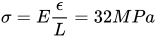
{\displaystyle \displaystyle \sigma =E{\frac {\epsilon }{L}}=32MPa}
ϵ
=
δ
L
{\displaystyle \displaystyle \epsilon ={\frac {\delta }{L}}}
σ
=
E
ϵ
{\displaystyle \displaystyle \sigma =E\epsilon }
σ
=
P
A
{\displaystyle \displaystyle \sigma ={\frac {P}{A}}}
Write Area in terms of diameter:
σ
=
P
A
=
P
π
(
d
2
)
2
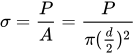
{\displaystyle \displaystyle \sigma ={\frac {P}{A}}={\frac {P}{\pi ({\frac {d}{2}})^{2}}}}
Solve equation for diameter (d):
d
=
4
P
π
σ
=
.631
m
m
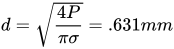
{\displaystyle \displaystyle d={\sqrt {\frac {4P}{\pi \sigma }}}=.631mm}
Problem Number 2.16, p.74. Contents taken from Mechanics of Materials Textbook 6th edition. Authors: F.P BEER, E.R. JOHNSTON, J.T. DEWOLF AND D.F. MAZUREK ISBN:9780077565664
The brass tube AB (
E
=
105
GPa
{\displaystyle E=105{\text{GPa}}}
140
mm
2
{\displaystyle 140{\text{mm}}^{2}}
Figure 2.16 from Mechanics of Materials textbook 6th edition Authors Beer, Johnston, DeWolf, and Mazurek
E
A
B
=
105
G
P
a
≥
105
∗
10
9
P
a
{\displaystyle \displaystyle E_{AB}=105GPa\geq 105*10^{9}Pa}
X
A
B
=
104
m
m
2
≥
1.4
∗
10
−
4
m
{\displaystyle \displaystyle X_{AB}=104mm^{2}\geq 1.4*10^{-4}m}
E
C
D
=
72
G
P
a
≥
72
∗
10
9
P
a
{\displaystyle \displaystyle E_{C}D=72GPa\geq 72*10^{9}Pa}
X
C
D
=
250
m
m
2
≥
2.5
∗
10
−
4
m
{\displaystyle \displaystyle X_{C}D=250mm^{2}\geq 2.5*10^{-4}m}
Must be moved down 1 mm to find P (force or load required).
δ
=
P
L
E
A
{\displaystyle \delta ={\frac {PL}{EA}}}
L
A
B
=
375
mm
+
1
mm
=
376
mm
{\displaystyle L_{AB}=375{\text{mm}}+1{\text{mm}}=376{\text{mm}}}
δ
A
B
=
P
L
A
B
E
A
B
A
A
B
⟹
P
(
0.376
m
)
(
105
∗
10
9
P
a
)
(
1.40
∗
10
−
4
m
2
)
=
2.558
∗
10
−
8
P
{\displaystyle \delta _{AB}={\frac {PL_{AB}}{E_{AB}A_{AB}}}\implies {\frac {P(0.376m)}{(105*10^{9}Pa)(1.40*10^{-4}m^{2})}}=2.558*10^{-8}P}
δ
C
D
=
P
L
C
D
E
C
D
A
C
D
⟹
P
(
0.375
)
(
72
∗
10
9
P
a
)
(
2.5
∗
10
−
4
m
2
)
=
2.0833
∗
10
−
8
P
a
{\displaystyle \delta _{CD}={\frac {PL_{CD}}{E_{CD}A_{CD}}}\implies {\frac {P(0.375)}{(72*10^{9}Pa)(2.5*10^{-4}m^{2})}}=2.0833*10^{-8}Pa}
δ
A
=
δ
A
B
+
δ
C
D
⟹
1
∗
10
−
3
m
=
(
2.558
∗
10
−
8
+
2.0833
∗
10
−
8
)
P
{\displaystyle \delta _{A}=\delta _{AB}+\delta _{CD}\implies 1*10^{-3}m=(2.558*10^{-8}+2.0833*10^{-8})P}
P
=
1
∗
10
−
3
m
2.558
∗
10
−
8
+
2.0833
∗
10
−
8
=
21546.35
N
⟹
21.5
k
N
{\displaystyle P={\frac {1*10^{-3}m}{2.558*10^{-8}+2.0833*10^{-8}}}=21546.35N\implies 21.5kN}
Problem Number 2.24, p.75. Contents taken from Mechanics of Materials Textbook 6th edition. Authors: F.P BEER, E.R. JOHNSTON, J.T. DEWOLF AND D.F. MAZUREK ISBN:9780077565664
For the steel truss (E=29*10^6 psi) and loading shown, determine the deformations of members BD and DE, knowin that their cross-sectional areas are 2 in^2 and 3 in^2, respectively.
Done by method of sections. Cut off the top half of the truss by cutting midway through sections BD, DE and EG.
It is assumed that the structure is in equilibrium.
∑
M
E
=
(
−
30
k
i
p
s
)
(
0
)
+
(
−
30
k
i
p
s
)
(
8
)
+
(
−
30
k
i
p
s
)
(
16
)
+
F
B
D
∗
15
=
0
⟹
{\displaystyle \displaystyle \sum M_{E}=(-30kips)(0)+(-30kips)(8)+(-30kips)(16)+F_{BD}*15=0\implies }
F
B
D
=
48
k
i
p
s
{\displaystyle F_{BD}=48kips}
∑
F
H
=
30
k
i
p
s
+
30
k
i
p
s
−
F
D
E
=
0
⟹
{\displaystyle \displaystyle \sum F_{H}=30kips+30kips-F_{DE}=0\implies }
F
D
E
=
60
k
i
p
s
{\displaystyle F_{DE}=60kips}
δ
B
D
=
F
B
D
L
B
D
A
B
D
E
B
D
=
48
k
i
p
s
∗
96
i
n
2
i
n
∗
(
29
E
−
6
)
p
s
i
⟹
{\displaystyle \displaystyle \delta _{BD}={\frac {F_{BD}L_{BD}}{A_{BD}E_{BD}}}={\frac {48kips*96in}{2in*(29E-6)psi}}\implies }
δ
B
D
=
0.0794
i
n
{\displaystyle \delta _{BD}=0.0794in}
δ
D
E
=
F
D
E
L
D
E
A
D
E
∗
E
D
E
=
60
k
i
p
s
∗
180
i
n
3
i
n
∗
(
29
E
−
6
)
p
s
i
⟹
{\displaystyle \displaystyle \delta _{DE}={\frac {F_{DE}L_{DE}}{A_{DE}*E_{DE}}}={\frac {60kips*180in}{3in*(29E-6)psi}}\implies }
δ
D
E
=
0.124
i
n
{\displaystyle \delta _{DE}=0.124in}
Problem Number 2.40, p.89. Contents taken from Mechanics of Materials Textbook 6th edition. Authors: F.P BEER, E.R. JOHNSTON, J.T. DEWOLF AND D.F. MAZUREK ISBN:9780077565664
A polystyrene rod consisting of two cylindrical portions AB and BC is restrained at both ends and supports and supports two 6-kip loads as shown. Knowing that E=0.45*10^6 psi, determine (a) the reactions at A and C, (b) the normal stress in each portion of the rod.
We begin by first sketching the free body diagram of the system
From this diagram we can see that:
R
A
+
R
B
=
12
k
i
p
s
{\displaystyle \displaystyle R_{A}+R_{B}=12kips}
(1)
δ
=
P
A
B
L
A
B
A
A
B
E
+
P
B
C
L
B
C
A
B
C
E
=
0
{\displaystyle \displaystyle \delta ={\frac {P_{AB}L_{AB}}{A_{AB}E}}+{\frac {P_{BC}L_{BC}}{A_{BCE}}}=0}
(Text 2.15)
Having been given values for all variables in the equation except P we must solve for those two forces.
Substituting into the original equation we find:
R
A
L
A
B
A
A
B
−
R
C
L
B
C
A
B
C
=
0
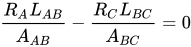
{\displaystyle \displaystyle {\frac {R_{A}L_{AB}}{A_{AB}}}-{\frac {R_{C}L_{BC}}{A_{BC}}}=0}
Calculating the areas gives us:
A
A
B
=
π
(
0.625
)
2
=
1.22
i
n
2
{\displaystyle \displaystyle A_{AB}=\pi (0.625)^{2}=1.22in^{2}}
A
B
C
=
π
(
1
)
2
=
3.14
i
n
2
{\displaystyle \displaystyle A_{BC}=\pi (1)^{2}=3.14in^{2}}
R
C
=
L
A
B
A
B
C
L
B
C
A
A
B
∗
R
A
=
4.29
R
A
{\displaystyle \displaystyle R_{C}={\frac {L_{AB}A_{BC}}{L_{BC}A_{AB}}}*R_{A}=4.29R_{A}}
(2)
Using the equations (1) and (2) we can solve for
R
A
{\displaystyle R_{A}}
R
B
{\displaystyle R_{B}}
R
A
=
2.3
k
i
p
s
{\displaystyle R_{A}=2.3kips}
R
B
=
9.7
k
i
p
s
{\displaystyle R_{B}=9.7kips}
To find the normal stress we simply use formula 1.5 from the first chapter of the text:
σ
=
P
A
{\displaystyle \displaystyle \sigma ={\frac {P}{A}}}
(Text 1.5)
σ
A
B
=
R
A
A
A
B
=
1.88
k
s
i
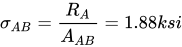
{\displaystyle \displaystyle \sigma _{AB}={\frac {R_{A}}{A_{AB}}}=1.88ksi}
σ
B
C
=
−
R
C
A
B
C
=
−
3.09
k
s
i
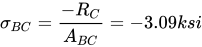
{\displaystyle \displaystyle \sigma _{BC}={\frac {-R_{C}}{A_{BC}}}=-3.09ksi}
Problem Number 2.44, p.90. Contents taken from Mechanics of Materials Textbook 6th edition. Authors: F.P BEER, E.R. JOHNSTON, J.T. DEWOLF AND D.F. MAZUREK ISBN:9780077565664
Egm3520.s13.team1.scheppegrell.jas (discuss • contribs ) 16:57, 6 February 2013 (UTC)
Figure from Lecture Notes via textbook Mechanics of Materials - Authors: Beer, Johnston, DeWolf, Mazurek The rigid bar AD is supported by two steel wires of 1/16in diameter (E=29*10^6 psi) and a pin and bracket at D. Knowing that the wires were initially taut, determine (a) the additional tension in each wire when a 120-lb load P is P is applied at B, (b) the corresponding deflection of point B.
Given
Applied Force
Area
Length
Young's Modulus
P=120lb
A
A
E
=
A
C
F
=
π
4
1
256
i
n
2
=
A
{\displaystyle A_{AE}=A_{CF}={\frac {\pi }{4}}{\frac {1}{256}}in^{2}=A}
L
A
E
=
15
i
n
=
L
A
{\displaystyle L_{AE}=15in=L_{A}}
E
A
E
=
E
C
F
=
29
∗
10
6
p
s
i
{\displaystyle E_{AE}=E_{CF}=29*10^{6}psi}
L
C
F
=
8
i
n
=
L
C
{\displaystyle L_{CF}=8in=L_{C}}
δ
i
=
P
i
L
i
A
E
{\displaystyle \delta _{i}={\frac {P_{i}L_{i}}{AE}}}
δ
A
=
P
A
15
π
4
1
256
(
29
∗
10
6
)
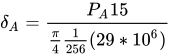
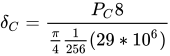
{\displaystyle \delta _{A}={\frac {P_{A}15}{{\frac {\pi }{4}}{\frac {1}{256}}(29*10^{6})}}}
δ
C
=
P
C
8
π
4
1
256
(
29
∗
10
6
)
{\displaystyle \delta _{C}={\frac {P_{C}8}{{\frac {\pi }{4}}{\frac {1}{256}}(29*10^{6})}}}
δ
A
=
3
2
δ
B
{\displaystyle \delta _{A}={\frac {3}{2}}\delta _{B}}
δ
C
=
1
2
δ
B
{\displaystyle \delta _{C}={\frac {1}{2}}\delta _{B}}
2
3
P
A
15
π
4
1
256
(
29
∗
10
6
)
=
2
P
C
8
π
4
1
256
(
29
∗
10
6
)
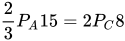
{\displaystyle {\frac {2}{3}}{\frac {P_{A}15}{{\frac {\pi }{4}}{\frac {1}{256}}(29*10^{6})}}=2{\frac {P_{C}8}{{\frac {\pi }{4}}{\frac {1}{256}}(29*10^{6})}}}
2
3
P
A
15
=
2
P
C
8
{\displaystyle {\frac {2}{3}}P_{A}15=2P_{C}8}
P
A
=
8
5
P
C
{\displaystyle P_{A}={\frac {8}{5}}P_{C}}
8
5
P
C
3
2
+
P
C
1
2
=
120
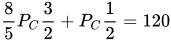
{\displaystyle {\frac {8}{5}}P_{C}{\frac {3}{2}}+P_{C}{\frac {1}{2}}=120}
P
C
29
10
=
120
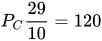
{\displaystyle P_{C}{\frac {29}{10}}=120}
P
C
=
1200
29
⟹
P
A
=
1920
29
{\displaystyle P_{C}={\frac {1200}{29}}\implies P_{A}={\frac {1920}{29}}}
T
e
n
s
i
o
n
C
=
41.4
l
b
{\displaystyle Tension_{C}=41.4lb}
T
e
n
s
i
o
n
A
=
66.2
l
b
{\displaystyle Tension_{A}=66.2lb}
δ
C
=
8
∗
41.4
π
4
∗
256
29
∗
10
6
=
3.72
∗
10
−
3
{\displaystyle \delta _{C}={\frac {8*41.4}{{\frac {\pi }{4*256}}29*10^{6}}}=3.72*10^{-3}}
δ
B
=
δ
B
∗
2
=
3.72
∗
10
−
3
)
∗
2
=
7.44
∗
10
−
3
i
n
c
h
e
s
{\displaystyle \delta _{B}=\delta _{B}*2=3.72*10^{-3})*2=7.44*10^{-3}inches}
7.44
∗
10
−
3
i
n
c
h
e
s
{\displaystyle 7.44*10^{-3}inches}
m = meter
mm = millimeter
d = diameter
G = giga
Pa = Pascal
A = area
Q/P = load
N = Newton
δ = deflection