Jump to content

Template:Regular convex 4-polytopes

From Wikiversity
Sequence of 6 regular convex 4-polytopes
Symmetry group A4 B4 F4 H4
Name 5-cell

Hyper-tetrahedron
5-point

16-cell

Hyper-octahedron
8-point

8-cell

Hyper-cube
16-point

24-cell

Hyper-cuboctahedron
24-point

600-cell

Hyper-icosahedron
120-point


120-cell

Hyper-dodecahedron
600-point

Schläfli symbol {3, 3, 3} {3, 3, 4} {4, 3, 3} {3, 4, 3} {3, 3, 5} {5, 3, 3}
Coxeter mirrors
Mirror dihedrals 𝝅/3 𝝅/3 𝝅/3 𝝅/2 𝝅/2 𝝅/2 𝝅/3 𝝅/3 𝝅/4 𝝅/2 𝝅/2 𝝅/2 𝝅/4 𝝅/3 𝝅/3 𝝅/2 𝝅/2 𝝅/2 𝝅/3 𝝅/4 𝝅/3 𝝅/2 𝝅/2 𝝅/2 𝝅/3 𝝅/3 𝝅/5 𝝅/2 𝝅/2 𝝅/2 𝝅/5 𝝅/3 𝝅/3 𝝅/2 𝝅/2 𝝅/2
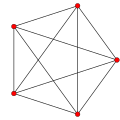
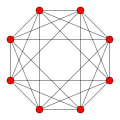
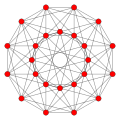
Graph
Vertices[a] 5 tetrahedral 8 octahedral 16 tetrahedral 24 cubical 120 icosahedral 600 tetrahedral
Edges 10 triangular 24 square 32 triangular 96 triangular 720 pentagonal 1200 triangular
Faces 10 triangles 32 triangles 24 squares 96 triangles 1200 triangles 720 pentagons
Cells 5 {3, 3} 16 {3, 3} 8 {4, 3} 24 {3, 4} 600 {3, 3} 120 {5, 3}
Tori 5 {3, 3} 8 {3, 3} x 2 4 {4, 3} x 2 6 {3, 4} x 4 30 {3, 3} x 20 10 {5, 3} x 12
Inscribed 120 in 120-cell 675 in 120-cell 2 16-cells 3 8-cells 25 24-cells 10 600-cells
Great polygons 2 squares x 3[b] 4 rectangles x 4 4 hexagons x 4 12 decagons x 6 100 irregular hexagons x 4
Petrie polygons[c] 1 pentagon x 2 1 octagon x 3 2 octagons x 4 2 dodecagons x 4 4 30-gons x 6 20 30-gons x 4
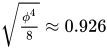
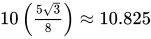
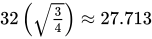
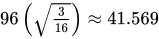
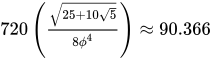
Edge length[d]
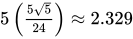
Isocline chord[e]
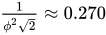
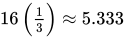
Isoclinic ratio[f]
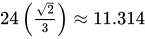
Long radius
Edge radius
Face radius
Short radius
Area
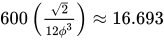
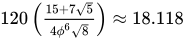
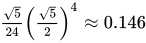
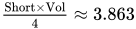
Volume
4-Content
  1. The convex regular 4-polytopes can be ordered by size as a measure of 4-dimensional content (hypervolume) for the same radius. This is their proper order of enumeration: the order in which they nest inside each other as compounds.[1] Each greater polytope in the sequence is rounder than its predecessor, enclosing more 4-content within the same radius.[2] The 4-simplex (5-cell) is the limit smallest case, and the 120-cell is the largest. Complexity (as measured by comparing configuration matrices or simply the number of vertices) follows the same ordering. This provides an alternative numerical naming scheme for regular polytopes in the ascending sequence that begins with the 5-point (5-cell) 4-polytope and ends with the 600-point (120-cell) 4-polytope.
  2. In 4 dimensional space we can construct 4 perpendicular axes and 6 perpendicular planes through a point. Without loss of generality, we may take these to be the axes and orthogonal central planes of a (w, x, y, z) Cartesian coordinate system. In 4 dimensions we have the same 3 orthogonal planes (xy, xz, yz) that we have in 3 dimensions, and also 3 others (wx, wy, wz). Each of the 6 orthogonal planes shares an axis with 4 of the others, and is completely orthogonal to just one of the others: the only one with which it does not share an axis. Thus there are 3 pairs of completely orthogonal planes: xy and wz intersect only at the origin; xz and wy intersect only at the origin; yz and wx intersect only at the origin.
  3. Coxeter describes the helical Petrie polygons of regular 4-polytopes. He begins by noting that the regular tesselations of 3-space (which may be viewed as "flat" 4-polytopes) have the same kind of helical Petrie polygons as spherical 4-polytopes:

    Among the vertices and edges of a regular honeycomb we can pick out a new kind of Petrie polygon in which every three consecutive edges belong to the Petrie polygon of a cell but no four consecutive edges belong to the same cell. ... The isometry which takes us one step along the Petrie polygon, being conjugate to the product of half-turns about two opposite edges of the characteristic tetrahedron, is the product of half-turns about two skew lines, that is, a twist: the product of a translation along a line (which measures the shortest distance between two skew lines) and a rotation about the same line. Thus the Petrie polygon is a "helical" polygon: its edges are the chords of a helix. This description is valid in hyperbolic space as well as in Euclidean space.
    In spherical space, is, of course, a great circle, the "translation" along it is a rotation about a polar great circle, and the twist is a compound rotation [double rotation]: the product of two rotations whose axes are polar great circles (lying in completely orthogonal planes of the Euclidean 4-space). Let denote the period of this compound rotation, so that the Petrie polygon is a skew -gon.[3]

  4. A procedure to construct each of these 4-polytopes from the 4-polytope to its left (its predecessor) preserves the radius of the predecessor, but generally produces a successor with a smaller edge length. The successor edge length will always be less unless predecessor and successor are both radially equilateral, i.e. their edge length is the same as their radius (so both are preserved). Since radially equilateral polytopes are rare, it seems that the only such construction (in any dimension) is from the 8-cell to the 24-cell, making the 24-cell the unique regular polytope (in any dimension) which has the same edge length as its predecessor of the same radius.
  5. The distance in which each vertex is displaced in each step of the characteristic isoclinic (equi-angled) double rotation.
  6. The ratio of the isocline chord to the edge length is a constant independent of the metric unit (long radius).
  1. Coxeter 1973, p. 136, §7.8 The enumeration of possible regular figures.
  2. Coxeter 1973, pp. 292-293, Table I(ii): The sixteen regular polytopes {p,q,r} in four dimensions; An invaluable table providing all 20 metrics of each 4-polytope in edge length units. They must be algebraically converted to compare polytopes of unit radius.
  3. Coxeter 1970, p. 25, Twisted Honeycombs, §11. The Petrie polygon of a honeycomb.