Talk:Group theory
Add topicYou may want to review Sets.
Definition of a Group
[edit source]A group is defined as any set along with a binary operator such that the following is true:
(1) If and , then .
(2) There exists an element such that if , then .
(3) If , then there exists a such that .
(4) If , then .
It's quite interesting to note that this definition, while often the standard, holds some redundancies. For instance, replacing requirements 2 and 3 with the following "one-sided" definitions doesn't actually lessen the scope of the definitions:
(2b) There exists an element such that if , then .
(3b) If , then there exists a such that .
Before going forward with our study of groups, it's sometimes helpful to stop and put into English what the definition actually states:
(1) requires that the binary operator is closed under the set , (2) requires the existence of an identity element, (3) requires the existence of inverses, and (4) allows the interchange of parentheses.
Exercises
1. Show that (where + is the "usual" addition) is a group.
2. Show that the natural numbers with the usual addition is not a group.
3. Show that the set with the usual multiplication is a group.
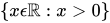
4. Show that with the usual multiplication is not a group.
5. Is there a smallest number of elements a group can contain? If so, what is it?
6. Is there a greatest number of elements a group can contain? If so, what is it?
*7. What is the smallest set which contains the natural numbers and forms a group with the usual multiplication?
*8. Show that the two-sided definition of a group follows from the one-sided definition. (The proofs for the right-sided definition is similar to the left-sided one, so you may choose one or the other here - sorry, but not both)