

Real function/Derivative/Monotonicity/Fact/Proof
Proof
(1). It is enough to prove the statements for increasing functions. If is increasing and , then the difference quotient fulfills


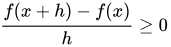
for every with
.
This estimate carries over to the limit as , and this limit is .
Suppose now that the derivative is . We assume, in order to obtain a contradiction, that there exist two points
in with
.
Due to the
mean value theorem,
there exists some with
and


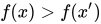


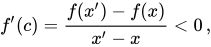
which contradicts the condition.
(2). Suppose now that
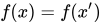
holds with finitely many exceptions. We assume that
holds for two points
.
Since is increasing, due to the first part, it follows that is constant on the interval . But then
on this interval, which contradicts the condition that has only finitely many zeroes.

![{\displaystyle {}[x,x']}](https://wikimedia.org/api/rest_v1/media/math/render/svg/2acf421d83169702fc7a052271ea035d0d599e6e)

