

PlanetPhysics/Homotopy Category
\newcommand{\sqdiagram}[9]{Failed to parse (unknown function "\diagram"): {\displaystyle \diagram #1 \rto^{#2} \dto_{#4}& \eqno{\mbox{#9}}} }
Homotopy category, fundamental groups and fundamental groupoids
[edit | edit source]Let us consider first the category whose objects are topological spaces with a chosen basepoint and whose morphisms are continuous maps that associate the basepoint of to the basepoint of . The fundamental group of specifies a functor , with being the category of groups and group homomorphisms, which is called the fundamental group functor .



Homotopy category
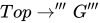
[edit | edit source]Next, when one has a suitably defined relation of homotopy between morphisms, or maps, in a category , one can define the homotopy category as the category whose objects are the same as the objects of , but with morphisms being defined by the homotopy classes of maps; this is in fact the homotopy category of unbased spaces .


Fundamental groups
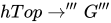
[edit | edit source]We can further require that homotopies on map each basepoint to a corresponding basepoint, thus leading to the definition of the homotopy category of based spaces . Therefore, the fundamental group is a homotopy invariant functor on , with the meaning that the latter functor factors through a functor . A homotopy equivalence in is an isomorphism in . Thus, based homotopy equivalence induces an isomorphism of fundamental groups.

Fundamental groupoid
[edit | edit source]In the general case when one does not choose a basepoint, a fundamental groupoid of a topological space needs to be defined as the category whose objects are the base points of and whose morphisms are the equivalence classes of paths from to .


- Explicitly, the objects of are the points of
- morphisms are homotopy classes of paths "rel endpoints" that is where, denotes homotopy rel endpoints, and,
- composition of morphisms is defined via piecing together, or concatenation, of paths.



Fundamental groupoid functor
[edit | edit source]Therefore, the set of endomorphisms of an object is precisely the fundamental group . One can thus construct the \htmladdnormallink{groupoid {http://planetphysics.us/encyclopedia/GroupoidHomomorphism2.html} of homotopy equivalence classes}; this construction can be then carried out by utilizing functors from the category , or its subcategory , to the \htmladdnormallink{category of groupoids {http://planetphysics.us/encyclopedia/GroupoidCategory4.html} and groupoid homomorphisms}, . One such functor which associates to each topological space its fundamental (homotopy) groupoid is appropriately called the fundamental groupoid functor.


An example: the category of simplicial, or CW-complexes
[edit | edit source]As an important example, one may wish to consider the category of simplicial, or -complexes and homotopy defined for -complexes. Perhaps, the simplest example is that of a one-dimensional -complex, which is a graph. As described above, one can define a functor from the category of graphs, Grph , to and then define the fundamental homotopy groupoids of graphs, hypergraphs, or pseudographs. The case of freely generated graphs (one-dimensional -complexes) is particularly simple and can be computed with a digital computer by a finite algorithm using the finite groupoids associated with such finitely generated -complexes.

Remark
[edit | edit source]Related to this concept of homotopy category for unbased topological spaces, one can then prove the approximation theorem for an arbitrary space by considering a functor and also the construction of an approximation of an arbitrary space as the colimit of a sequence of cellular inclusions of -complexes , so that one obtains .



![{\displaystyle X\equiv colim[X_{i}]}](https://wikimedia.org/api/rest_v1/media/math/render/svg/9e3f33e5e9af7edd9c255cd38e971650eea79484)
Furthermore, the homotopy groups of the -complex are the colimits of the homotopy groups of , and is a group epimorphism.

