The equation for the balance of energy is

If the absence of heat flux or heat sources in the RVE, the equation reduces to

The quantity on the right is the stress power density and is a measure of the internal energy density of the material.
The average stress power in a RVE is defined as
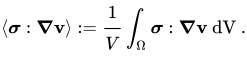
Note that the quantities  and
and  need not be related in the general case.
The average velocity gradient  is defined as
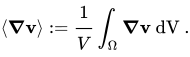
To get an expression for the average stress power in terms of the boundary conditions, we use the identity

to get
![{\displaystyle \langle {\boldsymbol {\sigma }}:{\boldsymbol {\nabla }}\mathbf {v} \rangle ={\cfrac {1}{V}}\int _{\Omega }{\boldsymbol {\sigma }}:{\boldsymbol {\nabla }}\mathbf {v} ~{\text{dV}}={\cfrac {1}{V}}\int _{\Omega }\left[{\boldsymbol {\nabla }}\bullet ({\boldsymbol {\sigma }}^{T}\cdot \mathbf {v} )-({\boldsymbol {\nabla }}\bullet {\boldsymbol {\sigma }})\cdot \mathbf {v} \right]~{\text{dV}}~.}](https://wikimedia.org/api/rest_v1/media/math/render/svg/d22cf3137b65175518e8a533278573492809d469)
Using the balance of linear momentum ( ), we get
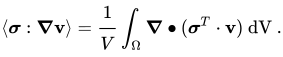
Using the divergence theorem, we have

Now, the surface traction is given by  . Therefore,
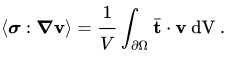
{\scriptsize
}
In micromechanics, it is of interest to see how the average stress power of a RVE is related to the product of the average stress  and the average velocity gradient . While homogenizing a RVE, we would ideally like to have

However, this is not true in general. We can show that if the gradient of the velocity is a symmetric tensor (i.e., there is no spin), then (see Appendix for proof)
![{\displaystyle {\langle {\boldsymbol {\sigma }}:{\boldsymbol {\nabla }}\mathbf {v} \rangle -\langle {\boldsymbol {\sigma }}\rangle :\langle {\boldsymbol {\nabla }}\mathbf {v} \rangle ={\cfrac {1}{V}}\int _{\partial {\Omega }}[\mathbf {v} -\langle {\boldsymbol {\nabla }}\mathbf {v} \rangle \cdot \mathbf {x} ]\cdot [({\boldsymbol {\sigma }}-\langle {\boldsymbol {\sigma }}\rangle )\cdot \mathbf {n} ]~{\text{dA}}~.}}](https://wikimedia.org/api/rest_v1/media/math/render/svg/1440a30417998062deb25a8876f186cdfa719968)
We can arrive at  if either of the following
conditions is met on the boundary
if either of the following
conditions is met on the boundary  :
:
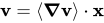 ~.
~.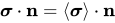 ~.
~.
If the prescribed velocities on are a linear function of
 , then we can write

where  is a constant second-order tensor.
From the divergence theorem
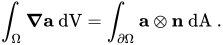
Therefore,

Hence, on the boundary
![{\displaystyle \mathbf {v} -\langle {\boldsymbol {\nabla }}\mathbf {v} \rangle \cdot \mathbf {x} ={\boldsymbol {G}}\cdot \mathbf {x} -\left[{\cfrac {1}{V}}\int _{\partial {\Omega }}({\boldsymbol {G}}\cdot \mathbf {x} )\otimes \mathbf {n} ~{\text{dA}}\right]\cdot \mathbf {x} }](https://wikimedia.org/api/rest_v1/media/math/render/svg/3f0551303921fd242b12f53cf5aedda1bb5693c4)
Using the identity (see Appendix)

and since is constant, we get
![{\displaystyle \mathbf {v} -\langle {\boldsymbol {\nabla }}\mathbf {v} \rangle ^{T}\cdot \mathbf {x} ={\boldsymbol {G}}\cdot \mathbf {x} -\left[{\boldsymbol {G}}\cdot \left({\cfrac {1}{V}}\int _{\partial {\Omega }}\mathbf {x} \otimes \mathbf {n} ~{\text{dA}}\right)\right]\cdot \mathbf {x} ~.}](https://wikimedia.org/api/rest_v1/media/math/render/svg/93c7fe9e1e1b7bdd7e2ca9f632d2e0fc4bc0da38)
From the divergence theorem,

Therefore,

If the prescribed tractions on the boundary are uniform,
they can be expressed in terms of a constant symmetric second-order tensor through the relation

The tractions are related to the stresses at the boundary of the RVE by  .
.
The average stress in the RVE is given by

Using the identity
 (see Appendix),
we have
(see Appendix),
we have
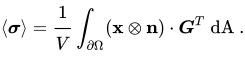
Since is constant and symmetric, we have
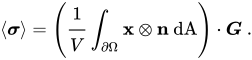
Applying the divergence theorem,

Therefore,

Recall that for small deformations, the displacement gradient  can be expressed as

For small deformations, the time derivative of gives us the velocity gradient , i.e.,

If  , we get

Hence, for small strains and in the absence of rigid body rotations, the stress power density is given by  . Then the average stress power is defined as
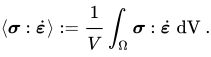
and the average strain rate is defined as
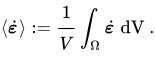
In terms of the surface tractions and the applied boundary velocities, we have
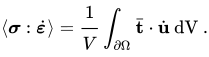
For small strains and no rotation, the stress-power difference relation becomes
![{\displaystyle {\langle {\boldsymbol {\sigma }}:{\dot {\boldsymbol {\varepsilon }}}\rangle -\langle {\boldsymbol {\sigma }}\rangle :\langle {\dot {\boldsymbol {\varepsilon }}}\rangle ={\cfrac {1}{V}}\int _{\partial {\Omega }}[{\dot {\mathbf {u} }}-\langle {\boldsymbol {\nabla }}{\dot {\mathbf {u} }}\rangle \cdot \mathbf {x} ]\cdot [({\boldsymbol {\sigma }}-\langle {\boldsymbol {\sigma }}\rangle )\cdot \mathbf {n} ]~{\text{dA}}~.}}](https://wikimedia.org/api/rest_v1/media/math/render/svg/f7aa0ed2e928f825db24d9631681911d1cbe448c)
We can arrive at  if either of the following conditions is met on the boundary :
 Linear boundary velocity field.
 Uniform boundary tractions.
We can also show in an identical manner that
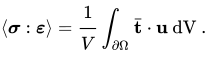
and that, when is symmetric,
![{\displaystyle {\langle {\boldsymbol {\sigma }}:{\boldsymbol {\varepsilon }}\rangle -\langle {\boldsymbol {\sigma }}\rangle :\langle {\boldsymbol {\varepsilon }}\rangle ={\cfrac {1}{V}}\int _{\partial {\Omega }}[\mathbf {u} -\langle {\boldsymbol {\nabla }}\mathbf {u} \rangle \cdot \mathbf {x} ]\cdot [({\boldsymbol {\sigma }}-\langle {\boldsymbol {\sigma }}\rangle )\cdot \mathbf {n} ]~{\text{dA}}~.}}](https://wikimedia.org/api/rest_v1/media/math/render/svg/c7ae7768c9861cfedcfcbed92e15284113b4a6fc)
In this case, we can arrive at the relation  if either of the following conditions is met at the boundary:
 Linear boundary displacement field.
- Uniform boundary tractions.

