The average strain tensor is defined as

where the average displacement gradient is
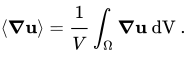
We would like to find the relation between the average strain in a RVE and the applied displacements at the boundary of the RVE. To do that, recall the relation (see Appendix)
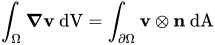
where  is a vector field on
  and
and  is the normal to
  . Using this relation, we get
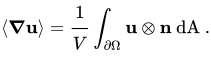
Hence,
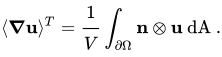
Plugging these into the definition of average strain, we get

This implies that the average strain is completely defined in terms of the applied displacements at the boundary! Also, the average strain tensor is symmetric by virtue of its definition.
We can define the average rotation tensor (which represents an infinitesimal rotation) in an analogous manner. The rotation tensor is given by
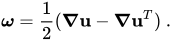
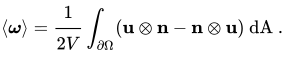
Therefore, the average rotation can be defined as

In terms of the applied boundary displacements,
Let us consider a rigid body displacement given by (see Appendix)

where  is a constant translation and
  is a second-order skew symmetric tensor representing an infinitesimal rotation. Then,

Recall that

where  is a second-order tensor and
  and are vectors. Therefore,

From the divergence theorem,

where is a second-order tensor field and is the unit outward normal vector to . Hence,

We also have (see appendix),
where is a vector and is the unit outward normal to . Therefore,

We then have

Since is a skew-symmetric second-order tensor we have

Therefore,

Hence, the average strain is not affected by rigid body motions. However, for simplicity, we assume that the displacement field in a RVE does not contain any rigid body motions.

