- Exercises
We want to find a rational approximation for the number  , such that the deviation of the true value should be at most
  . How good has to be an approximation for
  such that we obtain the asked for approximation?
Is there any relation between the Din-Norm for paper and square roots?
Compute by hand the approximations  in Heron's method to find the square root of
  with initial value
 .
.
Do the first three steps in Heron's method to compute the square root of
 with initial value
 (so the approximations
  for
for  shall be computed; these numbers have to be given as fractions reduced to lowest terms).
Let
 be a positive real number and let
  be the
Heron-sequenceMDLD/Heron-sequence
for the computation of
be the
Heron-sequenceMDLD/Heron-sequence
for the computation of  with the initial value
 .
Let
.
Let
 ,
,
 ,
,
 and let
  be the Heron-sequence for the computation of
  with initial value
  . Show that
-

holds for all
 .
.
Determine for the sequence
-
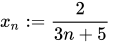
and
-

for which
(minimal)
 the estimate
-

holds.
===Exercise Exercise 7.7
change===
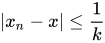
Let be a real sequence. Prove that the sequence converges to  if and only if for all
 a natural number
 exists, such that for all
 the estimation
 holds.
Negate the statement that a sequence  convergesMDLD/converges (R)
in
convergesMDLD/converges (R)
in  to by transforming the quantifiers.
Examine the convergence of the following sequence
-

where
 .
.
Regarding the sequence
 ,
somebody says: "The numerator and the denominator are both going to infinity. However, the denominator is much faster, therefore the sequence converges to
,
somebody says: "The numerator and the denominator are both going to infinity. However, the denominator is much faster, therefore the sequence converges to  “. What do you think about this argument?
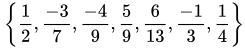
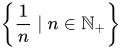
Determine whether the following subsets
 are
boundedMDLD/bounded (R)
or not.
are
boundedMDLD/bounded (R)
or not.
-
 ,
,
-
 ,
,
-
![{\displaystyle {}]{-5},2]}](https://wikimedia.org/api/rest_v1/media/math/render/svg/5f8275b540747bbf9937e8dd9c18990b6e33b92f) ,
,
-
 ,
,
-
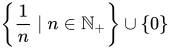 ,
,
-
 ,
,
-
 ,
,
-
 ,
,
-
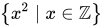 .
.
Let
 be a
real number.MDLD/real number
Show that the sequence
be a
real number.MDLD/real number
Show that the sequence
 is not
bounded.MDLD/bounded (R)
is not
bounded.MDLD/bounded (R)
Let be a null sequence and let be a bounded real sequence. Show that also the product sequence  is a null sequence.
===Exercise Exercise 7.16
change===
Let and be convergent real sequences with
 for all
.
Prove that
for all
.
Prove that
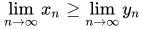 holds.
===Exercise Exercise 7.17
change===
Let  and
and  be three real sequences. Let
 for all
and and be convergent to the same limit
for all
and and be convergent to the same limit  . Prove that also converges to the same limit .
Let
be a convergent sequence of real numbers with limit equal to
. Prove that also the sequence
-

converges, and specifically to

.
Let the sequence be given by
-

- Determine
 and
and  .
.
- Does this sequence converge in
 ?
?
Prove by induction the Binet formula for the Fibonacci numbers. This says that
-
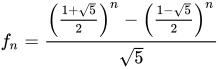
holds
().
- Hand-in-exercises
===Exercise (3 marks) Create referencenumber===
Compute by hand the approximations in Heron's method to find the square root of  with initial value
.
with initial value
.
Write a computer-program
(pseudocode)
for the computation of rational approximations for the square root of a rational number using
Heron's method.MDLD/Heron's method
- The computer has as many memory units as needed, which can contain natural numbers.
- It can compare the content of memory units and can, depending on the outcome, switch to a certain program line.
- It can add the content of two memory units and write the result into another memory unit.
- It can multiply the content of two memory units and write the result into another memory unit.
- It can print contents of memory units and it can print given texts.
The initial configuration is
-

with
 .
Here,
.
Here,  is the number from which we want to compute the square root,
 is the initial value and
  is the wished-for accuracy. The program shall compute and print the Heron-sequence
  (the numerators and denominators are printed successively)
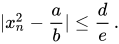
and it shall stop when the member printed last fulfills the property
(the numerators and denominators are printed successively)
and it shall stop when the member printed last fulfills the property
-
Attention! All operations are to be done within
!
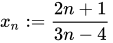
Determine for the sequence
-
and for
-
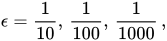
for which
(minimal)
the estimate
-
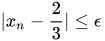
holds.
Let be a
convergentMDLD/convergent (R)
real sequenceMDLD/real sequence
with
limitMDLD/limit (real sequence)
. Show that the sequence defined by
-

also converges to .
Hint: reduce to the case
 .
.
Prove that the real sequence
-

converges to
.
Hint: Find a suitable estimate for

using the binomial theorem.
Let  and
and  be sequences of real numbers and let the sequence
  be defined as
 and
and
 .
Prove that converges if and only if and converge to the same limit.
.
Prove that converges if and only if and converge to the same limit.

