- Exercises
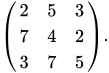
Compute the
characteristic polynomial
of the
matrix
-
Compute the
characteristic polynomial,
the
eigenvalues
and the
eigenspaces
of the matrix
-

over  .
.
Show that the characteristic polynomial of a
linear mapping
 on a
finite-dimensional
on a
finite-dimensional
 -vector space
 is well-defined, that is, independent of the chosen
basis.
is well-defined, that is, independent of the chosen
basis.
Let be a
field
and let  denote an
 -matrix
over . Show that for every
-matrix
over . Show that for every
 ,
the relation
,
the relation
-

holds.[1]
Let be a field and let be an
-matrix
over . Where can you find the
determinant
of within the
characteristic polynomial
 ?
?
Show that the
characteristic polynomial
of the so-called companion matrix
-
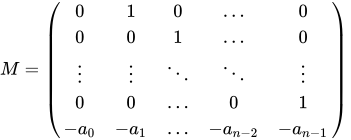
equals
-

We consider the real matrix
-
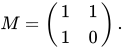
a) Determine
-

for
 .
.
b) Let
-
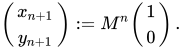
Establish a relation between the sequences  and
and  , and determine a recursive formula for these sequences.
c) Determine the eigenvalues and the eigenvectors of .
Let
-
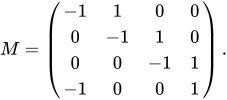
- Determine the
characteristic polynomial
of .
- Determine a zero of the characteristic polynomial of , and write the polynomial using the corresponding linear factor.
- Show that the characteristic polynomial of has at least two real roots.
Let  be a zero of the polynomial
-

Show that
-
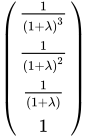
is an
eigenvector
of the matrix
-
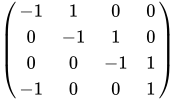
for the
eigenvalue
.
To solve the following exercise, the two exercises above and also
Exercise 24.31
are helpful.
We consider the mapping
-

that assigns to a four tuple  the four tuple
-

Show that there exists a tuple , for that arbitrary iterations of the mapping do never reach the zero tuple.
Determine the eigenvalues and the eigenspaces of the linear mapping
-

given by the matrix
-
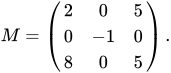
We consider the linear mapping
-

that is given by the matrix
-
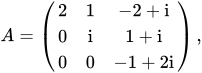
with respect to the standard basis.
a) Determine the characteristic polynomial and the eigenvalues of  .
.
b) Compute, for every eigenvalue, an eigenvector.
c) Establish a matrix for  with respect to a basis of eigenvectors.
Let
-
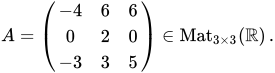
Compute:
- the eigenvalues of ;
- the corresponding eigenspaces;
- the geometric and algebraic multiplicities of each eigenvalue;
- a matrix
 such that
  is a diagonal matrix.
Determine the
eigenspace
and the
geometric multiplicity
for  of the matrix
-
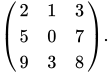
Show that the
matrix
-

is
diagonalizable
over  .
.
Let
 be a
matrix
with
be a
matrix
with  (pairwise)
different
eigenvalues.
Show that the
determinant
of is the product of the eigenvalues.
(pairwise)
different
eigenvalues.
Show that the
determinant
of is the product of the eigenvalues.
Let be a field,
 and
and
 numbers with
 .
Give an example of an
-matrix
, such that
.
Give an example of an
-matrix
, such that  is an
eigenvalue
for with
algebraic multiplicity
and
geometric multiplicity
is an
eigenvalue
for with
algebraic multiplicity
and
geometric multiplicity
 .
.
Determine, which of the following elementary-geometric mappings are linear, which are diagonalizable and which are trigonalizable.
- The reflection in the plane, given by the line
 as axis.
- The translation with the vector
 .
.
- The rotation by
 degree counter-clockwise around the origin.
- The reflection with
 as center.
Determine, whether the real matrix
-
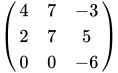
is
trigonalizable
or not.
Suppose that a
linear mapping
-
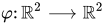
is given by the
matrix
-

with respect to the
standard basis.
Find a
basis,
such that is described by the matrix
-

with respect to this basis.
The next exercises use the following definition.
Let
a
linear mapping
on a
-vector space
over a field . Show the following properties.
- The
zero space
 is
-invariant.
is
-invariant.
- is -invariant.
- Eigenspaces
are -invariant.
- Let
 be
-invariant linear subspaces. Then also
be
-invariant linear subspaces. Then also  and
and  are -invariant.
- Let
 be a -invariant linear subspace. Then also the
image space
be a -invariant linear subspace. Then also the
image space
 and the
preimage space
and the
preimage space
 are -invariant.
Let
a
linear mapping
on a
-vector space
over a field , and let
 .
Show that the smallest
-invariant linear subspace
of that contains
.
Show that the smallest
-invariant linear subspace
of that contains  , equals
-

Let
a
linear mapping
on a
-vector space
over a field . Show that the subset of , defined by
-

is an
-invariant linear subspace.
Let
be a
linear mapping
on a
-vector space
. Let  be a
basis
of , such that is described, with respect to this basis, by an
upper triangular matrix.
Show that the
linear subspaces
be a
basis
of , such that is described, with respect to this basis, by an
upper triangular matrix.
Show that the
linear subspaces
-

are
-invariant
for every  .
.
Determine, whether the real matrix
-
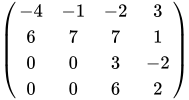
is
trigonalizable
or not.
- Hand-in-exercises
Compute the
characteristic polynomial
of the
matrix
-

Compute the
characteristic polynomial,
the
eigenvalues
and the
eigenspaces
of the matrix
-

over .
Let
-

be a
linear mapping.
Show that has at least one
eigenvector.
Let
-
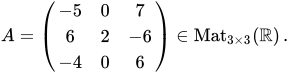
Compute:
- the eigenvalues of ;
- the corresponding eigenspaces;
- the geometric and algebraic multiplicities of each eigenvalue;
- a matrix
such that is a diagonal matrix.
Determine for every
 the
algebraic
and
geometric
multiplicities for the
matrix
the
algebraic
and
geometric
multiplicities for the
matrix
-
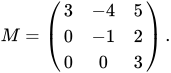
Decide whether the
matrix
-

is
trigonalizable
over  .
.
Determine whether the real matrix
-
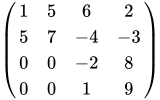
is
trigonalizable
or not.
- Footnotes
- ↑ The main difficulty might be here to recognize that there is indeed something to show.



