- Exercises
Write in  the vector
-

as a linear combination of the vectors
-

Write in  the vector
-

as a
linear combination
of the vectors
-

Let  be a
field,
and let
be a
field,
and let  be a
-vector space.
Show that the following statements hold.
be a
-vector space.
Show that the following statements hold.
- For a family
 ,
,  ,
of elements in ,
linear span
is a
linear subspace
of .
,
of elements in ,
linear span
is a
linear subspace
of .
- The family
, ,
is a spanning system of if and only if
-

Let be a
field,
and let be a
-vector space.
Let
, ,
be a family of vectors in and
 ,
,  ,
another family of vectors in . Then, for the
spanned linear subspaces,
the inclusion
,
another family of vectors in . Then, for the
spanned linear subspaces,
the inclusion
 holds, if and only if
 holds for all
.
holds for all
.
Let be a
field,
and let be a
-vector space.
Let ,
,
be a family of vectors in , and let
 be another vector. Assume that the family
-

is a system of generators of , and that  is a linear combination of the ,
.
Prove that also ,
,
is a system of generators of .
is a linear combination of the ,
.
Prove that also ,
,
is a system of generators of .
We consider in  the
linear subspaces
the
linear subspaces
-
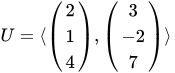
and
-
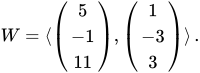
Show that
 .
.
Show that the three vectors
-
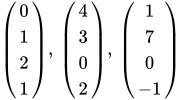
in  are
linearly independent.
are
linearly independent.
Find, for the vectors
-
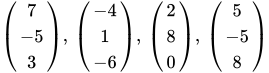
in , a non-trivial representation of the zero-vector.
Give an example of three vectors in  such that each two of them is linearly independent, but all three vectors together are linearly dependent.
Let be a field, let be a -vector space and let
, ,
be a family of vectors in . Prove the following facts.
- If the family is linearly independent, then for each subset
 ,
also the family
,
,
also the family
,  is linearly independent.
- The empty family is linearly independent.
- If the family contains the null vector, then it is not linearly independent.
- If a vector appears several times in the family, then the family is not linearly independent.
- A vector
 is linearly independent if and only if
 .
.
- Two vectors
and
 are linearly independent if and only if is not a scalar multiple of and vice versa.
Let be a field, let be a -vector space, and let
,
be a family of vectors in . Let
 ,
be a family of elements
,
be a family of elements  in . Prove that the family
, ,
is linearly independent
(a system of generators of , a basis of ),
if and only if the same holds for the family
in . Prove that the family
, ,
is linearly independent
(a system of generators of , a basis of ),
if and only if the same holds for the family
 , .
, .
Determine a basis for the solution space of the linear equation
-

Determine a basis for the solution space of the linear system of equations
-

Prove that in , the three vectors
-
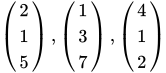
are a basis.
Establish if in the two vectors
-
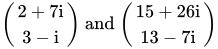
form a basis.
Let be a field. Find a linear system of equations in three variables, whose solution space is exactly
-
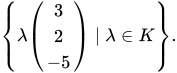
Let be a field, and let
-
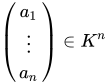
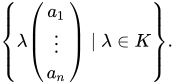
be a nonzero vector. Find a linear system of equations in  variables with
  equations, whose solution space is exactly
-
Let be a field, and let be a -vector space of dimension
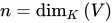 .
Suppose that vectors
.
Suppose that vectors  in are given. Prove that the following facts are equivalent.
- form a basis for .
- form a system of generators for .
- are linearly independent.
Let be a field, and let ![{\displaystyle {}K[X]}](https://wikimedia.org/api/rest_v1/media/math/render/svg/7861df9df3d7463835d927c4d0d4c27f5e2f8416) denote the
polynomial ring
over . Let
denote the
polynomial ring
over . Let
 .
Show that the set of all polynomials of degree
.
Show that the set of all polynomials of degree  is a
finite-dimensional
linear subspace
of . What is its
dimension?
is a
finite-dimensional
linear subspace
of . What is its
dimension?
Show that the set of all real
polynomials
of
degree
 , which have a zero for
  and for
  , form a
finite-dimensional
linear subspace
in
, form a
finite-dimensional
linear subspace
in ![{\displaystyle {}\mathbb {R} [X]}](https://wikimedia.org/api/rest_v1/media/math/render/svg/52a170b822ae65cbe9d1cb122f493fcd88305b7f) . Determine its
dimension.
. Determine its
dimension.
Let be a field, and let
and  be two finite-dimensional vector spaces with
-

and
-

What is the dimension of the Cartesian product  ?
?
Let be a finite-dimensional vector space over the complex numbers, and let be a basis of . Prove that the family of vectors
-

form a basis for , considered as a real vector space.
Let be a
finite field
with  elements, and let be an
-dimensional
vector space.
Let
elements, and let be an
-dimensional
vector space.
Let  be an enumeration
(without repetitions)
of the elements from . After how many elements can we be sure that these form a
generating system
of .
be an enumeration
(without repetitions)
of the elements from . After how many elements can we be sure that these form a
generating system
of .
- Hand-in-exercises
Write in the vector
-

as a linear combination of the vectors
-

Prove that it cannot be expressed as a linear combination of two of the three vectors.
We consider in  the
linear subspaces
the
linear subspaces
-
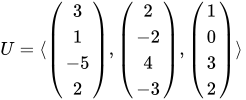
and
-
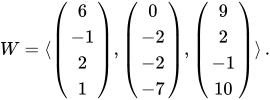
Show that
.
Establish if in the three vectors
-

form a basis.
Establish if in the two vectors
-
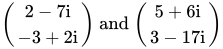
form a basis.
Let  be the -dimensional standard vector space over
  , and let
 be a family of vectors. Prove that this family is a -basis of if and only if the same family, considered as a family in
  , is a
  -basis of .
Show that the set of all real
polynomials
of
degree
 , which have a zero at
  , at
, at  and at
  , is a
finite-dimensional
subspace
of . Determine the
dimension
of this vector space.
, is a
finite-dimensional
subspace
of . Determine the
dimension
of this vector space.
Let be a field, and let be a -vector space. Let  be a family of vectors in , and let
-

be the
linear subspace
they span. Prove that the family is linearly independent if and only if the dimension of  is exactly
  .
.

