- Warm-up-exercises
Determine the Taylor polynomial of degree  of the function
-

at the zero point.
Determine all the Taylor polynomials of the function
-

at the point
 .
.
Let 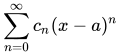 be a convergent power series. Determine the derivatives
  .
.
Let
![{\displaystyle {}p\in \mathbb {R} [Y]}](https://wikimedia.org/api/rest_v1/media/math/render/svg/c31604bad592d5f545212100558efcdb81e66835) be a polynomial and
be a polynomial and
-

Prove that the derivative  has also the shape
-
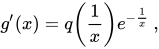
where  is a polynomial.
We consider the function
-

Prove that for all
 the
the  -th derivative
  satisfies the following property
-

Determine the Taylor series of the function
-

at point
 up to order (Give also the Taylor polynomial of degree at point
  , where the coefficients must be stated in the most simple form).
Determine the Taylor polynomial of degree  of the function
-

at point
-

Let
-

be a differentiable function with the property
-

Prove that
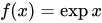 for all
 .
.
Determine the Taylor polynomial up to fourth order of the inverse of the sine function at the point  with the power series approach described in
an remark.
with the power series approach described in
an remark.
- Hand-in-exercises
Find the Taylor polynomials in up to degree of the function
-

Discuss the behavior of the function
-
![{\displaystyle f\colon [0,2\pi ]\longrightarrow \mathbb {R} ,x\longmapsto f(x)=\sin x\cos x,}](https://wikimedia.org/api/rest_v1/media/math/render/svg/0634f89c847364eaa6f2a291345fa99a4bfde03a)
concerning zeros, growth behavior, (local) extrema. Sketch the graph of the function.
Discuss the behavior of the function
-
![{\displaystyle f\colon [-{\frac {\pi }{2}},{\frac {\pi }{2}}]\longrightarrow \mathbb {R} ,x\longmapsto f(x)=\sin ^{3}x-{\frac {1}{4}}\sin x,}](https://wikimedia.org/api/rest_v1/media/math/render/svg/6d7713929cf399cf4357dc45d82dc22e71615529)
concerning zeros, growth behavior, (local) extrema. Sketch the graph of the function.
Determine the Taylor polynomial up to fourth order of the natural logarithm at point  with the power series approach described in
remark
from the power series of the exponential function.
with the power series approach described in
remark
from the power series of the exponential function.
For
 let
let  be the area of a circle inscribed in the unit regular -gon. Prove that
 .
.

