Proof
Since we want
 ,
and since a
linear mapping
respects all
linear combinations,
that is
,
and since a
linear mapping
respects all
linear combinations,
that is
-
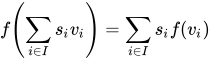
holds, and since every vector
 is such a linear combination, there can exist at most one such linear mapping.
We define now a
mapping
-

in the following way: we write every vector
with the given basis as
-

(where
 for almost all
 )
and define
)
and define
-

Since the representation of  as such a
linear combination
is unique, this mapping is well-defined. Also,
is clear.
as such a
linear combination
is unique, this mapping is well-defined. Also,
is clear.
Linearity. For two vectors
 and
and  ,
we have
,
we have
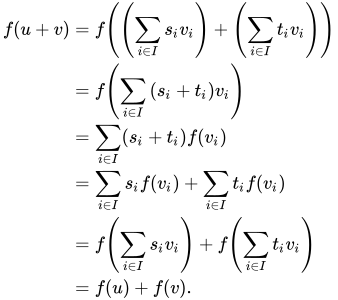
The compatibility with scalar multiplication is shown in a similar way, see
exercise.

