

Linear algebra (Osnabrück 2024-2025)/Part I/Lecture 3/refcontrol
- Groups
In linear algebra, we work in general over a fixed base field . The most important field for us is the field of real numbers , which we have already used and which is introduced in analysis in an axiomatic way. A field is characterized by the existence of two binary operations fulfilling certain properties, namely addition and multiplication. Both these operations (for multiplication, one has to remove ) are instances of an important algebraic structure: a group.


A set together with a special element and with a binary operationMDLD/binary operation


is called a group when the following properties are fulfilled.
- The binary operation is associative, i.e., for all
,
we have
- The element is a neutral element, i.e., for all
,
we have
- For every
,
there exists an inverse element, i.e., there exists some
such that







A group is called commutative if the operation is commutative. Important examples for commutative groups are , , or with the componentwise zero


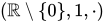


and componentwise addition.
In a group , the neutral element is uniquely determined. For if is another element fulfilling the characteristic property of the neutral element, meaning



for all , then we can directly deduce


Let be a group.MDLD/group Then, for every , the element fulfilling


Let
and

Then we have


Abstract structures like a set, a mapping, a binary operation, or a group have a double life. On one hand, they are really just the given formal structure; the elements are just some elements in a somehow given set, a binary operation is just any binary operation, and one should not imagine anything concrete. The symbols chosen are arbitrary and without any meaning. On the other hand, these abstract structures gain a second life in that many concrete mathematical structures obey the abstract properties. These concrete structures are examples or models for the abstract structure (and they are also a motivation to introduce the abstract structure). Both viewpoints are important, and one should always try not to confuse them.
Group theory is a branch of mathematics on its own, which we will not develop here systematically. Instead, we work with rings, and in particular with fields.
- Rings
A set is called a ring if there are two binary operationsMDLD/binary operations (called addition and multiplication)


and two elements that fulfill the following properties.

- Axioms for the addition:
- Associative law: holds for all .
- Commutative law: holds for all .
- is the neutral element of the addition, i.e., holds for all .
- Existence of the negative: For every , there exists an element with .
- Axioms of the multiplication:
- Associative law: holds for all .
- is the neutral element for the multiplication, i.e., holds for all .
- Distributive law: holds for all .









For us, the most important commutative rings are the set of integer numbers , the rational numbers , and the real numbers . The real numbers (and the rational numbers) with their natural operations fulfill all these axioms, as should be known from school. An axiomatic reasoning is possible, but we will not do this here. With its addition, a ring (forgetting the multiplicative structure) is in particular a commutative group.


In a ring, we use the convention that multiplication ties stronger than addition. Therefore, we write instead of . To simplify further the notation, we omit the product symbol. The special elements and in a ring are called the null element and the unit. For , we call the (according to Lemma 3.2 ) uniquely determined element fulfilling the negative of and denote it by . We have , since shows that the element equals the uniquely determined negative of . We write instead of and call this a difference. Hence, the difference is not a basic operation but is defined as the addition with the negative element.

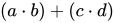


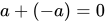


The following properties are familiar for the real numbers; we prove them using only the axioms of a ring. So they hold for any ring.

- (annihilation rule).
(rules for sign).
- (general law of distributivity).




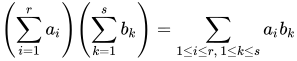
In the noncommutative case, we only proof one half of the statements.
- We have . Subtracting (meaning addition with the negative of ) on both sides gives the claim.
due to part (1). Therefore, is the (uniquely determined) negative of .
- Due to (2), we have , and because of (which holds in every group), we get the claim.
- This follows from the parts proved so far.
- This follows with a double induction.






- Fields
A large part of linear algebra might be worked out over an arbitrary commutative ring, but that needs many more additional concepts. In this course, we will work over a field.
A commutative ringMDLD/commutative ring is called a field if
and if every element different from has a multiplicative inverse.
In all details, this means the following:
A set is called a field if there are two binary operationsMDLD/binary operations (called addition and multiplication)

and two different elements that fulfill the following properties.

- Axioms for the addition:
- Associative law: holds for all .
- Commutative law: holds for all .
- is the neutral element of the addition, i.e., holds for all .
- Existence of the negative: For every , there exists an element with .
- Axioms of the multiplication:
- Associative law: holds for all .
- Commutative law: holds for all .
- is the neutral element for the multiplication, i.e., holds for all .
- Existence of the inverse: For every with , there exists an element such that .
- Distributive law: holds for all .


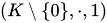
The properties described in Lemma 3.5 for rings (and the conventions) hold in particular for fields. Using the concept of a group, we may say that a field is a set with two binary operations and and two fixed elements , such that and are commutative groups,[1] and that the distributivity law holds.


For an element and a natural number , we define to be the -fold sum of with itself. Here we put . For


we also write simply or just . This means that we can find every natural number in every field (also in every ring). However, this assignment is not necessarily injective, and it is possible that or holds in a field (see the examples below). For a negative integer , we set



where denotes the negative of in the field. Due to Exercise 3.23 , everything fits well together. For example, one may consider as the -fold sum of with itself, or as the product of and , where this means the -fold sum of with itself.


Due to Lemma 3.2 , we know that for every , , the element fulfilling is unique. It is called the inverse of and denoted by .


For , , we write


The terms on the left are abbreviations for the term on the right.
For a field element and , we denote its -th power by ; this is defined as the -fold product of with itself ( is the number of factors). Moreover, we set , and, for and a negative integer , we interpret as .


A "strange“ field is given in the following example. This field with two elements is important in computer science and in coding theory; it will not play a big role here. It shows that it is not helpful for every field to imagine its elements on the number line.
== Example Example 3.8
change==
We are trying to find the structure of a fieldMDLD/structure of a field on the set . If is supposed to be the neutral element of the addition and the neutral element of the multiplication, then everything is already determined: The equation must hold since has an inverse element with respect to the addition, and since holds, due to Lemma 3.5 (1). Hence, the operation tables look like


and
With some tedious computations, one can check that this is indeed a field.
== Example Example 3.9
change==
On the set (with seven elements), one can define a fieldMDLD/field structure using



Without any further theory, it is very tedious to so show that this is indeed a field.
Let denote a field. Then implies that or
.


We prove this by contradiction, so we assume that and are both not . Then there exist inverse elements and , and hence . On the other hand, we have by the premise, and so the annihilation rule gives





hence , which contradicts the field properties.

- Footnotes
- ↑ This implies in particular that the multiplication can be restricted to give a binary operation on . This follows from the field axioms, as we will see below.

| << | Linear algebra (Osnabrück 2024-2025)/Part I | >> PDF-version of this lecture Exercise sheet for this lecture (PDF) |
|---|