

Linear algebra (Osnabrück 2024-2025)/Part I/Lecture 28
- A decomposition theorem
Let

denote a trigonalizable -endomorphism on the finite-dimensional -vector space . Then there exists a decomposition



where is diagonalizable and is nilpotent, and where



Due to Lemma 26.14 , we have

where the are the generalized eigenspaces for the eigenvalues , and we have



with . Let


denote the composition , that is, is in particular a projection. We set



This mapping is obviously diagonalizable, on it is the multiplication with . Sei

The property of this mapping of being nilpotent can be checked on the separately. There, we have

so this is nilpotent. Moreover, and commute, since induces the identity on and on , , the zero mapping. Therefore, also the direct sums of those commute, and hence also and commute. Thus, and commute.




Under the conditions given in the theorem, this decomposition is even unique.
An endomorphism
on a -vector space is called unipotent, if we can write

with some nilpotent mapping
.
For a unipotent mapping, the diagonalizable part in the sense of the canonical decomposition is simple, it is just the identity.
- Jordan normal form


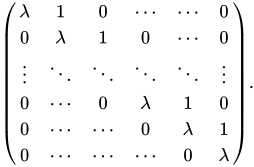
If we consider such a Jordan matrix as a linear mapping on the standard space , then


In particular, is a eigenvector to the eigenvalue . A simple observation shows that there is no further eigenvector linearly independent to (see Exercise 28.22 ). The property on the right is equivalent with the condition[2]


for . The eigenvector is a generating element of the kernel of the mapping , and the other standard vectors arise successively as preimages of under .




A square matrix of the form

where each is a Jordan matrix, is called a matrix in
Jordan normal form.
The Jordan matrices occurring here are called the Jordan blocks of the matrix. Their eigenvalues might be different or equal. In the matrix

there are three Jordan blocks,

with eigenvalues and again .


We state and prove now the theorem about the Jordan normal form for trigonalizable endomorphisms.
For every trigonalizable endomorphism
on a finite-dimensional -vector space , there exists a basis, such that the describing matrix is in
Jordan normal form.Since is trigonalizable, we can apply Lemma 26.14 . Hence, there exists a direct sum decomposition

where the generalized eigenspaces are -invariant. Looking at the situation for each generalized eigenspace, we may assume that has only one eigenvalue , and that

holds. Then,

is nilpotent. Therefore, because of Fact *****, there exists a basis such that is described by a matrix of the form

where the equal or equal . With respect to this basis,



has the form

Hence, every upper triangular matrix is similar to a matrix in Jordan normal form. Over the complex numbers, every matrix can be brought to Jordan normal form. If a matrix has Jordan normal form, then we can read of directly the diagonalizable and the nilpotent part in the sense of
Theorem 28.1
:
The diagonal yields the diagonalizable part, and the entries which are strictly above the diagonal, yield the nilpotent part
(in general, this is not true for upper triangular matrices).
We describe how to find to a linear trigonalizable mapping a basis, such that describing matrix with respect to this basis is in Jordan normal form. For this, we determine, for every eigenvalue , the minimal exponent with



This kernel is the generalized eigenspace to . We set

for . This yields the chain


Now, we choose a vector from . The vectors


form a basis for a Jordan block. If this basis generates the generalized eigenspace, then we are done. Otherwise, we look in for another vector which is linearly independent to and to . Again, we add this vector and all its successive images. If is exhausted, then we look whether is already covered, and so on. If the generalized eigenspace to is covered, then we continue with the next eigenvalue.


Under certain circumstances, we can also start with a basis of the eigenspace. If, for example, the eigenspace to is one-dimensional, then we can choose an eigenvector for , and we can find successively preimages under of the vectors, that is, we have to solve the equation


then

etc.
If, for example, the eigenspace is -dimensional and the generalized eigenspace is -dimensional, then we only have to find a preimage for one eigenvector under .


We consider the matrix

and want to bring it to Jordan normal form. bringen. The vector is an eigenvector to the eigenvalue . We have
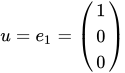
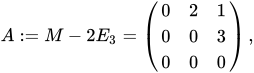
so that there exists no further linearly independent eigenvector. We look at the linear system . This imples (looking at the second row) and so (we can choose freely to be ). Hence, we set . Finally, we need a solution for . This yields the equation . The matrix acts as


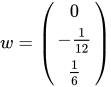


so that the mapping is described with respect to the basis by


This matrix is a Jordan matrix and, in particular, in Jordan normal form.
We consider the matrix
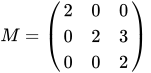
and want to bring it to Jordan normal form. The vectors and are linearly independent eigenvectors to the eigenvalue . We have
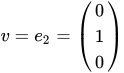
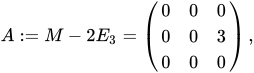
so that and span this eigenspace. An eigenvector must be the image of some vector under the matrix . In fact, the linear system


has the solution . Therefore, the matrix acts in the following way


Hence, the mapping is described, with respect to the basis , by the matrix

This matrix is in Jordan normal form with the Jordan blocks and .


We consider the matrix
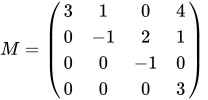
and want to bring in in Jordan normal for. Here, we have two eigenvalues and, therefore, two two-dimensional generalized eigenspaces, which we treat separately. We have
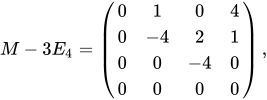
therefore, belongs to the kernel. The determinant of the upper right submatrix is not , so the rank of the matrix is , and its kernel is one-dimensional. The second power is
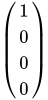

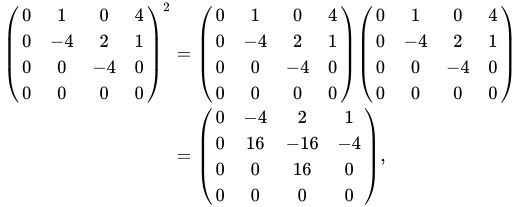
a new element of the kernel is . Thus, we have
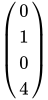

Because of

we can use the vectors and to establish the first Jordan block.
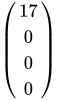
We have
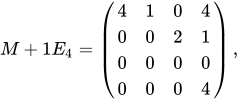
therefore, belongs to the kernel. The rank of this matrix is again , and the kernel has dimension one. The second power is
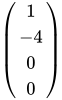
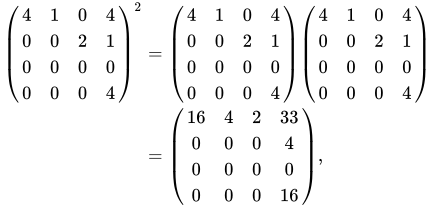
a new element in the kernel is . Thus, we have
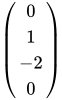

Because of

we can use the vectors and to establish the second Jordan block. Altogether, the linear mapping defined by has, with respect the basis

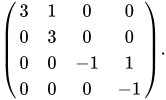
- Endomorphisms with finite order
In Lemma 24.11 , we have seen that permutation matrices over are diagonalizable. This is true over for all endomorphisms of finite order.

Every invertible matrix of finite order is
diagonalizable.
The matrix is trigonalizable and can be brought, due to Theorem 28.5 , into Jordan normal form. We show that the Jordan blocks
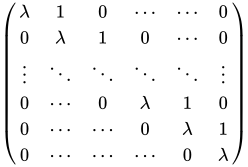
are trivial. Because of the finite order, is a root of unity. By multiplying with , we can assume that we have a matrix of the form

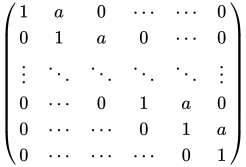
(with ). If this is not an -matrix, then there exist two vectors , where is an eigenvector and where is sent to . The -th iteration of the matrix sends to , and this is never , contradicting the property of being of finite order.


- Footnotes
- ↑ Some authors define a Jordan matrix one where the are below the diagonal.
- ↑ In the context of trigonalizable mappings and in order to find the Jordan normal form, it is useful to work with instead of .


| << | Linear algebra (Osnabrück 2024-2025)/Part I | >> PDF-version of this lecture Exercise sheet for this lecture (PDF) |
|---|