- Exercise for the break
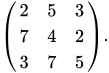
Compute the
characteristic polynomial
of the
matrix
-
- Exercises
Determine the characteristic polynomial and the eigenvalues of the linear mapping
-
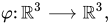
given by the matrix
-

with respect to the standard basis.
Let  be a
field
and let
be a
field
and let  denote an
 -matrix
over . Show that for every
-matrix
over . Show that for every
 ,
the relation
,
the relation
-

holds.[1]
Let be a field and let be an
-matrix
over . Where can you find the
determinant
of within the
characteristic polynomial
 ?
?
Let be a
field,
and let denote an
-matrix
over . How can we find the  in the
characteristic polynomial
?
in the
characteristic polynomial
?
Determine the
characteristic polynomial
of a matrix
-

What is the relevance of the coefficients of this polynomial?
Determine the
characteristic polynomial
of a matrix
-
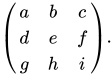
What is the relevance of the coefficients of this polynomial?
Compute the
characteristic polynomial
of the matrix
-
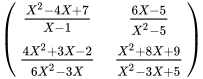
over the
field of rational functions
 .
.
Compute the
characteristic polynomial,
the
eigenvalues
and the
eigenspaces
of the matrix
-

over  .
.
Determine the
characteristic polynomial,
the
eigenvalues,
and the
eigenspaces
of the
matrix
-
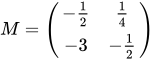
over .
Determine the eigenvalues and the eigenspaces of the linear mapping
-

given by the matrix
-
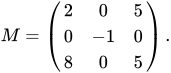
We consider the linear mapping
-

that is given by the matrix
-
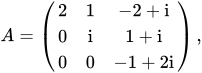
with respect to the standard basis.
a) Determine the characteristic polynomial and the eigenvalues of  .
.
b) Compute, for every eigenvalue, an eigenvector.
c) Establish a matrix for  with respect to a basis of eigenvectors.
Let
-
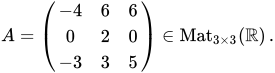
Compute:
- the eigenvalues of ;
- the corresponding eigenspaces;
- the geometric and algebraic multiplicities of each eigenvalue;
- a matrix
 such that
  is a diagonal matrix.
Let
-
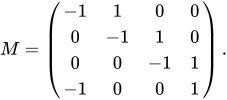
- Determine the
characteristic polynomial
of .
- Determine a zero of the characteristic polynomial of , and write the polynomial using the corresponding linear factor.
- Show that the characteristic polynomial of has at least two real roots.
Let  be a zero of the polynomial
-

Show that
-
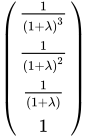
is an
eigenvector
of the matrix
-
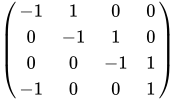
for the
eigenvalue
.
To solve the following exercise, besides the preceding exercises also
Exercise 10.16
is helpful.
We consider the mapping
-

that assigns to a four tuple  the four tuple
-

Show that there exists a tuple , for that arbitrary iterations of the mapping do never reach the zero tuple.
Let be a
field,
and let denote an
-matrix
over with the property, that the
characteristic polynomial
splits into linear factors, that is,
-

Show that
-

Let be the
field with two elements,
we consider the
matrix
-

over . Show that the
characteristic polynomial
is not the zero polynomial, but that
-

holds for all
.
Show that a square matrix and its
transposed matrix
have the same
characteristic polynomial.
What is wrong in the following argumentation:
"For two
-matrices
 , the
characteristic polynomials
fulfill the relation
, the
characteristic polynomials
fulfill the relation
-

This is because, by definition, we have
-

where the equation in the middle rests on the multiplication theorem for determinants“.
Let be an
-matrix,
with the
characteristic polynomial
-

Determine the characteristic polynomial of the scaled matrix  ,
,
 .
.
Let be a field,
 and
and
 numbers with
 .
Give an example of an
-matrix
, such that
.
Give an example of an
-matrix
, such that  is an
eigenvalue
for with
algebraic multiplicity
is an
eigenvalue
for with
algebraic multiplicity
 and
geometric multiplicity
and
geometric multiplicity
 .
.
Let
 be a
field extension.
Let an
-matrix
over be given. Show that the
characteristic polynomial
be a
field extension.
Let an
-matrix
over be given. Show that the
characteristic polynomial
![{\displaystyle {}\chi _{M}\in K[X]}](https://wikimedia.org/api/rest_v1/media/math/render/svg/d7761d915bc61465d1d173c6000c3cf9ff1e3782) coincides with the characteristic polynomial of , considered as a matrix over
coincides with the characteristic polynomial of , considered as a matrix over  .
.
Show that the characteristic polynomial of a
linear mapping
 on a
finite-dimensional
-vector space
on a
finite-dimensional
-vector space
 is well-defined, that is, independent of the chosen
basis.
is well-defined, that is, independent of the chosen
basis.
Let be a
finite-dimensional
-vector space, and let
 .
Show that the following statements are equivalent:
.
Show that the following statements are equivalent:
- The linear mapping is an isomorphism.
 is not an eigenvalue of .
- The constant term of the characteristic polynomial
 is
is  .
.
Let
-

be an
endomorphism
on a
finite-dimensional
-vector space
, and let
an
eigenvalue
of . Show that is also an eigenvalue of the
dual mapping
-

We consider the real matrix
-
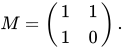
a) Determine
-

for
 .
.
b) Let
-
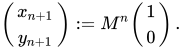
Establish a relation between the sequences  and
and  , and determine a recursive formula for these sequences.
c) Determine the eigenvalues and the eigenvectors of .
Let denote a
field,
and let denote a
-vector space
of finite dimension. Let
-
be a
linear mapping.
Suppose that the
characteristic polynomial
factors into different
linear factors.
Show that is
diagonalizable.
Let
a
linear mapping
on a
-vector space
over a field . Show the following properties.
- The
zero space
 is
-invariant.
is
-invariant.
- is -invariant.
- Eigenspaces
are -invariant.
- Let
 be
-invariant linear subspaces. Then also
be
-invariant linear subspaces. Then also  and
and  are -invariant.
- Let
 be a -invariant linear subspace. Then also the
image space
be a -invariant linear subspace. Then also the
image space
 and the
preimage space
and the
preimage space
 are -invariant.
Let
a
linear mapping
on a
-vector space
over a field , and let
 .
Show that the smallest
-invariant linear subspace
of that contains
.
Show that the smallest
-invariant linear subspace
of that contains  , equals
-

Let be a
field,
let be a
-vector space,
and let
-
a
linear mapping. Let
be a
-invariant linear subspace
of . Show that, for a polynomial
![{\displaystyle {}P\in K[X]}](https://wikimedia.org/api/rest_v1/media/math/render/svg/4692e3ffcbd66e900f8975113ff3f32f1cabc21a) ,
the space
,
the space  is also
  -invariant.
Let
be a
linear mapping
on a
-vector space
. Let  be a
basis
of , such that is described, with respect to this basis, by an
upper triangular matrix.
Show that the
linear subspaces
be a
basis
of , such that is described, with respect to this basis, by an
upper triangular matrix.
Show that the
linear subspaces
-

are
-invariant
for every  .
.
Let
a
linear mapping
on a
-vector space
over a field . Show that the subset of , defined by
-

is an
-invariant linear subspace.
Let
be a
linear mapping
on a
finite-dimensional
-vector space
. Let
 .
Show that there exists an
invariant linear subspace
of dimension
.
Show that there exists an
invariant linear subspace
of dimension  , if and only if there exists a
basis
of such that the
describing matrix
of , with respect to this basis, has the form
, if and only if there exists a
basis
of such that the
describing matrix
of , with respect to this basis, has the form
-

Let
be a
linear mapping
on the
finite-dimensional
-vector space
. Let
.
Show that there exists a
direct sum decomposition
 into
invariant linear subspaces
into
invariant linear subspaces
 of dimension and
  , if and only if there exists a
basis
of such that the
describing matrix
of with respect to this basis has the form
, if and only if there exists a
basis
of such that the
describing matrix
of with respect to this basis has the form
-

Let be a
finite-dimensional
-vector space,
and
a
linear subspace.
Show that
-

is, with the natural addition and multiplication of endomorphisms, a
ring,
and a
linear subspace
of  . Determine the
dimension
of this space.
. Determine the
dimension
of this space.
- Hand-in-exercises
Compute the
characteristic polynomial
of the
matrix
-

Compute the
characteristic polynomial,
the
eigenvalues
and the
eigenspaces
of the matrix
-

over .
Let
-
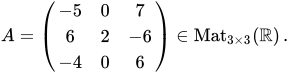
Compute:
- the eigenvalues of ;
- the corresponding eigenspaces;
- the geometric and algebraic multiplicities of each eigenvalue;
- a matrix
such that is a diagonal matrix.
Determine for every
 the
algebraic
and
geometric
multiplicities for the
matrix
the
algebraic
and
geometric
multiplicities for the
matrix
-
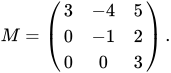
Show that the
characteristic polynomial
of the so-called companion matrix
-
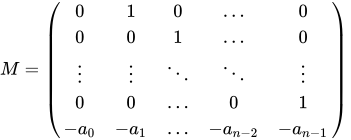
equals
-

Let
-

be a
linear mapping.
Show that has at least one
eigenvector.
- Footnotes
- ↑ The main difficulty might be here to recognize that there is indeed something to show.

