Proof
(1). We write
 and
and  respectively with the objects which were formulated in
fact,
that is
respectively with the objects which were formulated in
fact,
that is
-

and
-

Summing up yields
-

Here, the sum  is again continuous in
  , with value
  .
.
(2). We start again with
-
and
-

and multiply both equations. This yields

Due to
fact
for
limits,
the expression consisting of the last six summands is a continuous function, with value for
 .
.
(3) follows from (2), since a constant function is differentiable with derivative .
(4). We have
-
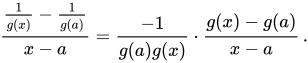
Since is continuous in , due to
fact,
the left-hand factor converges for  to
to  , and because of the differentiability of in , the right-hand factor converges to
  .
.
(5) follows from (2) and (4).

