The balance of linear momentum can be expressed as:
        ρ


                v

              ˙


        −

          ∇

        ∙

          σ

        −
        ρ


          b

        =
        0


    {\displaystyle \rho ~{\dot {\mathbf {v} }}-{\boldsymbol {\nabla }}\bullet {\boldsymbol {\sigma }}-\rho ~\mathbf {b} =0}
where
ρ
(
x
,
t
)
{\displaystyle \rho (\mathbf {x} ,t)}
v
(
x
,
t
)
{\displaystyle \mathbf {v} (\mathbf {x} ,t)}
σ
(
x
,
t
)
{\displaystyle {\boldsymbol {\sigma }}(\mathbf {x} ,t)}
ρ
b
{\displaystyle \rho ~\mathbf {b} }
Recall the general equation for the balance of a physical quantity
d
d
t
[
∫
Ω
f
(
x
,
t
)
dV
]
=
∫
∂
Ω
f
(
x
,
t
)
[
u
n
(
x
,
t
)
−
v
(
x
,
t
)
⋅
n
(
x
,
t
)
]
dA
+
∫
∂
Ω
g
(
x
,
t
)
dA
+
∫
Ω
h
(
x
,
t
)
dV
.
{\displaystyle {\cfrac {d}{dt}}\left[\int _{\Omega }f(\mathbf {x} ,t)~{\text{dV}}\right]=\int _{\partial {\Omega }}f(\mathbf {x} ,t)[u_{n}(\mathbf {x} ,t)-\mathbf {v} (\mathbf {x} ,t)\cdot \mathbf {n} (\mathbf {x} ,t)]~{\text{dA}}+\int _{\partial {\Omega }}g(\mathbf {x} ,t)~{\text{dA}}+\int _{\Omega }h(\mathbf {x} ,t)~{\text{dV}}~.}
In this case the physical quantity of interest is the momentum density,
i.e.,
f
(
x
,
t
)
=
ρ
(
x
,
t
)
v
(
x
,
t
)
{\displaystyle f(\mathbf {x} ,t)=\rho (\mathbf {x} ,t)~\mathbf {v} (\mathbf {x} ,t)}
g
(
x
,
t
)
=
t
{\displaystyle g(\mathbf {x} ,t)=\mathbf {t} }
h
(
x
,
t
)
=
ρ
(
x
,
t
)
b
(
x
,
t
)
{\displaystyle h(\mathbf {x} ,t)=\rho (\mathbf {x} ,t)~\mathbf {b} (\mathbf {x} ,t)}
d
d
t
[
∫
Ω
ρ
v
dV
]
=
∫
∂
Ω
ρ
v
[
u
n
−
v
⋅
n
]
dA
+
∫
∂
Ω
t
dA
+
∫
Ω
ρ
b
dV
.
{\displaystyle {\cfrac {d}{dt}}\left[\int _{\Omega }\rho ~\mathbf {v} ~{\text{dV}}\right]=\int _{\partial {\Omega }}\rho ~\mathbf {v} [u_{n}-\mathbf {v} \cdot \mathbf {n} ]~{\text{dA}}+\int _{\partial {\Omega }}\mathbf {t} ~{\text{dA}}+\int _{\Omega }\rho ~\mathbf {b} ~{\text{dV}}~.}
The surface tractions are related to the Cauchy stress by
t
=
σ
⋅
n
.
{\displaystyle \mathbf {t} ={\boldsymbol {\sigma }}\cdot \mathbf {n} ~.}
Therefore,
d
d
t
[
∫
Ω
ρ
v
dV
]
=
∫
∂
Ω
ρ
v
[
u
n
−
v
⋅
n
]
dA
+
∫
∂
Ω
σ
⋅
n
dA
+
∫
Ω
ρ
b
dV
.
{\displaystyle {\cfrac {d}{dt}}\left[\int _{\Omega }\rho ~\mathbf {v} ~{\text{dV}}\right]=\int _{\partial {\Omega }}\rho ~\mathbf {v} [u_{n}-\mathbf {v} \cdot \mathbf {n} ]~{\text{dA}}+\int _{\partial {\Omega }}{\boldsymbol {\sigma }}\cdot \mathbf {n} ~{\text{dA}}+\int _{\Omega }\rho ~\mathbf {b} ~{\text{dV}}~.}
Let us assume that
Ω
{\displaystyle \Omega }
∫
Ω
∂
∂
t
(
ρ
v
)
dV
=
−
∫
∂
Ω
ρ
v
(
v
⋅
n
)
dA
+
∫
∂
Ω
σ
⋅
n
dA
+
∫
Ω
ρ
b
dV
.
{\displaystyle \int _{\Omega }{\frac {\partial }{\partial t}}(\rho ~\mathbf {v} )~{\text{dV}}=-\int _{\partial {\Omega }}\rho ~\mathbf {v} ~(\mathbf {v} \cdot \mathbf {n} )~{\text{dA}}+\int _{\partial {\Omega }}{\boldsymbol {\sigma }}\cdot \mathbf {n} ~{\text{dA}}+\int _{\Omega }\rho ~\mathbf {b} ~{\text{dV}}~.}
Now, from the definition of the tensor product we have (for all vectors
a
{\displaystyle \mathbf {a} }
(
u
⊗
v
)
⋅
a
=
(
a
⋅
v
)
u
.
{\displaystyle (\mathbf {u} \otimes \mathbf {v} )\cdot \mathbf {a} =(\mathbf {a} \cdot \mathbf {v} )~\mathbf {u} ~.}
Therefore,
∫
Ω
∂
∂
t
(
ρ
v
)
dV
=
−
∫
∂
Ω
ρ
(
v
⊗
v
)
⋅
n
dA
+
∫
∂
Ω
σ
⋅
n
dA
+
∫
Ω
ρ
b
dV
.
{\displaystyle \int _{\Omega }{\frac {\partial }{\partial t}}(\rho ~\mathbf {v} )~{\text{dV}}=-\int _{\partial {\Omega }}\rho ~(\mathbf {v} \otimes \mathbf {v} )\cdot \mathbf {n} ~{\text{dA}}+\int _{\partial {\Omega }}{\boldsymbol {\sigma }}\cdot \mathbf {n} ~{\text{dA}}+\int _{\Omega }\rho ~\mathbf {b} ~{\text{dV}}~.}
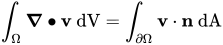
Using the divergence theorem
∫
Ω
∇
∙
v
dV
=
∫
∂
Ω
v
⋅
n
dA
{\displaystyle \int _{\Omega }{\boldsymbol {\nabla }}\bullet \mathbf {v} ~{\text{dV}}=\int _{\partial {\Omega }}\mathbf {v} \cdot \mathbf {n} ~{\text{dA}}}
we have
∫
Ω
∂
∂
t
(
ρ
v
)
dV
=
−
∫
Ω
∇
∙
[
ρ
(
v
⊗
v
)
]
dV
+
∫
Ω
∇
∙
σ
dV
+
∫
Ω
ρ
b
dV
{\displaystyle \int _{\Omega }{\frac {\partial }{\partial t}}(\rho ~\mathbf {v} )~{\text{dV}}=-\int _{\Omega }{\boldsymbol {\nabla }}\bullet [\rho ~(\mathbf {v} \otimes \mathbf {v} )]~{\text{dV}}+\int _{\Omega }{\boldsymbol {\nabla }}\bullet {\boldsymbol {\sigma }}~{\text{dV}}+\int _{\Omega }\rho ~\mathbf {b} ~{\text{dV}}}
or,
∫
Ω
[
∂
∂
t
(
ρ
v
)
+
∇
∙
[
(
ρ
v
)
⊗
v
)
]
−
∇
∙
σ
−
ρ
b
]
dV
=
0
.
{\displaystyle \int _{\Omega }\left[{\frac {\partial }{\partial t}}(\rho ~\mathbf {v} )+{\boldsymbol {\nabla }}\bullet [(\rho ~\mathbf {v} )\otimes \mathbf {v} )]-{\boldsymbol {\nabla }}\bullet {\boldsymbol {\sigma }}-\rho ~\mathbf {b} \right]~{\text{dV}}=0~.}
Since
Ω
{\displaystyle \Omega }
∂
∂
t
(
ρ
v
)
+
∇
∙
[
(
ρ
v
)
⊗
v
)
]
−
∇
∙
σ
−
ρ
b
=
0
.
{\displaystyle {\frac {\partial }{\partial t}}(\rho ~\mathbf {v} )+{\boldsymbol {\nabla }}\bullet [(\rho ~\mathbf {v} )\otimes \mathbf {v} )]-{\boldsymbol {\nabla }}\bullet {\boldsymbol {\sigma }}-\rho ~\mathbf {b} =0~.}
Using the identity
∇
∙
(
u
⊗
v
)
=
(
∇
∙
v
)
u
+
(
∇
u
)
⋅
v
{\displaystyle {\boldsymbol {\nabla }}\bullet (\mathbf {u} \otimes \mathbf {v} )=({\boldsymbol {\nabla }}\bullet \mathbf {v} )\mathbf {u} +({\boldsymbol {\nabla }}\mathbf {u} )\cdot \mathbf {v} }
we get
∂
ρ
∂
t
v
+
ρ
∂
v
∂
t
+
(
∇
∙
v
)
(
ρ
v
)
+
∇
(
ρ
v
)
⋅
v
−
∇
∙
σ
−
ρ
b
=
0
{\displaystyle {\frac {\partial \rho }{\partial t}}~\mathbf {v} +\rho ~{\frac {\partial \mathbf {v} }{\partial t}}+({\boldsymbol {\nabla }}\bullet \mathbf {v} )(\rho \mathbf {v} )+{\boldsymbol {\nabla }}(\rho ~\mathbf {v} )\cdot \mathbf {v} -{\boldsymbol {\nabla }}\bullet {\boldsymbol {\sigma }}-\rho ~\mathbf {b} =0}
or,
[
∂
ρ
∂
t
+
ρ
∇
∙
v
]
v
+
ρ
∂
v
∂
t
+
∇
(
ρ
v
)
⋅
v
−
∇
∙
σ
−
ρ
b
=
0
{\displaystyle \left[{\frac {\partial \rho }{\partial t}}+\rho ~{\boldsymbol {\nabla }}\bullet \mathbf {v} \right]\mathbf {v} +\rho ~{\frac {\partial \mathbf {v} }{\partial t}}+{\boldsymbol {\nabla }}(\rho ~\mathbf {v} )\cdot \mathbf {v} -{\boldsymbol {\nabla }}\bullet {\boldsymbol {\sigma }}-\rho ~\mathbf {b} =0}
Using the identity
∇
(
φ
v
)
=
φ
∇
v
+
v
⊗
(
∇
φ
)
{\displaystyle {\boldsymbol {\nabla }}(\varphi ~\mathbf {v} )=\varphi ~{\boldsymbol {\nabla }}\mathbf {v} +\mathbf {v} \otimes ({\boldsymbol {\nabla }}\varphi )}
we get
[
∂
ρ
∂
t
+
ρ
∇
∙
v
]
v
+
ρ
∂
v
∂
t
+
[
ρ
∇
v
+
v
⊗
(
∇
ρ
)
]
⋅
v
−
∇
∙
σ
−
ρ
b
=
0
{\displaystyle \left[{\frac {\partial \rho }{\partial t}}+\rho ~{\boldsymbol {\nabla }}\bullet \mathbf {v} \right]\mathbf {v} +\rho ~{\frac {\partial \mathbf {v} }{\partial t}}+\left[\rho ~{\boldsymbol {\nabla }}\mathbf {v} +\mathbf {v} \otimes ({\boldsymbol {\nabla }}\rho )\right]\cdot \mathbf {v} -{\boldsymbol {\nabla }}\bullet {\boldsymbol {\sigma }}-\rho ~\mathbf {b} =0}
From the definition
(
u
⊗
v
)
⋅
a
=
(
a
⋅
v
)
u
{\displaystyle (\mathbf {u} \otimes \mathbf {v} )\cdot \mathbf {a} =(\mathbf {a} \cdot \mathbf {v} )~\mathbf {u} }
we have
[
v
⊗
(
∇
ρ
)
]
⋅
v
=
[
v
⋅
(
∇
ρ
)
]
v
.
{\displaystyle [\mathbf {v} \otimes ({\boldsymbol {\nabla }}\rho )]\cdot \mathbf {v} =[\mathbf {v} \cdot ({\boldsymbol {\nabla }}\rho )]~\mathbf {v} ~.}
Hence,
[
∂
ρ
∂
t
+
ρ
∇
∙
v
]
v
+
ρ
∂
v
∂
t
+
ρ
∇
v
⋅
v
+
[
v
⋅
(
∇
ρ
)
]
v
−
∇
∙
σ
−
ρ
b
=
0
{\displaystyle \left[{\frac {\partial \rho }{\partial t}}+\rho ~{\boldsymbol {\nabla }}\bullet \mathbf {v} \right]\mathbf {v} +\rho ~{\frac {\partial \mathbf {v} }{\partial t}}+\rho ~{\boldsymbol {\nabla }}\mathbf {v} \cdot \mathbf {v} +[\mathbf {v} \cdot ({\boldsymbol {\nabla }}\rho )]~\mathbf {v} -{\boldsymbol {\nabla }}\bullet {\boldsymbol {\sigma }}-\rho ~\mathbf {b} =0}
or,
[
∂
ρ
∂
t
+
∇
ρ
⋅
v
+
ρ
∇
∙
v
]
v
+
ρ
∂
v
∂
t
+
ρ
∇
v
⋅
v
−
∇
∙
σ
−
ρ
b
=
0
.
{\displaystyle \left[{\frac {\partial \rho }{\partial t}}+{\boldsymbol {\nabla }}\rho \cdot \mathbf {v} +\rho ~{\boldsymbol {\nabla }}\bullet \mathbf {v} \right]\mathbf {v} +\rho ~{\frac {\partial \mathbf {v} }{\partial t}}+\rho ~{\boldsymbol {\nabla }}\mathbf {v} \cdot \mathbf {v} -{\boldsymbol {\nabla }}\bullet {\boldsymbol {\sigma }}-\rho ~\mathbf {b} =0~.}
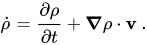
The material time derivative of
ρ
{\displaystyle \rho }
ρ
˙
=
∂
ρ
∂
t
+
∇
ρ
⋅
v
.
{\displaystyle {\dot {\rho }}={\frac {\partial \rho }{\partial t}}+{\boldsymbol {\nabla }}\rho \cdot \mathbf {v} ~.}
Therefore,
[
ρ
˙
+
ρ
∇
∙
v
]
v
+
ρ
∂
v
∂
t
+
ρ
∇
v
⋅
v
−
∇
∙
σ
−
ρ
b
=
0
.
{\displaystyle \left[{\dot {\rho }}+\rho ~{\boldsymbol {\nabla }}\bullet \mathbf {v} \right]\mathbf {v} +\rho ~{\frac {\partial \mathbf {v} }{\partial t}}+\rho ~{\boldsymbol {\nabla }}\mathbf {v} \cdot \mathbf {v} -{\boldsymbol {\nabla }}\bullet {\boldsymbol {\sigma }}-\rho ~\mathbf {b} =0~.}
From the balance of mass, we have
ρ
˙
+
ρ
∇
∙
v
=
0
.
{\displaystyle {\dot {\rho }}+\rho ~{\boldsymbol {\nabla }}\bullet \mathbf {v} =0~.}
Therefore,
ρ
∂
v
∂
t
+
ρ
∇
v
⋅
v
−
∇
∙
σ
−
ρ
b
=
0
.
{\displaystyle \rho ~{\frac {\partial \mathbf {v} }{\partial t}}+\rho ~{\boldsymbol {\nabla }}\mathbf {v} \cdot \mathbf {v} -{\boldsymbol {\nabla }}\bullet {\boldsymbol {\sigma }}-\rho ~\mathbf {b} =0~.}
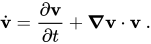
The material time derivative of
v
{\displaystyle \mathbf {v} }
v
˙
=
∂
v
∂
t
+
∇
v
⋅
v
.
{\displaystyle {\dot {\mathbf {v} }}={\frac {\partial \mathbf {v} }{\partial t}}+{\boldsymbol {\nabla }}\mathbf {v} \cdot \mathbf {v} ~.}
Hence,
ρ
v
˙
−
∇
∙
σ
−
ρ
b
=
0
.
{\displaystyle {\rho ~{\dot {\mathbf {v} }}-{\boldsymbol {\nabla }}\bullet {\boldsymbol {\sigma }}-\rho ~\mathbf {b} =0~.}}





![{\displaystyle {\cfrac {d}{dt}}\left[\int _{\Omega }f(\mathbf {x} ,t)~{\text{dV}}\right]=\int _{\partial {\Omega }}f(\mathbf {x} ,t)[u_{n}(\mathbf {x} ,t)-\mathbf {v} (\mathbf {x} ,t)\cdot \mathbf {n} (\mathbf {x} ,t)]~{\text{dA}}+\int _{\partial {\Omega }}g(\mathbf {x} ,t)~{\text{dA}}+\int _{\Omega }h(\mathbf {x} ,t)~{\text{dV}}~.}](https://wikimedia.org/api/rest_v1/media/math/render/svg/fcb120ab19e9001d85370ccb115c509cec72cf33)



![{\displaystyle {\cfrac {d}{dt}}\left[\int _{\Omega }\rho ~\mathbf {v} ~{\text{dV}}\right]=\int _{\partial {\Omega }}\rho ~\mathbf {v} [u_{n}-\mathbf {v} \cdot \mathbf {n} ]~{\text{dA}}+\int _{\partial {\Omega }}\mathbf {t} ~{\text{dA}}+\int _{\Omega }\rho ~\mathbf {b} ~{\text{dV}}~.}](https://wikimedia.org/api/rest_v1/media/math/render/svg/a46f11b5cfa9b04cb07575c7f4e042233fcce4d6)

![{\displaystyle {\cfrac {d}{dt}}\left[\int _{\Omega }\rho ~\mathbf {v} ~{\text{dV}}\right]=\int _{\partial {\Omega }}\rho ~\mathbf {v} [u_{n}-\mathbf {v} \cdot \mathbf {n} ]~{\text{dA}}+\int _{\partial {\Omega }}{\boldsymbol {\sigma }}\cdot \mathbf {n} ~{\text{dA}}+\int _{\Omega }\rho ~\mathbf {b} ~{\text{dV}}~.}](https://wikimedia.org/api/rest_v1/media/math/render/svg/adc3ef27ffa5e65209e677c035ea62b0e9cf1bb4)





![{\displaystyle \int _{\Omega }{\frac {\partial }{\partial t}}(\rho ~\mathbf {v} )~{\text{dV}}=-\int _{\Omega }{\boldsymbol {\nabla }}\bullet [\rho ~(\mathbf {v} \otimes \mathbf {v} )]~{\text{dV}}+\int _{\Omega }{\boldsymbol {\nabla }}\bullet {\boldsymbol {\sigma }}~{\text{dV}}+\int _{\Omega }\rho ~\mathbf {b} ~{\text{dV}}}](https://wikimedia.org/api/rest_v1/media/math/render/svg/34f59a0faa78bd490f4b097fe1846bee54252d62)
![{\displaystyle \int _{\Omega }\left[{\frac {\partial }{\partial t}}(\rho ~\mathbf {v} )+{\boldsymbol {\nabla }}\bullet [(\rho ~\mathbf {v} )\otimes \mathbf {v} )]-{\boldsymbol {\nabla }}\bullet {\boldsymbol {\sigma }}-\rho ~\mathbf {b} \right]~{\text{dV}}=0~.}](https://wikimedia.org/api/rest_v1/media/math/render/svg/03c321bc67c81041e73677bfadbe98c206a18988)
![{\displaystyle {\frac {\partial }{\partial t}}(\rho ~\mathbf {v} )+{\boldsymbol {\nabla }}\bullet [(\rho ~\mathbf {v} )\otimes \mathbf {v} )]-{\boldsymbol {\nabla }}\bullet {\boldsymbol {\sigma }}-\rho ~\mathbf {b} =0~.}](https://wikimedia.org/api/rest_v1/media/math/render/svg/615dfb89380d7157ae3c429c3eff733eacf30c58)


![{\displaystyle \left[{\frac {\partial \rho }{\partial t}}+\rho ~{\boldsymbol {\nabla }}\bullet \mathbf {v} \right]\mathbf {v} +\rho ~{\frac {\partial \mathbf {v} }{\partial t}}+{\boldsymbol {\nabla }}(\rho ~\mathbf {v} )\cdot \mathbf {v} -{\boldsymbol {\nabla }}\bullet {\boldsymbol {\sigma }}-\rho ~\mathbf {b} =0}](https://wikimedia.org/api/rest_v1/media/math/render/svg/1c6a6d133032adf207945ec955ca922476fa4de2)

![{\displaystyle \left[{\frac {\partial \rho }{\partial t}}+\rho ~{\boldsymbol {\nabla }}\bullet \mathbf {v} \right]\mathbf {v} +\rho ~{\frac {\partial \mathbf {v} }{\partial t}}+\left[\rho ~{\boldsymbol {\nabla }}\mathbf {v} +\mathbf {v} \otimes ({\boldsymbol {\nabla }}\rho )\right]\cdot \mathbf {v} -{\boldsymbol {\nabla }}\bullet {\boldsymbol {\sigma }}-\rho ~\mathbf {b} =0}](https://wikimedia.org/api/rest_v1/media/math/render/svg/d8f4634efd67549ed2d10b81b08fc879960a230b)

![{\displaystyle [\mathbf {v} \otimes ({\boldsymbol {\nabla }}\rho )]\cdot \mathbf {v} =[\mathbf {v} \cdot ({\boldsymbol {\nabla }}\rho )]~\mathbf {v} ~.}](https://wikimedia.org/api/rest_v1/media/math/render/svg/d51ffdfa1c0eef65a6d11cc792f7e0c9195e9412)
![{\displaystyle \left[{\frac {\partial \rho }{\partial t}}+\rho ~{\boldsymbol {\nabla }}\bullet \mathbf {v} \right]\mathbf {v} +\rho ~{\frac {\partial \mathbf {v} }{\partial t}}+\rho ~{\boldsymbol {\nabla }}\mathbf {v} \cdot \mathbf {v} +[\mathbf {v} \cdot ({\boldsymbol {\nabla }}\rho )]~\mathbf {v} -{\boldsymbol {\nabla }}\bullet {\boldsymbol {\sigma }}-\rho ~\mathbf {b} =0}](https://wikimedia.org/api/rest_v1/media/math/render/svg/9020d02391b4cbf5edfcfc6c8ab79644a13835de)
![{\displaystyle \left[{\frac {\partial \rho }{\partial t}}+{\boldsymbol {\nabla }}\rho \cdot \mathbf {v} +\rho ~{\boldsymbol {\nabla }}\bullet \mathbf {v} \right]\mathbf {v} +\rho ~{\frac {\partial \mathbf {v} }{\partial t}}+\rho ~{\boldsymbol {\nabla }}\mathbf {v} \cdot \mathbf {v} -{\boldsymbol {\nabla }}\bullet {\boldsymbol {\sigma }}-\rho ~\mathbf {b} =0~.}](https://wikimedia.org/api/rest_v1/media/math/render/svg/13599a24b1ac883c0ed676882f088c9209f86b41)

![{\displaystyle \left[{\dot {\rho }}+\rho ~{\boldsymbol {\nabla }}\bullet \mathbf {v} \right]\mathbf {v} +\rho ~{\frac {\partial \mathbf {v} }{\partial t}}+\rho ~{\boldsymbol {\nabla }}\mathbf {v} \cdot \mathbf {v} -{\boldsymbol {\nabla }}\bullet {\boldsymbol {\sigma }}-\rho ~\mathbf {b} =0~.}](https://wikimedia.org/api/rest_v1/media/math/render/svg/c4484bb80e35493fc3a7c3978fc27e937c0c2aeb)