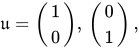
We consider in  the
standard basis,
the
standard basis,
-
and the basis
-
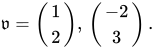
The basis vectors of  can be expressed directly with the standard basis, namely
-

Therefore, we get immediately
-
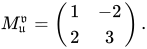
For example, the vector that has the
coordinates
 with respect to , has the coordinates
-

with respect to the standard basis  . The transformation matrix
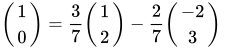
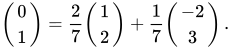
  is more difficult to compute. We have to write the standard vectors as
linear combinations
of
is more difficult to compute. We have to write the standard vectors as
linear combinations
of
 and
and  .
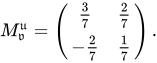
A direct computation
(solving two linear systems)
yields
.
A direct computation
(solving two linear systems)
yields
-
and
-
Hence,
-