

Four-force
Four-force (4-force) is a four-vector, considered as a relativistic generalization of the classical 3-vector of force to the four-dimensional spacetime. As in classical mechanics, the 4-force can be defined in two ways. The first one measures the change in the energy and momentum of a particle per unit of proper time. The second method introduces force characteristics – strengths of field, and with their help in certain energy and momentum of the particle is calculated 4-force acting on the particle in the field. The equality of 4-forces produced by these methods, gives the equation of motion of the particle in the given force field.
In special relativity 4-force is the derivative of 4-momentum with respect to the proper time of the particle: [1]


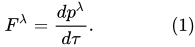
For a particle with constant invariant mass m > 0, , where is 4-velocity. This allows connecting 4-force with four-acceleration similarly to Newton's second law:


- ,

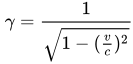
Given is the classic 3-vector of the particle velocity; is the Lorentz factor;

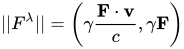
![{\displaystyle ~{\mathbf {F} }={d \over dt}\left(\gamma m{\mathbf {v} }\right)={d\mathbf {p} \over dt}=\gamma m\left(\mathbf {a} +\gamma ^{2}{\frac {\left(\mathbf {v} \cdot \mathbf {a} \right)}{c^{2}}}\mathbf {v} \right)=m\gamma ^{3}\left(\mathbf {a} +{\frac {\mathbf {v} \times [\mathbf {v} \times \mathbf {a} ]}{c^{2}}}\right)}](https://wikimedia.org/api/rest_v1/media/math/render/svg/8d0e1aba6593e87d2e91df2759bbc6e380e6f71b)
is the 3-vector of force, [2]
is the 3-vector of relativistic momentum, is the 3-acceleration,


- ,

is the relativistic energy.

In general relativity, the 4-force is determined by the covariant derivative of 4-momentum with respect to the proper time: [3]
- ,

where are the Christoffel symbols.

Examples
[edit | edit source]4-force acting in the electromagnetic field on the particle with electric charge , is expressed as follows:

- ,
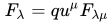
where is the electromagnetic tensor,

|
|
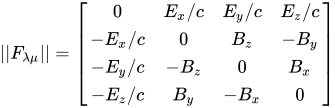
is the 4-velocity.

The density of 4-force
[edit | edit source]To describe liquid and extended media, in which we must find forces in different points in space, instead of 4-vector of force 4-vector of force density is used, acting locally on a small volume unit of the medium:
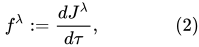
where is the mass 4-current, is the mass density in the rest reference frame relative to the matter.


In the special theory of relativity, the relations hold:
- ,

- ,
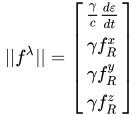
where is 3-vector of force density, is 3-vector of mass current, is the density of relativistic energy.
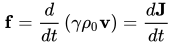


If we integrate (2) over the invariant volume of the matter unit, measured in the co-moving reference frame, we obtain the expression for 4-force (1):

This formula and determination of the four-force density through the mass four-current when taking into account the fields acting in the system require correction, since they do not contain an additional contribution from the four-momenta of the fields themselves. [4]

Four-force in CTG
[edit | edit source]If the particle is in the gravitational field, then according to the covariant theory of gravitation (CTG) gravitational 4-force equals:
- ,

where is the gravitational tensor, which is expressed through the gravitational field strength and the gravitational torsion field, is 4-momentum with lower (covariant) index, and particle mass includes contributions from the mass-energy of fields associated with the matter of the particle.


In CTG gravitational tensor with covariant indices is determined directly, and for transition to the tensor with contravariant indices in the usual way the metric tensor is used which is in general a function of time and coordinates:


Therefore the 4-force , which depends on the metric tensor through , also becomes a function of the metric. At the same time, the definition of 4-force with covariant index does not require knowledge of the metric:


In the covariant theory of gravitation 4-vector of force density is described with the help of acceleration field: [5] [6] [7]

where is the acceleration stress-energy tensor with mixed indices, is acceleration tensor, and the 4-potential of the acceleration field is expressed in terms of the scalar potential and the vector potential :


In the expression (3) the operator of proper-time-derivative is used, which generalizes the material derivative (substantial derivative) to the curved spacetime. [2]
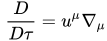
If there are only gravitational and electromagnetic forces and pressure force, then the following expression is valid:

where is the 4-vector of electromagnetic current density (4-current), is the density of electric charge of the matter unit in its rest reference frame, is the pressure field tensor, is the gravitational stress-energy tensor, is the electromagnetic stress-energy tensor, is the pressure stress-energy tensor.


In some cases, instead of the mass 4-current the quantity is used, where is the density of the moving matter in an arbitrary reference frame. The quantity is not a 4-vector, since the mass density is not an invariant quantity in coordinate transformations. After integrating over the moving volume of the matter unit due to the relations and we obtain:





For inertial reference systems in the last expression we can bring beyond the integral sign. This gives 4-force for these frames of reference:

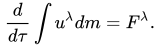
However, in addition to the momentum of particles, moving matter also has the momentum of the field associated with the matter, which requires a more general definition of four-momentum and four-force. [8]
In general relativity, it is believed that the stress-energy tensor of matter is determined by the expression , and for it , that is the quantity consists of four timelike components of this tensor. The integral of these components over the moving volume gives respectively the energy (up to the constant, equal to ) and the momentum of the matter unit. However, such a solution is valid only in approximation of inertial motion, as shown above. In addition, according to the findings in the article, [9] the integration of timelike components of the stress-energy tensor for energy and momentum of a system in general is not true and leads to paradoxes such as the problem of 4/3 for the gravitational and electromagnetic fields.
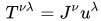


Instead of it, in the covariant theory of gravitation 4-momentum containing the energy and momentum is derived by the variation of the Lagrangian of the system and not from the stress-energy tensors.
Components of 4-force density
[edit | edit source]The expression (4) for 4-force density can be divided into two parts, one of which will describe the bulk density of energy capacity, and the other describe total force density of available fields. We assume that speed of gravity is equal to the speed of light.
In relation (4) we make a transformation:

where denotes interval, is the differential of coordinate time, is the mass density of moving matter, four-dimensional quantity consists of the time component equal to the speed of light , and the spatial component in the form of particle 3-velocity vector .


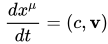
Similarly, we write the charge 4-current through the charge density of moving matter :
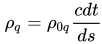

In addition, we express the tensors through their components, that is, the corresponding 3-vectors of the field strengths. Then the time component of the 4-force density with covariant index is:

where is the gravitational field strength, is the electromagnetic field strength, is the pressure field strength.


The spatial component of covariant 4-force is the 3-vector , i.e. 4-force is as


wherein the 3-force density is:
![{\displaystyle ~\mathbf {f} =\rho \mathbf {\Gamma } +\rho [\mathbf {v} \times \mathbf {\Omega } ]+\rho _{q}\mathbf {E} +\rho _{q}[\mathbf {v} \times \mathbf {B} ]+\rho \mathbf {C} +\rho [\mathbf {v} \times \mathbf {I} ],}](https://wikimedia.org/api/rest_v1/media/math/render/svg/193b1d1843d2a468b06f015b8af4587ad4e8a62c)
where is the gravitational torsion field, is the magnetic field, is the solenoidal vector of pressure field.


Expression for the covariant density of the 4-force can be also written in terms of the components of the acceleration tensor. Similarly to (3) we have:

![{\displaystyle ~\mathbf {f} =-\rho \mathbf {S} -\rho [\mathbf {v} \times \mathbf {N} ],}](https://wikimedia.org/api/rest_v1/media/math/render/svg/624b75097ef0701e0a2aeb557affb429fa3045ff)
where is the acceleration field strength, is the acceleration solenoidal vector.


Using the expression for the 4-potential of the accelerations field in terms of the scalar potential and the vector potentials and the definition of material derivative, from (3) and (4) for the scalar and vector components of the equation of motion, we obtain the following:

![{\displaystyle ~{\frac {d\mathbf {U} }{dt}}+\nabla \vartheta -v_{x}\nabla U_{x}-v_{y}\nabla U_{y}-v_{z}\nabla U_{z}=-\mathbf {S} -[\mathbf {v} \times \mathbf {N} ]=\mathbf {\Gamma } +[\mathbf {v} \times \mathbf {\Omega } ]+{\frac {\rho _{0q}}{\rho _{0}}}(\mathbf {E} +[\mathbf {v} \times \mathbf {B} ])+\mathbf {C} +[\mathbf {v} \times \mathbf {I} ].\qquad (6)}](https://wikimedia.org/api/rest_v1/media/math/render/svg/61ee549c8ffa2fc2668a797e64f75e1a60892a74)
Here are the components of the vector potential of the acceleration field, are the components of the velocity of the element of matter or particle.


Equations of the matter’s motion (5) and (6) are obtained in a covariant form and are valid in the curved spacetime. On the left-hand side of these equations there are either potentials or the strength and the solenoidal vector of the acceleration field. The right-hand side of the equations of motion is expressed in terms of the strengths and the solenoidal vectors of the gravitational and electromagnetic fields, as well as the pressure field inside the matter. Before solving these equations of motion, first it is convenient to find the potentials of all the fields with the help of the corresponding wave equations. Next, taking the four-curl of the fields’ four-potentials we can determine the strengths and the solenoidal vectors of all the fields. After substituting them in (5) and (6), it becomes possible to find the relation between the field coefficients, express the acceleration field coefficient, and thus completely determine this field in the matter.
Relationship with the four-acceleration
[edit | edit source]The peculiarity of equations of motion (5) and (6) is that they do not have a direct relationship with the four-acceleration of the matter particle under consideration. However, in some cases it is possible to determine the acceleration and velocity of motion, as well as the dependence of the distance traveled on time. The simplest example is the rectilinear motion of a uniform solid particle in uniform external fields. In this case, the four-potential of the acceleration field fully coincides with the four-velocity of the particle, so that the scalar potential , the vector potential , where is the Lorentz factor of the particle. Substituting the equality in (3) gives the following:


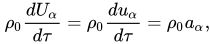

where is defined as the four-acceleration.
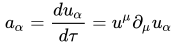
Then the equation for the four-acceleration of the particle follows from (3) and (4):

After multiplying by the particle’s mass, this equation will correspond to equation (1) for the four-force.
In the considered case of motion of a solid particle, the four-acceleration with a covariant index can be expressed in terms of the strength and the solenoidal vector of the acceleration field:
![{\displaystyle ~a_{\alpha }={\frac {cdt}{ds}}\left(-{\frac {1}{c}}\mathbf {S} \cdot \mathbf {v} {,}\qquad \mathbf {S} +[\mathbf {v} \times \mathbf {N} ]\right).}](https://wikimedia.org/api/rest_v1/media/math/render/svg/a6af09ae11d15bf6e0119de75b9cca63dcda41f7)
In special relativity and substituting the vectors and for a particle, for the covariant 4-acceleration we obtain the standard expression:
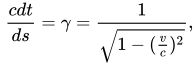


If the mass of the particle is constant, then for the force acting on the particle, we can write:
![{\displaystyle ~\mathbf {F} ={\frac {d\mathbf {p} }{dt}}=m{\frac {d(\gamma \mathbf {v} )}{dt}}=-m\left(\mathbf {S} +[\mathbf {v} \times \mathbf {N} ]\right)=\nabla E+{\frac {\partial \mathbf {p} }{\partial t}}-\mathbf {v} \times [\nabla \times \mathbf {p} ],}](https://wikimedia.org/api/rest_v1/media/math/render/svg/016c28b577978b22539dfa7234353e953f9797ea)
where is the relativistic energy, is the 3-vector of relativistic momentum of the particle.


For a body with a continuous distribution of matter vectors and are substantially different from the corresponding instantaneous vectors of specific particles in the vicinity of the observation point. These vectors represent the averaged value of 4-acceleration inside the bodies. In particular, within the bodies there is a 4-acceleration generated by the various forces in matter. The typical examples are the relativistic uniform system and the space bodies, where the major forces are the force of gravity and the internal pressure generally oppositely directed. Upon rotation of the bodies the 4-force density, 4-acceleration, vectors and are functions not only of the radius, but the distance from the axis of rotation to the point of observation.
In the general case for extended bodies the four-acceleration at each point of the body becomes a certain function of the coordinates and time. As a characteristic of the physical system’s motion we can choose the four-acceleration of the center of momentum, for the evaluation of which it is necessary to integrate the force density over the volume of the entire matter and divide the total force by the inertial mass of the system. Another method involves evaluation of the four-acceleration through the strength and the solenoidal vector of the acceleration field at the center of momentum in the approximation of the special theory of relativity, as was shown above.
See also
[edit | edit source]- Four-vector
- 4-velocity
- 4-acceleration
- 4-momentum
- 4-current
- Acceleration field
- Pressure field
- Equation of vector field
References
[edit | edit source]- ↑ Rindler, Wolfgang (1991). Introduction to Special Relativity (2nd). Oxford: Oxford University Press. ISBN 9780198539520.
- ↑ 2.0 2.1 Fedosin S.G. Fizicheskie teorii i beskonechnaia vlozhennost’ materii. – Perm, 2009, 844 pages, Tabl. 21, Pic. 41, Ref. 289. ISBN 978-5-9901951-1-0. (in Russian).
- ↑ Landau L.D., Lifshitz E.M. (1975). The Classical Theory of Fields. Vol. 2 (4th ed.). Butterworth-Heinemann. ISBN 978-0-750-62768-9.
- ↑ Fedosin S.G. Generalized four-momentum for continuously distributed matter. Preprint, 2019.
- ↑ Fedosin S.G. About the cosmological constant, acceleration field, pressure field and energy. Jordan Journal of Physics. Vol. 9 (No. 1), pp. 1-30 (2016). http://dx.doi.org/10.5281/zenodo.889304.
- ↑ Fedosin S.G. The procedure of finding the stress-energy tensor and vector field equations of any form. Advanced Studies in Theoretical Physics, Vol. 8, No. 18, pp. 771-779 (2014). http://dx.doi.org/10.12988/astp.2014.47101.
- ↑ Fedosin S.G. Equations of Motion in the Theory of Relativistic Vector Fields. International Letters of Chemistry, Physics and Astronomy, Vol. 83, pp. 12-30 (2019). https://doi.org/10.18052/www.scipress.com/ILCPA.83.12.
- ↑ Fedosin S.G. What should we understand by the four-momentum of the physical system? Preprint, 2019.
- ↑ Fedosin S.G. The generalized Poynting theorem for the general field and solution of the 4/3 problem. International Frontier Science Letters, Vol. 14, pp. 19-40 (2019). https://doi.org/10.18052/www.scipress.com/IFSL.14.19.