The content of these notes is based on the lectures by Prof. Graeme W. Milton (University of Utah) given in a course on metamaterials in Spring 2007.
In this lecture we will give a brief description of cloaking in the
context of conductivity. It is useful to start off with a
desciption of some variational principles for electrical conductivity
at this stage.
Suppose that the electrical conductivity
σ
(
x
)
{\displaystyle {\boldsymbol {\sigma }}(\mathbf {x} )}
α
1
≥
σ
(
x
)
≥
β
1
for all
α
,
β
>
0
.
{\displaystyle \alpha ~{\boldsymbol {\mathit {1}}}\geq {\boldsymbol {\sigma }}(\mathbf {x} )\geq \beta ~{\boldsymbol {\mathit {1}}}\qquad {\text{for all}}~~\alpha ,\beta >0~.}
Consider the body (
Ω
{\displaystyle \Omega }
∂
Ω
{\displaystyle \partial \Omega }
Figure 1. Body
Ω
{\displaystyle \Omega }
∂
Ω
{\displaystyle \partial \Omega }
u
=
u
0
{\displaystyle u=u_{0}}
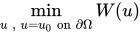
We would like to minimize the power dissipation into heat inside the
body. This statement can be expressed as
min
u
,
u
=
u
0
o
n
∂
Ω
W
(
u
)
{\displaystyle \min _{u~,~u=u_{0}~{\rm {{on}~\partial \Omega }}}W(u)}
where
W
(
u
)
=
∫
Ω
∇
u
⋅
σ
⋅
∇
u
d
Ω
.
{\displaystyle W(u)=\int _{\Omega }{\boldsymbol {\nabla }}u\cdot {\boldsymbol {\sigma }}\cdot {\boldsymbol {\nabla }}u~{\text{d}}\Omega ~.}
Now consider a variation
v
{\displaystyle v}
v
=
0
{\displaystyle v=0}
∂
Ω
{\displaystyle \partial \Omega }
δ
{\displaystyle \delta }
W
(
u
+
δ
v
)
=
∫
Ω
∇
(
u
+
δ
v
)
⋅
σ
⋅
∇
(
u
+
δ
v
)
d
Ω
=
∫
Ω
∇
u
⋅
σ
⋅
∇
u
d
Ω
+
2
δ
∫
Ω
∇
v
⋅
σ
⋅
∇
u
d
Ω
+
δ
2
∫
Ω
∇
v
⋅
σ
⋅
∇
v
d
Ω
>
0
.
{\displaystyle {\begin{aligned}W(u+\delta ~v)&=\int _{\Omega }{\boldsymbol {\nabla }}(u+\delta ~v)\cdot {\boldsymbol {\sigma }}\cdot {\boldsymbol {\nabla }}(u+\delta ~v)~{\text{d}}\Omega \\&=\int _{\Omega }{\boldsymbol {\nabla }}u\cdot {\boldsymbol {\sigma }}\cdot {\boldsymbol {\nabla }}u~{\text{d}}\Omega +2~\delta ~\int _{\Omega }{\boldsymbol {\nabla }}v\cdot {\boldsymbol {\sigma }}\cdot {\boldsymbol {\nabla }}u~{\text{d}}\Omega +\delta ^{2}~\int _{\Omega }{\boldsymbol {\nabla }}v\cdot {\boldsymbol {\sigma }}\cdot {\boldsymbol {\nabla }}v~{\text{d}}\Omega >0~.\end{aligned}}}
Using the identity
a
⋅
∇
b
=
∇
⋅
(
b
a
)
−
b
∇
⋅
a
{\displaystyle \mathbf {a} \cdot {\boldsymbol {\nabla }}b={\boldsymbol {\nabla }}\cdot (b~\mathbf {a} )-b~{\boldsymbol {\nabla }}\cdot \mathbf {a} }
in the middle term on the right hand side leads to
W
(
u
+
δ
v
)
=
∫
Ω
∇
u
⋅
σ
⋅
∇
u
d
Ω
+
2
δ
∫
Ω
∇
⋅
(
v
σ
⋅
∇
u
)
d
Ω
−
2
δ
∫
Ω
v
∇
⋅
(
σ
⋅
∇
u
)
d
Ω
+
δ
2
∫
Ω
∇
v
⋅
σ
⋅
∇
v
d
Ω
.
{\displaystyle W(u+\delta ~v)=\int _{\Omega }{\boldsymbol {\nabla }}u\cdot {\boldsymbol {\sigma }}\cdot {\boldsymbol {\nabla }}u~{\text{d}}\Omega +2~\delta ~\int _{\Omega }{\boldsymbol {\nabla }}\cdot (v~{\boldsymbol {\sigma }}\cdot {\boldsymbol {\nabla u)}}~{\text{d}}\Omega -2~\delta ~\int _{\Omega }v~{\boldsymbol {\nabla }}\cdot ({\boldsymbol {\sigma }}\cdot {\boldsymbol {\nabla u)}}~{\text{d}}\Omega +\delta ^{2}~\int _{\Omega }{\boldsymbol {\nabla }}v\cdot {\boldsymbol {\sigma }}\cdot {\boldsymbol {\nabla }}v~{\text{d}}\Omega ~.}
From the divergence theorem, we have
∫
Ω
∇
⋅
(
v
σ
⋅
∇
u
)
d
Ω
=
∫
∂
Ω
n
⋅
(
v
σ
⋅
∇
u
)
d
Γ
{\displaystyle \int _{\Omega }{\boldsymbol {\nabla }}\cdot (v~{\boldsymbol {\sigma }}\cdot {\boldsymbol {\nabla u)}}~{\text{d}}\Omega =\int _{\partial \Omega }\mathbf {n} \cdot (v~{\boldsymbol {\sigma }}\cdot {\boldsymbol {\nabla }}u)~{\text{d}}\Gamma }
where
n
{\displaystyle \mathbf {n} }
∂
Ω
{\displaystyle \partial \Omega }
Γ
≡
∂
Ω
{\displaystyle \Gamma \equiv \partial \Omega }
v
=
0
{\displaystyle v=0}
∂
Ω
{\displaystyle \partial \Omega }
∫
Ω
∇
⋅
(
v
σ
⋅
∇
u
)
d
Ω
=
0
.
{\displaystyle \int _{\Omega }{\boldsymbol {\nabla }}\cdot (v~{\boldsymbol {\sigma }}\cdot {\boldsymbol {\nabla u)}}~{\text{d}}\Omega =0~.}
Therefore,
W
(
u
+
δ
v
)
=
∫
Ω
∇
u
⋅
σ
⋅
∇
u
d
Ω
−
2
δ
∫
Ω
v
∇
⋅
(
σ
⋅
∇
u
)
d
Ω
+
δ
2
∫
Ω
∇
v
⋅
σ
⋅
∇
v
d
Ω
.
{\displaystyle W(u+\delta ~v)=\int _{\Omega }{\boldsymbol {\nabla }}u\cdot {\boldsymbol {\sigma }}\cdot {\boldsymbol {\nabla }}u~{\text{d}}\Omega -2~\delta ~\int _{\Omega }v~{\boldsymbol {\nabla }}\cdot ({\boldsymbol {\sigma }}\cdot {\boldsymbol {\nabla u)}}~{\text{d}}\Omega +\delta ^{2}~\int _{\Omega }{\boldsymbol {\nabla }}v\cdot {\boldsymbol {\sigma }}\cdot {\boldsymbol {\nabla }}v~{\text{d}}\Omega ~.}
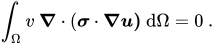
For
W
(
u
+
δ
v
)
{\displaystyle W(u+\delta v)}
v
{\displaystyle v}
∫
Ω
v
∇
⋅
(
σ
⋅
∇
u
)
d
Ω
=
0
.
{\displaystyle \int _{\Omega }v~{\boldsymbol {\nabla }}\cdot ({\boldsymbol {\sigma }}\cdot {\boldsymbol {\nabla u)}}~{\text{d}}\Omega =0~.}
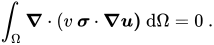
If this is to be true for all
v
{\displaystyle v}
∇
⋅
(
σ
⋅
∇
u
)
=
0
.
{\displaystyle {{\boldsymbol {\nabla }}\cdot ({\boldsymbol {\sigma }}\cdot {\boldsymbol {\nabla u)}}=0~.}}
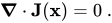
If we define the flux as
J
(
x
)
:=
σ
(
x
)
⋅
∇
u
{\displaystyle \mathbf {J} (\mathbf {x} ):={\boldsymbol {\sigma }}(\mathbf {x} )\cdot {\boldsymbol {\nabla }}u}
then we have
∇
⋅
J
(
x
)
=
0
.
{\displaystyle {{\boldsymbol {\nabla }}\cdot \mathbf {J} (\mathbf {x} )=0~.}}
Let us take new curvilinear coordinates
x
′
(
x
)
{\displaystyle \mathbf {x} '(\mathbf {x} )}
Figure 2. Transformation from spatial coordinates to material coordinates.
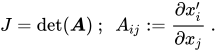
The Jacobian of the transformation
x
′
→
x
{\displaystyle \mathbf {x} '\rightarrow \mathbf {x} }
J
=
det
(
A
)
;
A
i
j
:=
∂
x
i
′
∂
x
j
.
{\displaystyle J=\det({\boldsymbol {A}})~;~~A_{ij}:={\frac {\partial x'_{i}}{\partial x_{j}}}~.}
Then an infinitesimal volume
d
Ω
{\displaystyle {\text{d}}\Omega }
d
Ω
′
→
J
d
Ω
.
{\displaystyle {\text{d}}\Omega '\rightarrow J~{\text{d}}\Omega ~.}
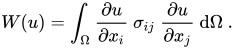
Recall that
W
(
u
)
=
∫
Ω
∂
u
∂
x
i
σ
i
j
∂
u
∂
x
j
d
Ω
.
{\displaystyle W(u)=\int _{\Omega }{\frac {\partial u}{\partial x_{i}}}~\sigma _{ij}~{\frac {\partial u}{\partial x_{j}}}~{\text{d}}\Omega ~.}
Then, using the chain rule, we get
W
(
u
)
=
∫
Ω
′
(
∂
u
∂
x
m
′
∂
x
m
′
∂
x
i
)
σ
i
j
(
∂
x
l
′
∂
x
j
∂
u
∂
x
l
′
)
1
J
d
Ω
′
{\displaystyle W(u)=\int _{\Omega '}\left({\frac {\partial u}{\partial x'_{m}}}~{\frac {\partial x'_{m}}{\partial x_{i}}}\right)~\sigma _{ij}~\left({\frac {\partial x'_{l}}{\partial x_{j}}}~{\frac {\partial u}{\partial x'_{l}}}\right)~{\cfrac {1}{J}}~{\text{d}}\Omega '}
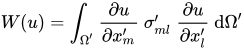
or,
W
(
u
)
=
∫
Ω
′
∂
u
∂
x
m
′
σ
m
l
′
∂
u
∂
x
l
′
d
Ω
′
{\displaystyle W(u)=\int _{\Omega '}{\frac {\partial u}{\partial x'_{m}}}~\sigma '_{ml}~{\frac {\partial u}{\partial x'_{l}}}~{\text{d}}\Omega '}
where
σ
m
l
′
=
1
J
∂
x
m
′
∂
x
i
σ
i
j
∂
x
l
′
∂
x
j
=
1
J
A
m
i
σ
i
j
A
l
j
.
{\displaystyle \sigma '_{ml}={\cfrac {1}{J}}~{\frac {\partial x'_{m}}{\partial x_{i}}}~\sigma _{ij}~{\frac {\partial x'_{l}}{\partial x_{j}}}={\cfrac {1}{J}}~A_{mi}~\sigma _{ij}~A_{lj}~.}
Hence, in the transformed coordinates, the functional
W
(
u
)
{\displaystyle W(u)}
W
(
u
)
=
∫
Ω
′
∇
′
u
⋅
σ
′
⋅
∇
′
u
d
Ω
′
{\displaystyle W(u)=\int _{\Omega '}{\boldsymbol {\nabla }}'u\cdot {\boldsymbol {\sigma }}'\cdot {\boldsymbol {\nabla }}'u~{\text{d}}\Omega '}
where
∇
′
(
∙
)
{\displaystyle {\boldsymbol {\nabla }}'(\bullet )}
x
′
{\displaystyle \mathbf {x} '}
σ
′
(
x
′
)
=
1
J
A
(
x
)
⋅
σ
(
x
)
⋅
A
T
(
x
)
.
{\displaystyle {\boldsymbol {\sigma }}'(\mathbf {x} ')={\cfrac {1}{J}}~{\boldsymbol {A}}(\mathbf {x} )\cdot {\boldsymbol {\sigma }}(\mathbf {x} )\cdot {\boldsymbol {A}}^{T}(\mathbf {x} )~.}
We can now interpret the minimization problem in the transformed
coordinates as follows:
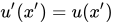
The function
u
′
(
x
′
)
=
u
(
x
′
)
{\displaystyle u'(x')=u(x')}
W
{\displaystyle W}
Ω
′
{\displaystyle \Omega '}
σ
′
(
x
′
)
{\displaystyle {\boldsymbol {\sigma }}'(\mathbf {x} ')}
x
1
′
,
x
2
′
,
x
3
′
{\displaystyle x'_{1},x'_{2},x'_{3}}
x
′
{\displaystyle x'}
Therefore, for
W
{\displaystyle W}
J
′
(
x
′
)
=
σ
′
(
x
′
)
⋅
∇
′
u
(
x
′
)
=
1
J
[
A
(
x
)
⋅
σ
(
x
)
⋅
A
T
(
x
)
]
⋅
∇
′
u
(
x
′
)
.
{\displaystyle \mathbf {J} '(\mathbf {x} ')={\boldsymbol {\sigma }}'(\mathbf {x} ')\cdot {\boldsymbol {\nabla }}'u(\mathbf {x} ')={\cfrac {1}{J}}~[{\boldsymbol {A}}(\mathbf {x} )\cdot {\boldsymbol {\sigma }}(\mathbf {x} )\cdot {\boldsymbol {A}}^{T}(\mathbf {x} )]\cdot {\boldsymbol {\nabla }}'u(\mathbf {x} ')~.}
Now,
[
∇
u
]
i
=
∂
u
∂
x
i
=
∂
x
m
′
∂
x
i
∂
u
∂
x
m
′
=
A
m
i
∂
u
∂
x
m
′
=
[
A
T
⋅
∇
′
u
]
i
.
{\displaystyle [{\boldsymbol {\nabla }}u]_{i}={\frac {\partial u}{\partial x_{i}}}={\frac {\partial x'_{m}}{\partial x_{i}}}~{\frac {\partial u}{\partial x'_{m}}}=A_{mi}~{\frac {\partial u}{\partial x'_{m}}}=[{\boldsymbol {A}}^{T}\cdot {\boldsymbol {\nabla }}'u]_{i}~.}
Hence,
J
′
(
x
′
)
=
1
J
[
A
(
x
)
⋅
σ
(
x
)
⋅
A
T
(
x
)
]
⋅
[
A
T
(
x
)
]
−
1
⋅
∇
u
(
x
)
{\displaystyle \mathbf {J} '(\mathbf {x} ')={\cfrac {1}{J}}~[{\boldsymbol {A}}(\mathbf {x} )\cdot {\boldsymbol {\sigma }}(\mathbf {x} )\cdot {\boldsymbol {A}}^{T}(\mathbf {x} )]\cdot [{\boldsymbol {A}}^{T}(\mathbf {x} )]^{-1}\cdot {\boldsymbol {\nabla }}u(\mathbf {x} )}
or,
J
′
(
x
′
)
=
1
J
A
(
x
)
⋅
σ
(
x
)
⋅
∇
u
(
x
)
=
A
⋅
J
(
x
)
det
(
A
)
.
{\displaystyle {\mathbf {J} '(\mathbf {x} ')={\cfrac {1}{J}}~{\boldsymbol {A}}(\mathbf {x} )\cdot {\boldsymbol {\sigma }}(\mathbf {x} )\cdot {\boldsymbol {\nabla }}u(\mathbf {x} )={\cfrac {{\boldsymbol {A}}\cdot \mathbf {J} (\mathbf {x} )}{\det({\boldsymbol {A}})}}~.}}
This is the transformation law for currents. Using the same arguments as
before, we can show that
∇
′
⋅
J
′
(
x
′
)
=
0
.
{\displaystyle {{\boldsymbol {\nabla }}'\cdot \mathbf {J} '(\mathbf {x} ')=0~.}}
Let the electric field
E
{\displaystyle \mathbf {E} }
u
{\displaystyle u}
E
(
x
)
=
∇
u
(
x
)
and
E
′
(
x
′
)
=
∇
′
u
(
x
′
)
{\displaystyle \mathbf {E} (\mathbf {x} )={\boldsymbol {\nabla }}u(\mathbf {x} )\qquad {\text{and}}\qquad \mathbf {E} '(\mathbf {x} ')={\boldsymbol {\nabla }}'u(\mathbf {x} ')}
are related via
E
′
(
x
′
)
=
(
A
T
)
−
1
⋅
E
(
x
)
.
{\displaystyle {\mathbf {E} '(\mathbf {x} ')=({\boldsymbol {A}}^{T})^{-1}\cdot \mathbf {E} (\mathbf {x} )~.}}
Therefore, there are two transformations which are equivalent. However,
an isotropic material transforms to an anisotropic material via the
transformation equation for conductivity.
Consider the situation shown in Figure 1. Let the conductivity of the body be
σ
(
x
)
{\displaystyle {\boldsymbol {\sigma }}(\mathbf {x} )}
∇
⋅
(
σ
⋅
∇
u
)
=
0
{\displaystyle {\boldsymbol {\nabla }}\cdot ({\boldsymbol {\sigma }}\cdot {\boldsymbol {\nabla u)}}=0}
n
⋅
J
(
x
)
{\displaystyle \mathbf {n} \cdot \mathbf {J} (\mathbf {x} )}
u
0
{\displaystyle u_{0}}
Suppose one knows the Dirchlet to Neumann map (
φ
{\displaystyle \varphi }
φ
:
u
0
→
n
⋅
J
(
x
)
=
g
(
x
)
.
{\displaystyle \varphi :u_{0}\rightarrow \mathbf {n} \cdot \mathbf {J} (\mathbf {x} )=g(\mathbf {x} )~.}
Can one find
σ
(
x
)
{\displaystyle {\boldsymbol {\sigma }}(\mathbf {x} )}
x
′
=
x
{\displaystyle \mathbf {x} '=\mathbf {x} }
x
′
≠
x
{\displaystyle \mathbf {x} '\neq \mathbf {x} }
Ω
′
=
Ω
{\displaystyle \Omega '=\Omega }
J
′
=
J
{\displaystyle \mathbf {J} '=\mathbf {J} }
u
′
=
u
{\displaystyle u'=u}
Ω
′
≠
Ω
{\displaystyle \Omega '\neq \Omega }
J
′
{\displaystyle \mathbf {J} '}
Figure 3. Illustration of why the Dirchlet to Neumann map on the surface may not, in general, be used to determine the conductivity inside a body.
From the figure we can see that the Dirichlet-Neumman map will remain unchanged on
∂
Ω
{\displaystyle \partial \Omega }
x
′
{\displaystyle \mathbf {x} '}
Even though this fact has been known for a while, there was still hope that you could determine
σ
(
x
)
{\displaystyle {\boldsymbol {\sigma }}(\mathbf {x} )}
Greenleaf03 ).
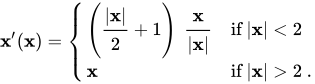
Greenleaf et al. (Greenleaf03 ) provided the first example of
transformation based cloaking. They considered a singular transformation
x
′
(
x
)
=
{
(
|
x
|
2
+
1
)
x
|
x
|
if
|
x
|
<
2
x
if
|
x
|
>
2
.
{\displaystyle \mathbf {x} '(\mathbf {x} )={\begin{cases}\left({\cfrac {|\mathbf {x} |}{2}}+1\right)~{\cfrac {\mathbf {x} }{|\mathbf {x} |}}&{\text{if}}~|\mathbf {x} |<2\\\mathbf {x} &{\text{if}}~|\mathbf {x} |>2~.\end{cases}}}
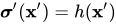
The effect of this mapping is shown in the schematic in Figure 4. An epsilon ball at the center of
Ω
{\displaystyle \Omega }
Ω
′
{\displaystyle \Omega '}
σ
′
(
x
′
)
{\displaystyle {\boldsymbol {\sigma }}'(\mathbf {x} ')}
σ
′
(
x
′
)
=
h
(
x
′
)
{\displaystyle {\boldsymbol {\sigma }}'(\mathbf {x} ')=h(\mathbf {x} ')}
Figure 4. Transformation cloaking using the Greenleaf-Lassas-Uhlmann map.
Therefore we can put a small body inside and the potential outside will be
undisturbed by the presence of the body in the cloaking region.
Pendry, Schurig, and Smith (Pendry06 ) showed in 2006 that cloaking could be achieved for electromagnetic waves. The concept of cloaking follows from the
observation that Maxwell's equations keep their form under coordinate transformations.
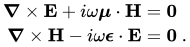
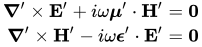
The Maxwell's equations at fixed frequency
ω
{\displaystyle \omega }
∇
×
E
+
i
ω
μ
⋅
H
=
0
∇
×
H
−
i
ω
ϵ
⋅
E
=
0
.
{\displaystyle {\begin{aligned}{\boldsymbol {\nabla }}\times \mathbf {E} +i\omega {\boldsymbol {\mu }}\cdot \mathbf {H} &={\boldsymbol {0}}\\{\boldsymbol {\nabla }}\times \mathbf {H} -i\omega {\boldsymbol {\epsilon }}\cdot \mathbf {E} &={\boldsymbol {0}}~.\end{aligned}}}
A coordinate transformation (
x
→
x
′
{\displaystyle \mathbf {x} \rightarrow \mathbf {x} '}
∇
′
×
E
′
+
i
ω
μ
′
⋅
H
′
=
0
∇
′
×
H
′
−
i
ω
ϵ
′
⋅
E
′
=
0
{\displaystyle {\begin{aligned}{\boldsymbol {\nabla }}'\times \mathbf {E} '+i\omega {\boldsymbol {\mu }}'\cdot \mathbf {H} '&={\boldsymbol {0}}\\{\boldsymbol {\nabla }}'\times \mathbf {H} '-i\omega {\boldsymbol {\epsilon }}'\cdot \mathbf {E} '&={\boldsymbol {0}}\end{aligned}}}
with
x
′
=
x
′
(
x
)
;
E
′
(
x
′
)
=
(
A
T
)
−
1
E
(
x
)
;
H
′
(
x
′
)
=
(
A
T
)
−
1
H
(
x
)
{\displaystyle \mathbf {x} '=\mathbf {x} '(\mathbf {x} )~;~~\mathbf {E} '(\mathbf {x} ')=({\boldsymbol {A}}^{T})^{-1}~\mathbf {E} (\mathbf {x} )~;~~\mathbf {H} '(\mathbf {x} ')=({\boldsymbol {A}}^{T})^{-1}~\mathbf {H} (\mathbf {x} )}
where
A
k
i
=
∂
x
k
′
∂
x
i
;
[
A
−
1
]
i
j
=
∂
x
i
∂
x
j
′
{\displaystyle A_{ki}={\frac {\partial x'_{k}}{\partial x_{i}}}~;~~[{\boldsymbol {A}}^{-1}]_{ij}={\frac {\partial x_{i}}{\partial x'_{j}}}}
and
μ
′
(
x
′
)
=
A
⋅
μ
(
x
)
⋅
A
T
det
(
A
)
;
ϵ
′
(
x
′
)
=
A
⋅
ϵ
(
x
)
⋅
A
T
det
(
A
)
.
{\displaystyle {\boldsymbol {\mu }}'(\mathbf {x} ')={\cfrac {{\boldsymbol {A}}\cdot {\boldsymbol {\mu }}(\mathbf {x} )\cdot {\boldsymbol {A}}^{T}}{\det({\boldsymbol {A}})}}~;~~{\boldsymbol {\epsilon }}'(\mathbf {x} ')={\cfrac {{\boldsymbol {A}}\cdot {\boldsymbol {\epsilon }}(\mathbf {x} )\cdot {\boldsymbol {A}}^{T}}{\det({\boldsymbol {A}})}}~.}
To see that this invariance of form under coordinate transformations does indeed hold, observe that
(1)
−
i
ω
μ
′
⋅
H
′
=
−
i
ω
A
⋅
μ
⋅
H
det
(
A
)
=
A
⋅
(
∇
×
E
)
det
(
A
)
.
{\displaystyle {\text{(1)}}\qquad -i\omega {\boldsymbol {\mu }}'\cdot \mathbf {H} '={\cfrac {-i\omega {\boldsymbol {A}}\cdot {\boldsymbol {\mu }}\cdot \mathbf {H} }{\det({\boldsymbol {A}})}}={\cfrac {{\boldsymbol {A}}\cdot ({\boldsymbol {\nabla }}\times \mathbf {E} )}{\det({\boldsymbol {A}})}}~.}
We want to show that this equals
∇
′
×
E
′
{\displaystyle {\boldsymbol {\nabla }}'\times \mathbf {E} '}
In index notation, (1) can be written as
[
−
i
ω
μ
′
⋅
H
′
]
h
=
[
A
⋅
(
∇
×
E
)
]
h
det
(
A
)
=
1
det
(
A
)
∂
x
h
′
∂
x
j
E
j
m
k
∂
E
k
∂
x
m
=
1
det
(
A
)
∂
x
h
′
∂
x
j
E
j
m
k
∂
x
l
′
∂
x
m
∂
E
k
∂
x
l
′
.
{\displaystyle {\begin{aligned}\left[-i\omega {\boldsymbol {\mu }}^{'}\cdot \mathbf {H} ^{'}\right]_{h}&={\cfrac {\left[{\boldsymbol {A}}\cdot \left({\boldsymbol {\nabla }}\times \mathbf {E} \right)\right]_{h}}{\det({\boldsymbol {A}})}}\\&={\cfrac {1}{\det({\boldsymbol {A}})}}~{\frac {\partial x'_{h}}{\partial x_{j}}}~{\mathcal {E}}_{jmk}~{\frac {\partial E_{k}}{\partial x_{m}}}\\&={\cfrac {1}{\det({\boldsymbol {A}})}}~{\frac {\partial x'_{h}}{\partial x_{j}}}~{\mathcal {E}}_{jmk}~{\frac {\partial x'_{l}}{\partial x_{m}}}~{\frac {\partial E_{k}}{\partial x'_{l}}}~.\end{aligned}}}
On the other hand,
[
∇
′
×
E
′
]
h
=
[
∇
′
×
(
A
−
T
⋅
E
)
]
h
=
E
h
l
m
∂
∂
x
i
(
∂
x
k
∂
x
m
′
E
k
)
=
E
h
l
m
∂
2
x
k
∂
x
l
′
∂
x
m
′
E
k
+
E
h
l
m
∂
x
k
∂
x
m
′
∂
E
k
∂
x
l
′
=
E
h
l
m
∂
x
k
∂
x
m
′
∂
E
k
∂
x
l
′
.
{\displaystyle {\begin{aligned}\left[{\boldsymbol {\nabla }}'\times \mathbf {E} '\right]_{h}&=\left[{\boldsymbol {\nabla }}'\times ({\boldsymbol {A}}^{-T}\cdot \mathbf {E} )\right]_{h}\\&={\mathcal {E}}_{hlm}~{\frac {\partial }{\partial x_{i}}}\left({\frac {\partial x_{k}}{\partial x'_{m}}}~E_{k}\right)\\&={\mathcal {E}}_{hlm}~{\frac {\partial ^{2}x_{k}}{\partial x'_{l}\partial x'_{m}}}~E_{k}+{\mathcal {E}}_{hlm}~{\frac {\partial x_{k}}{\partial x'_{m}}}~{\frac {\partial E_{k}}{\partial x'_{l}}}\\&={\mathcal {E}}_{hlm}~{\frac {\partial x_{k}}{\partial x'_{m}}}~{\frac {\partial E_{k}}{\partial x'_{l}}}~.\end{aligned}}}
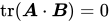
The first term above evaluates to zero because of
tr
(
A
⋅
B
)
=
0
{\displaystyle {\text{tr}}({\boldsymbol {A}}\cdot {\boldsymbol {B}})=0}
A
{\displaystyle {\boldsymbol {A}}}
B
{\displaystyle {\boldsymbol {B}}}
So we now need to show that
E
h
l
m
∂
x
k
∂
x
m
′
∂
E
k
∂
x
l
′
=
1
det
(
A
)
∂
x
h
′
∂
x
j
E
j
m
k
∂
x
l
′
∂
x
m
∂
E
k
∂
x
l
′
{\displaystyle {\mathcal {E}}_{hlm}~{\frac {\partial x_{k}}{\partial x'_{m}}}~{\frac {\partial E_{k}}{\partial x'_{l}}}={\cfrac {1}{\det({\boldsymbol {A}})}}~{\frac {\partial x'_{h}}{\partial x_{j}}}~{\mathcal {E}}_{jmk}~{\frac {\partial x'_{l}}{\partial x_{m}}}~{\frac {\partial E_{k}}{\partial x'_{l}}}}
or that,
(2)
det
(
A
)
E
h
l
m
∂
x
k
∂
x
m
′
=
∂
x
h
′
∂
x
j
E
j
m
k
∂
x
l
′
∂
x
m
.
{\displaystyle {\text{(2)}}\qquad \det({\boldsymbol {A}})~{\mathcal {E}}_{hlm}~{\frac {\partial x_{k}}{\partial x'_{m}}}={\frac {\partial x'_{h}}{\partial x_{j}}}~{\mathcal {E}}_{jmk}~{\frac {\partial x'_{l}}{\partial x_{m}}}~.}
Multiply both sides of (2) by
A
p
k
{\displaystyle A_{pk}}
k
{\displaystyle k}
A
{\displaystyle {\boldsymbol {A}}}
det
(
A
)
E
h
l
m
∂
x
k
∂
x
m
′
∂
x
p
′
∂
x
k
=
E
j
m
k
∂
x
h
′
∂
x
j
∂
x
l
′
∂
x
m
∂
x
p
′
∂
x
k
{\displaystyle \det({\boldsymbol {A}})~{\mathcal {E}}_{hlm}~{\frac {\partial x_{k}}{\partial x'_{m}}}~{\frac {\partial x'_{p}}{\partial x_{k}}}={\mathcal {E}}_{jmk}~{\frac {\partial x'_{h}}{\partial x_{j}}}~{\frac {\partial x'_{l}}{\partial x_{m}}}~{\frac {\partial x'_{p}}{\partial x_{k}}}}
or,
det
(
A
)
E
h
l
m
∂
x
p
′
∂
x
m
′
=
det
(
A
)
E
h
l
m
δ
p
m
=
det
(
A
)
E
h
l
p
=
E
j
m
k
∂
x
h
′
∂
x
j
∂
x
l
′
∂
x
m
∂
x
p
′
∂
x
k
.
{\displaystyle \det({\boldsymbol {A}})~{\mathcal {E}}_{hlm}~{\frac {\partial x'_{p}}{\partial x'_{m}}}=\det({\boldsymbol {A}})~{\mathcal {E}}_{hlm}~\delta _{pm}=\det({\boldsymbol {A}})~{\mathcal {E}}_{hlp}={\mathcal {E}}_{jmk}~{\frac {\partial x'_{h}}{\partial x_{j}}}~{\frac {\partial x'_{l}}{\partial x_{m}}}~{\frac {\partial x'_{p}}{\partial x_{k}}}~.}
Both sides are completely antisymmetric with respect o
h
,
l
,
p
{\displaystyle h,l,p}
h
=
1
{\displaystyle h=1}
l
=
2
{\displaystyle l=2}
p
=
3
{\displaystyle p=3}
det
(
A
)
E
123
=
det
(
A
)
=
E
j
m
k
∂
x
1
′
∂
x
j
∂
x
2
′
∂
x
m
∂
x
3
′
∂
x
k
.
{\displaystyle \det({\boldsymbol {A}})~{\mathcal {E}}_{123}=\det({\boldsymbol {A}})={\mathcal {E}}_{jmk}~{\frac {\partial x'_{1}}{\partial x_{j}}}~{\frac {\partial x'_{2}}{\partial x_{m}}}~{\frac {\partial x'_{3}}{\partial x_{k}}}~.}
The right hand side above is the well known formula for the determinant of
the Jacobian. Hence the first of the transformed Maxwell equations holds.
We can follow the same procedure to show that the second Maxwell's equation
also maintains its form under coordinate transformations. Hence Maxwell's
equations are invariant with respect to coordinate transformations.
[Greenleaf03] Mathematical Research Letters , 10:685--693, 2003.[Pendry06] Science , 312:1780--1782, 2006.




























![{\displaystyle \mathbf {J} '(\mathbf {x} ')={\boldsymbol {\sigma }}'(\mathbf {x} ')\cdot {\boldsymbol {\nabla }}'u(\mathbf {x} ')={\cfrac {1}{J}}~[{\boldsymbol {A}}(\mathbf {x} )\cdot {\boldsymbol {\sigma }}(\mathbf {x} )\cdot {\boldsymbol {A}}^{T}(\mathbf {x} )]\cdot {\boldsymbol {\nabla }}'u(\mathbf {x} ')~.}](https://wikimedia.org/api/rest_v1/media/math/render/svg/88a9a65539eb067a80445948b21a5b1e8aa9a133)
![{\displaystyle [{\boldsymbol {\nabla }}u]_{i}={\frac {\partial u}{\partial x_{i}}}={\frac {\partial x'_{m}}{\partial x_{i}}}~{\frac {\partial u}{\partial x'_{m}}}=A_{mi}~{\frac {\partial u}{\partial x'_{m}}}=[{\boldsymbol {A}}^{T}\cdot {\boldsymbol {\nabla }}'u]_{i}~.}](https://wikimedia.org/api/rest_v1/media/math/render/svg/98bace68857d3f80f1e8725bd44bb4c24b353d6a)
![{\displaystyle \mathbf {J} '(\mathbf {x} ')={\cfrac {1}{J}}~[{\boldsymbol {A}}(\mathbf {x} )\cdot {\boldsymbol {\sigma }}(\mathbf {x} )\cdot {\boldsymbol {A}}^{T}(\mathbf {x} )]\cdot [{\boldsymbol {A}}^{T}(\mathbf {x} )]^{-1}\cdot {\boldsymbol {\nabla }}u(\mathbf {x} )}](https://wikimedia.org/api/rest_v1/media/math/render/svg/e9511f4bc6b54b4e9f13385795853e2d39aa92c6)
















![{\displaystyle A_{ki}={\frac {\partial x'_{k}}{\partial x_{i}}}~;~~[{\boldsymbol {A}}^{-1}]_{ij}={\frac {\partial x_{i}}{\partial x'_{j}}}}](https://wikimedia.org/api/rest_v1/media/math/render/svg/181af9e3023e4ec51553a544f903934665c51f26)



![{\displaystyle {\begin{aligned}\left[-i\omega {\boldsymbol {\mu }}^{'}\cdot \mathbf {H} ^{'}\right]_{h}&={\cfrac {\left[{\boldsymbol {A}}\cdot \left({\boldsymbol {\nabla }}\times \mathbf {E} \right)\right]_{h}}{\det({\boldsymbol {A}})}}\\&={\cfrac {1}{\det({\boldsymbol {A}})}}~{\frac {\partial x'_{h}}{\partial x_{j}}}~{\mathcal {E}}_{jmk}~{\frac {\partial E_{k}}{\partial x_{m}}}\\&={\cfrac {1}{\det({\boldsymbol {A}})}}~{\frac {\partial x'_{h}}{\partial x_{j}}}~{\mathcal {E}}_{jmk}~{\frac {\partial x'_{l}}{\partial x_{m}}}~{\frac {\partial E_{k}}{\partial x'_{l}}}~.\end{aligned}}}](https://wikimedia.org/api/rest_v1/media/math/render/svg/cd39cc95def3371653e9b3290d083909aa82329b)
![{\displaystyle {\begin{aligned}\left[{\boldsymbol {\nabla }}'\times \mathbf {E} '\right]_{h}&=\left[{\boldsymbol {\nabla }}'\times ({\boldsymbol {A}}^{-T}\cdot \mathbf {E} )\right]_{h}\\&={\mathcal {E}}_{hlm}~{\frac {\partial }{\partial x_{i}}}\left({\frac {\partial x_{k}}{\partial x'_{m}}}~E_{k}\right)\\&={\mathcal {E}}_{hlm}~{\frac {\partial ^{2}x_{k}}{\partial x'_{l}\partial x'_{m}}}~E_{k}+{\mathcal {E}}_{hlm}~{\frac {\partial x_{k}}{\partial x'_{m}}}~{\frac {\partial E_{k}}{\partial x'_{l}}}\\&={\mathcal {E}}_{hlm}~{\frac {\partial x_{k}}{\partial x'_{m}}}~{\frac {\partial E_{k}}{\partial x'_{l}}}~.\end{aligned}}}](https://wikimedia.org/api/rest_v1/media/math/render/svg/a052ce82d53dd25ca02289013e472e11d584ec2e)