While considering a single interface between two layers (in the
previous lecture) we had used a coordinate system ().
[1]
In the following we switch to a system () to make our notation
a bit less confusing for multilayered media. In the following we assume
that the material properties of each layer in a multilayered material
are piecewise constant.
Consider the TE wave shown in Figure 1.
Figure 1. A TE wave at an interface between two layers.
Then, from the previous lecture and using the new notation ()
shown in the figure, the solution for the TE wave can be written as
and the governing equation is
Recall that plane waves propagating in the direction
have the form
Therefore, in region 1 (see Figure~1) for fixed ,
The first term of the left hand side of (1) represents the
incoming wave while the second term on represents the reflected wave
(hence the difference in signs of ). The quantity is a
reflection coefficient.
Similarly, in region 2 (see Figure 1),
where is a transmission coefficient.
Continuity at the interface requires that the following conditions be
satisfied:
If we choose the coordinate system such that at the interface,
substitution of (1), (2) into (3) gives
Solving for and from equations (4) gives
Note that these quantities are the Fresnel coefficients of the bilayer
and that the reflection and transmission coefficients may be complex.
Recall from the previous lecture that
Therefore, if , then is
purely imaginary. If is real, then the first of equations
(5) implies that the numerator and the denominator are complex
conjugates. This means that
If such a situation exists, the wave in region 2 is called evanescent.
Let us first examine the problem of reflection and transmission in a
three layer medium (see Figure 2). Our goal is to
find the effective reflection and transmission coefficients in this
medium. Once we know these coefficients, we can choose the materials
in the layers to achieve a desired reflectivity or transmissivity.
Figure 2. Reflection and transmission in a three layer medium.
Let the interface between regions 1 and 2 be located at and
that between regions 2 and 3 be located at . Then, using a
change of coordinates , in region 1 (from equation
1) we have
or,
where
and is the apparent reflection coefficient at the
interface between regions 1 and 2 due to the slab.
Similarly, for region 2, we have
and is the apparent reflection coefficient for a downgoing
wave at the interface between regions 2 and 3 due to the slab. However,
since the wave is transmitted in region 3 and there are no further
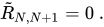
reflections, we have
Since the wave is only transmitted in region 3, we have
At this stage we don't know what is. To find this quantity,
note that the downgoing wave in region 2 equals the sum of the transmission
of the downgoing wave in region 1 and a reflection of the upgoing wave in
region 2 (see Figure 2). Hence, at the top interface
,
where is the transmission coefficient between regions 1 and 2
and is the reflection coefficient of waves from
region 2 incident upon region 1.
Also, the upgoing wave in region 1 is the sum of the reflection of the
incoming wave in region 1 and the transmission at interface 2-1 of the
reflected wave at interface 2-3. Hence, at we have
or,
Eliminating from (6) gives
Plugging (8) into (7), we get
which gives us an expression for the generalized reflection coefficient
.
We have considered only two internal reflections so far. How about
further reflections? It turns out that equation (9) can
be interpreted to include all possible internal reflections. To see
this, let us assume that
Then we can expand (9) in series form to get
This equation can be interpreted as shown in Figure 3.
However, sometimes the series may not converge at it is preferable to
use (9) for computations.
Figure 3. Interpretation of series expansion of .
We can now generalize the above results to a medium with layers
(see Figure 4 for a schematic of the situation).
If one additional layer is added, then we only need to replace
in equation (9) with .
Figure 4. A medium with layers.
Therefore, in general, the wave in the -th region takes the form
For the last layer,
For all other layers we get a recursion relation
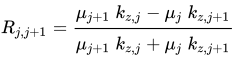
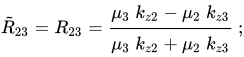
Recall from equation (4) that
Using equation (12), equation (11) simplifies
to
where
is the Fresnel reflection coefficient for transverse electric waves.
In the next lecture we will take the continuum limit of these equations
and derive equations for the effective reflection coefficient of a
smoothly graded multilayered medium with a few isolated jumps.



![{\displaystyle \left[\mu (z)~{\cfrac {d}{dz}}\left(\mu (z)^{-1}~{\cfrac {d}{dz}}\right)+\omega ^{2}~\epsilon (z)~\mu (z)-k_{x}^{2}\right]~{\tilde {E}}_{y}=0~.}](https://wikimedia.org/api/rest_v1/media/math/render/svg/5b7b43eaa4aff029b82214d6164796ddf63734ab)

![{\displaystyle {\tilde {E}}_{y}(z)={\tilde {E}}_{0}~\exp[i(k_{z}~z-\omega ~t)]~.}](https://wikimedia.org/api/rest_v1/media/math/render/svg/e7b1d00c9cd52fcb354e37e506e68103b5028cb3)

![{\displaystyle {\text{(1)}}\qquad {\tilde {E}}_{y1}(z)={\tilde {E}}_{0}~\left[\exp(-i~k_{z1}~z)+R^{TE}~\exp(i~k_{z1}~z)\right]~.}](https://wikimedia.org/api/rest_v1/media/math/render/svg/bcc8b8368a4ca031299394f9b005ae1ea6e1769e)













![{\displaystyle {\begin{aligned}{\tilde {E}}_{y1}(z)&={\tilde {E}}_{0}~\left[\exp[-i~k_{z1}~(z+d_{1})]+{\tilde {R}}_{12}~\exp[i~k_{z1}~(z+d_{1})]\right]\\&={\tilde {E}}_{0}~\exp(-i~k_{z1}~d_{1})~\left[\exp(-i~k_{z1}~z)+{\tilde {R}}_{12}~\exp(i~k_{z1}~z)~\exp(2~i~k_{z1}~d_{1})\right]\end{aligned}}}](https://wikimedia.org/api/rest_v1/media/math/render/svg/19c6f17f9a5da40d602354213c820bfefa92a189)
![{\displaystyle {\tilde {E}}_{y1}(z)=A_{1}~\left[\exp(-i~k_{z1}~z)+{\tilde {R}}_{12}~\exp(i~k_{z1}~z+2~i~k_{z1}~d_{1})\right]}](https://wikimedia.org/api/rest_v1/media/math/render/svg/14a6a044d1d41e8342ae4ea1a54b0f402218c5ec)


![{\displaystyle {\tilde {E}}_{y2}(z)=A_{2}~\left[\exp(-i~k_{z2}~z)+{\tilde {R}}_{23}~\exp(i~k_{z2}~z+2~i~k_{z2}~d_{2})\right]}](https://wikimedia.org/api/rest_v1/media/math/render/svg/89e5f6ce5d26186fc71e00a58fa36cb07287c273)








![{\displaystyle {\text{(8)}}\qquad A_{2}={\cfrac {T_{12}~A_{1}~\exp[i~(k_{z1}-k_{z2})~d_{1}]}{1-R_{21}~R_{23}~\exp[2~i~k_{z2}~(d_{2}-d_{1})]}}~.}](https://wikimedia.org/api/rest_v1/media/math/render/svg/ed8b4459d3e57fab5f67819481283c84bb608b6c)
![{\displaystyle {\text{(9)}}\qquad {\tilde {R}}_{12}=R_{12}+{\cfrac {T_{12}~T_{21}~R_{23}~\exp[2~i~k_{z2}~(d_{2}-d_{1})]}{1-R_{21}~R_{23}~\exp[2~i~k_{z2}~(d_{2}-d_{1})]}}}](https://wikimedia.org/api/rest_v1/media/math/render/svg/c1ed3dab7fbe32a42c1b6371a230a21d62a301a4)

![{\displaystyle {\text{(10)}}\qquad {\tilde {R}}_{12}=R_{12}+T_{12}~T_{21}~R_{23}~e^{2ik_{z2}(d_{2}-d_{1})}\left[1+R_{21}~R_{23}~e^{2ik_{z2}(d_{2}-d_{1})}+R_{21}^{2}~R_{23}^{2}~e^{4ik_{z2}(d_{2}-d_{1})}+\dots \right]~.}](https://wikimedia.org/api/rest_v1/media/math/render/svg/c1ae034339fbb2711a8a8f0159b4403cbc4fcc8e)


![{\displaystyle {\tilde {E}}_{yj}(z)=A_{j}~\left[\exp(-i~k_{zj}~z)+{\tilde {R}}_{j,j+1}~\exp(i~k_{zj}~z+2~i~k_{zj}~d_{j})\right]~.}](https://wikimedia.org/api/rest_v1/media/math/render/svg/3fb44332055530d822cc6cf6d3d7e4049b6c7278)
![{\displaystyle {\text{(11)}}\qquad {\tilde {R}}_{j,j+1}=R_{j,j+1}+{\cfrac {T_{j,j+1}~T_{j+1,j}~{\tilde {R}}_{j+1,j+2}~\exp[2~i~k_{z,j+1}~(d_{j+1}-d_{j})]}{1-R_{j+1,j}~{\tilde {R}}_{j+1,j+2}~\exp[2~i~k_{z,j+1}~(d_{j+1}-d_{j})]}}~.}](https://wikimedia.org/api/rest_v1/media/math/render/svg/5860a53cc7bd054829c8383e339a50f46a275c3a)

![{\displaystyle {\text{(13)}}\qquad {{\tilde {R}}_{j,j+1}={\cfrac {R_{j,j+1}+{\tilde {R}}_{j+1,j+2}~\exp[2~i~k_{z,j+1}~(d_{j+1}-d_{j})]}{1+R_{j,j+1}~{\tilde {R}}_{j+1,j+2}~\exp[2~i~k_{z,j+1}~(d_{j+1}-d_{j})]}}~.}}](https://wikimedia.org/api/rest_v1/media/math/render/svg/f76022710b2e9125fb1d8dc69d5d0d54d52f1985)