Talk:Continuum mechanics/Stress-strain relation for thermoelasticity

From Wikiversity
Jump to: navigation, search

First of all I have to apologize for a probably not conforming style, this is my first own-written discussion so please be patient.

Problem:
The argumentation for
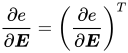
    \frac{\partial e}{\partial \boldsymbol{E}} = \left(\frac{\partial e}{\partial \boldsymbol{E}}\right)^T because of ~ \boldsymbol{\sigma} = \boldsymbol{\sigma}^T \Rightarrow \boldsymbol{A} = \boldsymbol{A}^T
doesn't sound reasonable to me.

I think this argument only leads to

    \left(\frac{\partial e}{\partial \boldsymbol{E}}\right)^T+ \frac{\partial e}{\partial \boldsymbol{E}} = \frac{\partial e}{\partial \boldsymbol{E}} + \left(\frac{\partial e}{\partial \boldsymbol{E}}\right)^T

what is obviously not helpful.

Proposal for Solution:

In my opinion one should argue that \boldsymbol{E} is symmetric and therefore

    \left(\frac{\partial e}{\partial \boldsymbol{E}}\right)_{ij} = \frac{\partial e}{\partial \boldsymbol{E}_{ij}} = \frac{\partial e}{\partial \boldsymbol{E}_{ji}} = \left(\frac{\partial e}{\partial \boldsymbol{E}}\right)_{ji}

what gives the demanded symmetry.

