The rate of deformation is defined as
D
=
sym
(
∇
v
)
=
1
2
[
∇
v
+
(
∇
v
)
T
]
{\displaystyle {\boldsymbol {D}}={\text{sym}}({\boldsymbol {\nabla }}\mathbf {v} )={\frac {1}{2}}\left[{\boldsymbol {\nabla }}\mathbf {v} +({\boldsymbol {\nabla }}\mathbf {v} )^{T}\right]}
where
v
{\displaystyle \mathbf {v} }
D
i
j
=
sym
(
v
i
,
j
)
=
1
2
(
v
i
,
j
+
v
j
,
i
)
=
1
2
(
∂
v
i
∂
x
j
+
∂
v
j
∂
x
i
)
,
i
,
j
=
1
,
2
,
3
.
{\displaystyle D_{ij}={\text{sym}}(v_{i,j})={\frac {1}{2}}\left(v_{i,j}+v_{j,i}\right)={\frac {1}{2}}\left({\frac {\partial v_{i}}{\partial x_{j}}}+{\frac {\partial v_{j}}{\partial x_{i}}}\right),\qquad i,j=1,2,3~.}
Given the above definition, derive equations (9.2.1) through (9.2.7) of the book chapter.
The motion of a point
P
{\displaystyle P}
C
{\displaystyle C}
Figure 2. Motion of continuum-based beam.
Since the normal (
n
{\displaystyle \mathbf {n} }
P
{\displaystyle P}
C
{\displaystyle C}
v
PC
=
ω
×
r
{\displaystyle \mathbf {v} _{\text{PC}}={\boldsymbol {\omega }}\times \mathbf {r} }
where
ω
{\displaystyle {\boldsymbol {\omega }}}
r
{\displaystyle \mathbf {r} }
C
{\displaystyle C}
P
{\displaystyle P}
Expressed in terms of the local basis vectors
e
x
{\displaystyle \mathbf {e} _{x}}
e
y
{\displaystyle \mathbf {e} _{y}}
e
z
{\displaystyle \mathbf {e} _{z}}
ω
=
0
e
x
+
0
e
y
+
ω
e
z
=
ω
e
z
r
=
0
e
x
+
y
e
y
+
0
e
z
=
y
e
y
.
{\displaystyle {\begin{aligned}{\boldsymbol {\omega }}&=0~\mathbf {e} _{x}+0~\mathbf {e} _{y}+\omega ~\mathbf {e} _{z}=\omega ~\mathbf {e} _{z}\\\mathbf {r} &=0~\mathbf {e} _{x}+y~\mathbf {e} _{y}+0~\mathbf {e} _{z}=y~\mathbf {e} _{y}~.\end{aligned}}}
Therefore,
v
PC
=
(
ω
e
z
)
×
(
y
e
y
)
=
y
ω
e
z
×
e
y
=
−
y
ω
e
x
.
{\displaystyle \mathbf {v} _{\text{PC}}=(\omega ~\mathbf {e} _{z})\times (y~\mathbf {e} _{y})=y~\omega ~\mathbf {e} _{z}\times \mathbf {e} _{y}=-y~\omega ~\mathbf {e} _{x}~.}
Let
v
M
(
x
,
t
)
{\displaystyle \mathbf {v} ^{M}(\mathbf {x} ,t)}
C
{\displaystyle C}
t
{\displaystyle t}
P
{\displaystyle P}
v
=
v
M
+
v
PC
.
{\displaystyle \mathbf {v} =\mathbf {v} ^{M}+\mathbf {v} _{\text{PC}}~.}
Now, in terms of the local basis vectors
v
M
=
v
x
M
e
x
+
v
y
M
e
y
+
0
e
z
.
{\displaystyle \mathbf {v} ^{M}=v_{x}^{M}~\mathbf {e} _{x}+v_{y}^{M}~\mathbf {e} _{y}+0~\mathbf {e} _{z}~.}
Therefore,
v
=
v
x
M
e
x
+
v
y
M
e
y
−
y
ω
e
x
=
(
v
x
M
−
y
ω
)
e
x
+
v
y
M
e
y
.
{\displaystyle \mathbf {v} =v_{x}^{M}~\mathbf {e} _{x}+v_{y}^{M}~\mathbf {e} _{y}-y~\omega ~\mathbf {e} _{x}=(v_{x}^{M}-y~\omega )\mathbf {e} _{x}+v_{y}^{M}\mathbf {e} _{y}~.}
Therefore, the velocity of any point
P
{\displaystyle P}
v
(
x
,
y
,
z
,
t
)
=
v
x
e
x
+
v
y
e
y
+
v
z
e
z
=
[
v
x
M
(
x
,
t
)
−
y
ω
(
x
,
t
)
]
e
x
+
v
y
M
(
x
,
t
)
e
y
+
0
e
z
.
{\displaystyle {\begin{aligned}\mathbf {v} (x,y,z,t)&=v_{x}~\mathbf {e} _{x}&+&v_{y}~\mathbf {e} _{y}&+&v_{z}~\mathbf {e} _{z}\\&=[v_{x}^{M}(x,t)-y~\omega (x,t)]~\mathbf {e} _{x}&+&v_{y}^{M}(x,t)~\mathbf {e} _{y}&+&0~\mathbf {e} _{z}~.\end{aligned}}}
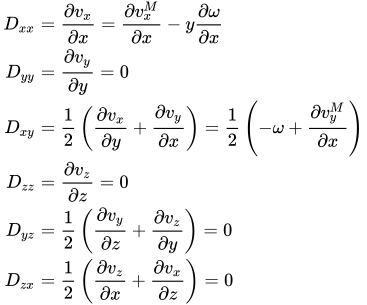
The components of the rate of deformation tensor are
D
i
j
=
1
2
(
∂
v
i
∂
x
j
+
∂
v
j
∂
x
i
)
,
i
,
j
=
1
,
2
,
3
.
{\displaystyle D_{ij}={\frac {1}{2}}\left({\frac {\partial v_{i}}{\partial x_{j}}}+{\frac {\partial v_{j}}{\partial x_{i}}}\right),\qquad i,j=1,2,3~.}
In terms of the local basis, these components are
D
x
x
=
∂
v
x
∂
x
=
∂
v
x
M
∂
x
−
y
∂
ω
∂
x
D
y
y
=
∂
v
y
∂
y
=
0
D
x
y
=
1
2
(
∂
v
x
∂
y
+
∂
v
y
∂
x
)
=
1
2
(
−
ω
+
∂
v
y
M
∂
x
)
D
z
z
=
∂
v
z
∂
z
=
0
D
y
z
=
1
2
(
∂
v
y
∂
z
+
∂
v
z
∂
y
)
=
0
D
z
x
=
1
2
(
∂
v
z
∂
x
+
∂
v
x
∂
z
)
=
0
{\displaystyle {\begin{aligned}D_{xx}&={\frac {\partial v_{x}}{\partial x}}={\frac {\partial v_{x}^{M}}{\partial x}}-y{\frac {\partial \omega }{\partial x}}\\D_{yy}&={\frac {\partial v_{y}}{\partial y}}=0\\D_{xy}&={\frac {1}{2}}\left({\frac {\partial v_{x}}{\partial y}}+{\frac {\partial v_{y}}{\partial x}}\right)={\frac {1}{2}}\left(-\omega +{\frac {\partial v_{y}^{M}}{\partial x}}\right)\\D_{zz}&={\frac {\partial v_{z}}{\partial z}}=0\\D_{yz}&={\frac {1}{2}}\left({\frac {\partial v_{y}}{\partial z}}+{\frac {\partial v_{z}}{\partial y}}\right)=0\\D_{zx}&={\frac {1}{2}}\left({\frac {\partial v_{z}}{\partial x}}+{\frac {\partial v_{x}}{\partial z}}\right)=0\end{aligned}}}
For the Euler-Bernoulli beam theory, the normals remain normal to the reference line. Let
θ
{\displaystyle \theta }
θ
=
∂
u
y
M
∂
x
{\displaystyle \theta ={\frac {\partial u_{y}^{M}}{\partial x}}}
where
u
y
M
{\displaystyle u_{y}^{M}}
y
{\displaystyle y}
Figure 3. Euler-Bernoulli beam kinematics.
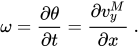
The angular velocity of the normal is given by
ω
=
∂
θ
∂
t
=
∂
v
y
M
∂
x
.
{\displaystyle \omega ={\frac {\partial \theta }{\partial t}}={\frac {\partial v_{y}^{M}}{\partial x}}~.}
Hence,
D
x
x
=
∂
v
x
M
∂
x
−
y
∂
ω
∂
x
=
∂
v
x
M
∂
x
−
y
∂
2
v
y
M
∂
x
2
D
y
y
=
0
D
x
y
=
1
2
(
−
ω
+
∂
v
y
M
∂
x
)
=
0
D
z
z
=
0
D
y
z
=
0
D
z
x
=
0
{\displaystyle {\begin{aligned}D_{xx}&={\frac {\partial v_{x}^{M}}{\partial x}}-y{\frac {\partial \omega }{\partial x}}={\frac {\partial v_{x}^{M}}{\partial x}}-y{\frac {\partial ^{2}v_{y}^{M}}{\partial x^{2}}}\\D_{yy}&=0\\D_{xy}&={\frac {1}{2}}\left(-\omega +{\frac {\partial v_{y}^{M}}{\partial x}}\right)=0\\D_{zz}&=0\\D_{yz}&=0\\D_{zx}&=0\end{aligned}}}
![{\displaystyle {\boldsymbol {D}}={\text{sym}}({\boldsymbol {\nabla }}\mathbf {v} )={\frac {1}{2}}\left[{\boldsymbol {\nabla }}\mathbf {v} +({\boldsymbol {\nabla }}\mathbf {v} )^{T}\right]}](https://wikimedia.org/api/rest_v1/media/math/render/svg/5eee7965f2d1cf44a60a245b66392cdae68ce3fc)














![{\displaystyle {\begin{aligned}\mathbf {v} (x,y,z,t)&=v_{x}~\mathbf {e} _{x}&+&v_{y}~\mathbf {e} _{y}&+&v_{z}~\mathbf {e} _{z}\\&=[v_{x}^{M}(x,t)-y~\omega (x,t)]~\mathbf {e} _{x}&+&v_{y}^{M}(x,t)~\mathbf {e} _{y}&+&0~\mathbf {e} _{z}~.\end{aligned}}}](https://wikimedia.org/api/rest_v1/media/math/render/svg/c15250a22d154c7b5c027d679df5e6b4fe23f45c)