Moment of Inertia
Jump to navigation
Jump to search
The moment of inertia is sometimes called and referred to as "angular mass." It is the "amount of resistance" to rotational motion.
The moment of inertia of a point mass is

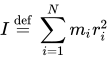
The moment of inertia is additive, therefore, for a rigid body consisting of point masses with distances to the rotation axis, the total moment of inertia is the sum of the point-mass moments of inertia


The moment of inertia is commonly used to calculate torque when multiplied by the angular acceleration. This analogous to F = ma.
