Materials Science and Engineering/List of Topics/Thermodynamics/Zeroth Law of Thermodynamics
The zeroth law of thermodynamics is a generalized statement about bodies in contact at thermal equilibrium and is the basis for the concept of temperature. The most common enunciation of the zeroth law of thermodynamics is:
"If two thermodynamic systems are in thermal equilibrium with a third, they are also in thermal equilibrium with each other."
In other words, the zeroth law says that if considered a mathematical binary relation, thermal equilibrium is transitive.
Temperature and the zeroth law[edit | edit source]
It is often claimed, for instance by Max Planck in his influential textbook on thermodynamics, that this law proves that we can define a temperature function, or more informally, that we can 'construct a thermometer'. Whether this is true is a subject in the philosophy of thermal and statistical physics.
In the space of thermodynamic parameters, zones of constant temperature will form a surface, which provides a natural order of nearby surfaces. It is then simple to construct a global temperature function that provides a continuous ordering of states. Note that the dimensionality of a surface of constant temperature is one less than the number of thermodynamic parameters (thus, for an ideal gas described with 3 thermodynamic parameter P, V and n, they are 2D surfaces). The temperature so defined may indeed not look like the Celsius temperature scale, but it is a temperature function.
For example, if two systems of ideal gas are in equilibrium, then where is the pressure in the ith system, is the volume, and is the 'amount' (in moles, or simply number of atoms) of gas.



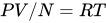
The surface defines surfaces of equal temperature, and the obvious (but not only) way to label them is to define T so that where R is some constant. These systems can now be used as a thermometer to calibrate other systems.