Hamiltonian operator
Jump to navigation
Jump to search
Hamiltonian operator tutorial[edit | edit source]
The Hamiltonian contains one- and two-electron terms. The two-electron terms (summed over i and j) are just the repulsion potential energies between all pairs of electrons. Thus:
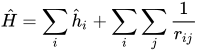
is the repulsion between a pair of electrons (distance apart).


The one-electron terms (summed over i) are more varied. For each electron, there is a kinetic energy term and a sum of attractive potential energy terms for each nucleus, A, in the molecule.
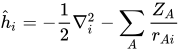
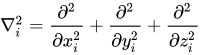
is the kinetic energy term with:

is the coulombic attraction between electron i and nucleus A.

is the nuclear charge (atomic number) of atom A and is the distance between electron i and nucleus A.


Return to Quantitative MO theory - Return to Empirical MO methods