Diffusion and osmosis
Diffusion[edit | edit source]

 |
Educational level: this is a tertiary (university) resource. |
 |
Subject classification: this is a science resource. |
 |
Type classification: this is a lesson resource. |
Simple diffusion is known as the random movement of solute molecules in a solvent tending towards an equilibrium (evenly-distributed) state, a better way to understand this is that diffusion is a type of passive transport where the net movement of molecules of a solute from a region of greater concentration move to a region of lower concentration.
Rate of Diffusion[edit | edit source]
The rate of Diffusion (J) is proportional to the concentration gradient over distance x (membrane thickness)

Rate of diffusion is independent of diffusion of other substances although it is related to
- Physical properties of solute and solvent molecules (e.g. size, electric charge)
- temperature
- electric field
Diffusion of a solute is rapid over short distances, although the membrane is a selective barrier to diffusion and the concentration gradient lies within the membrane barrier. To truly understand the mechanism of diffusion it must be described quantitatively as Fick's Law of Diffusion
Fick's Law of Diffusion[edit | edit source]
From a biological perspective Fick's First law gave rise to the Formula


- J = the rate of diffusion (mol/sec)
- P = the permeability coefficient of solute across membrane (m/sec)
- A = membrane area (m2)
- C2-C1 = The concentration difference often termed

J is also related to the diffusion coefficient in the membrane (D), within the membrane and the membrane thickness (x) and can be calculated by means of this equation

The Diffusion coefficient has various factors contributing to it and can be calculated using the formula
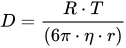
- R = Gas constant (8.3 J/K.mol)
- T = Absolute temperature (K)
- η = Viscosity of barrier
- r = Radius of diffusing molecule
The hydrophobic lattice structure of the bilayer acts like a viscous molecular "sieve" , also values for P and D are specific for membrane AND diffusing molecules. The solute concentration within a membrane depends on Kp. Kp is the lipid-water coefficient and is described as
- .

For a hydrophobic molecule Kp < 1 and for a hydrophilic molecule Kp < 1, permeability can then be calculated including Kp in the equation and thus gives us

Important factors for predicting passive permeability[edit | edit source]
frictional effects
- Molecular size - Small,P↑ ; large . P↓
- Molecular shapre - Straight, P↑ ; globular P↓
- Membrane Viscostiy - Short R chains, -C=C-, Tο
Lipid solubility (Kp)
- Kp high such as O2, CO2, anaesthetics, lipophilic group then P↑
- Kp low such as sugars, amino acids, ions , polar/charged groups then P↓
Osmosis[edit | edit source]
Osmosis is the net solvent flow, water moves from regions of higher to lower (more negative) water potentials, showing bulk flow. In animals water potential = Osmotive potential (zero for pure water; increasingly negative as solute concentration increases)
Osmolarity is proportional to the concentration of dissolved solutes and inversely proportional to osmotic potential. A common example to describe osmolarity is red blood cells in different salt concentrations.
If a solution contains a higher concentration of salt, than the solution's water flows into the cell. This causes the cell to swell and possibly bursts. This solution is known as Hyperosmotic.
Solutions that are at equilibrium with the cell salt concentration are known Isosmotic.
If a cell is placed in water, in which the salt concentration in the water is smaller than inside the cell, the water will flow out of the cell, causing it to shrink. This type of solution is know as Hyposmotic.