Defined infinity theory
Warning : This theory has not, yet, been rigorously validated by peer-review.
Scaling a 1m diameter circle an folds give a circle with a diameter of meters exactly. Stating that is not false if you meant that is infinite, but it's not more accurate than to state that a 1m diameter circle as a circumference equal to .





Instead of using as a vague infinity symbol, one may choose to mean a well defined infinity. Doing so enable him to manipulate the symbol as any other variable would act and get answer proportional to that defined infinity.
Imagine[edit | edit source]
Imagine to your left the first of an infinite line of adjacents 1m³ cubes and to your right a line of 3 more cubes starting at the same point and going in the same direction. Got it ? fine. Now sit a minute on the the edge of that third cube to your right to fully contemplate the infinite line going out of sight.
The question is : How many of these 1m³ cubes is there exactly ?
Most of you would say : "A vague infinite number of them". Which is fairly true, but is not a precise answer either. You would miss the very cube you're just sitting on. What would be the more accurate answer possible is : "The exact infinite number my premise says plus 3". If I had used the symbol (which I have good conventional reason to do so) to represent THAT infinity the precise answer would be " cubes". Exactly.

Theory[edit | edit source]
Most of the time, infinite quantities do not sprout out of experimental measurement. If you where gone in my example to count every singles cubes to validate my premise, you would never come back alive (unless you give up) and we would never get an true experimental count of them. In fact, infinite symbol come into equation because someone felt it would be convenient to make that theoretical supposition. So it's a deliberate choice. And so, it's also a deliberate choice to see the symbol is a vague infinite concept (which lead to vague answer) or to see it as a defined infinity; One deliberately chosen infinity out of all the vague infinites concepts. By doing so that "" react in equation exactly as any other unknown variable. So that :
- And so on.


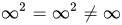
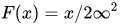
By doing that way, you might end up with a weird final answer "". This realy can't be reduced further unless you really wish to get a vague answer : "~ a second order infinity" and this IS really representative in regard to ratio of your first posed infinity. Assuming you have some others operations to do you can pose in your next formula and you'll keep track of you initial infinity. You might put it in . The answer here being exactly which give approximately 1.5+



Convergence/divergence application[edit | edit source]
While determining if a function or a series converge or diverge the standard approach right now is to suppose where is a vague infinite number. By using this theory you can be bold and set , make the substitution as was any other variable and, if the theory is right, end up with the good answer. If the greatest order of infinity is 0 or less, the function should converge. You can approximate the result by discarding any infinities of those order (being infinitely small) the sign of the greatest order just pointing the side of the convergence. Surprisingly you'll also end up with an exact value of divergence in term of ratio with the initial infinity.


Easy examples[edit | edit source]
- converge to
- diverge to exacty




It's that simple.
more complex example[edit | edit source]
- Please submit your formula that would normally require some others theorems to resolve
Hilbert hotel counter example[edit | edit source]
Let imagine an hotel with an exact infinite amount of room (instead of a vague infinite in Hilbert hotel). And lets say their is already 3 customers in the hotel. Now there is the same exact infinite number of customers that come to the hotel. If it's take 15 seconds to give a key to a customer that mean that after seconds there will be no more keys for the last 3 customers. The hotel is now full of THAT exact infinite amount of customers. If it's take 10 seconds to travel from one room to another. Then the last served customer will walk exactly seconds to get to is room and at the end of that hall he will REALLY see a wall of whatever the hotel is made of. If Hilbert used the decimal numbers to identify the room, the numbers of digit over that room would be exactly . Wich is by the way a infinite value, but not any one; just exactly . It would take some infinite amount of time to read it put not proportional to the first infinity; of course proportional to the . If that customer read 10 digit/sec this mean exactly seconds. Which is a glimpse if you compare to the time he tooks to get there, but, still, an infinite amount of time.


Hilbert was not completely wrong when he said and infinite rooms hotel could hold more then and infinity of customers. In fact if I suppose my hotel as rooms (which is infinite), that would mean it could hold exactly an folds of customers, but not one more.

The theorem in a bottle[edit | edit source]
Once properly posed, just react as any other variable.