

Continuum mechanics/Functions
-- Back to Nonlinear finite elements --
There are certain terms involving relationships between functions that you will often encounter in papers dealing with finite elements and continuum mechanics. We list some of the basic terms that you will see. More details can be found in books on advanced calculus and functional analysis.
Functions
[edit | edit source]Let and be two sets. A function is a rule that assigns to each an element of . A function is usually denoted by



Sometimes, one also writes

For example, if the function is , then we may write .


Domain and Range
[edit | edit source]For a function , the set is called the domain of . See Figure 1.


 |
The range of is the set

Therefore, .

One-to-one mapping (injection)
[edit | edit source]A function is called one-to-one (or an injection) if no two distinct elements of are mapped to the same element of .
Onto mapping (surjection)
[edit | edit source]A function is called onto if for every there is an such that .


If that case, .

One-to-one and onto mapping (bijection)
[edit | edit source]When a mapping is both one-to-one and onto it is called a bijection. For example, if and with

the map is one-to-one and onto.
On the other hand, if

the map is one-to-one but not onto.
If we choose

the map is neither one-to-one nor onto.
Image, pre-image, and inverse functions
[edit | edit source]Suppose we have a function . Let be a subset of (see Figure~1). Let us define


Then, is called the image of .

On the other hand, if is a subset of and we define


Then, is called the inverse image or pre-image of .

If is one-to-one and onto, then there is a unique function such that
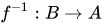

The function is called an inverse function of .

Identity map
[edit | edit source]The map such that for all is called the identity map. This map is one-to-one and onto.


Composition
[edit | edit source]A notation that you will commonly see in papers on nonlinear solid mechanics is the composition of two functions. See Figure 2.
 |
Let and be two functions such that and . The composition is defined as




Let us consider a stretch () followed by a translation (). Then we can write and .


The composition is given by


The inverse composition is given by


Isomorphism and Homeomorphism
[edit | edit source]You will also come across the terms isomorphism and homeomorphism in the literature on nonlinear solid mechanics.
Isomorphism is a very general concept that appears in several areas of mathematics. The word means, roughly, "equal shapes". It usually refers to one-to-one and onto maps that preserve relations among elements.
A homeomorphism is a continuous transformation between two geometric figures that is continuous in both directions. The map has to be one-to-one to be homeomorphic. It also has to satisfy the requirements on an equivalence relation.
Continuously differentiable functions
[edit | edit source]A function

is said to be -times continuous differentiable or of class if its derivatives of order (where ) exist and are continuous functions.


Figure 3 shows three functions (, , ) and their derivatives.


 |
C-1 Functions
[edit | edit source]The function is called the Heaviside step function (usually written ) which is defined as

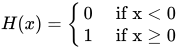
The derivative of the Heaviside function is the Dirac delta function (written ) which has the defining property that

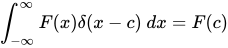
for any function and any constant . The delta function is singular and discontinuous. Hence, the Heaviside function is not continuously differentiable. Sometimes the Heaviside function is said to belong to the class of functions.


C0 Functions
[edit | edit source]The function in Figure 3 (also called a hat function) is continuous but has discontinuous derivatives. In this particular case, the function has the form
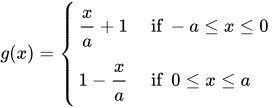
Such functions that are differentiable only once are called functions.

C∞ Functions
[edit | edit source]The function in Figure 3 is infinitely differentiable and has continuous derivatives every time it is differentiable. Such functions are called functions. Since the function can be differentiated once to give a continuous derivative, it also falls into the category of functions.


Sobolev spaces of functions
[edit | edit source]You will find Sobolev spaces being mentioned when you read the finite element literature. A clear understanding of these function spaces needs a knowledge of functional analysis. The book Introduction to Functional Analysis with Applications to Boundary Value Problems and Finite Elements by B. Daya Reddy is a good starting point that is just right for engineers. We will not get into the details here.
Of particular interest in finite element analysis are Sobolev spaces of functions such as

where
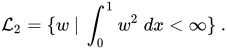
The function space is the space of square integrable functions.

Of interest to us is an outcome of Sobolev's theorem which says that if a function is of class then it is actually a bounded function. If we choose our basis functions from the set of square integrable functions with continuous derivatives, certain singularities are automatically precluded.
