Cohen's d
Cohen's d is an effect size used to indicate the standardised difference between two means. It can be used, for example, to accompany reporting of t-test and ANOVA results. It is also widely used in meta-analysis.
Cohen's d is an appropriate effect size for the comparison between two means. APA style strongly recommends use of Eta-Squared. Eta-squared covers how much variance in a dependent variable (DV) is explained by an independent variable (IV), but that IV possibly has multiple levels and hence partial eta-squared doesn't explain the size of difference between each of the pairwise mean differences.
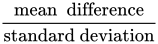
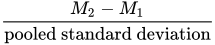
Cohen's d can be calculated as the difference between the means divided by the pooled SD:
or
Cohen's d, etc. is available in SPSS in the t test procedure and a number of other places.
In an ANOVA, you need to be clear about which two means you are interested in knowing about the size of difference between. This could most likely mean that you are interested in several ds, e.g., to compare marginal totals (for main effects) or cells (for interactions). In general, it is recommended to report all relevant Cohen's d values unless you've got a particular reason to just focus on a one or some of the possible values. From a descriptive statistics table, calculating Cohen's d is relatively straightforward.
Calculating Cohen's d provides useful information for discussion (e.g., allows ready comparison with meta-analyses and the size of effects reported in other studies). Where you are reporting about differences between two means, then a standardised mean effect size (such as d) would be an appropriate accompaniment to inferential testing.
See also[edit | edit source]
- Cohen's d (Wikipedia)
External links[edit | edit source]
- Becker's effect size calculator - an online calculator for Cohen's d and r
- Cohensd.xls - an Excel spreadsheet for calculating Cohen's d
- Understanding Statistical Power and Significance Testing - interactive visualization