Electronics/Capacitors

 |
Type classification: this is an article resource. |
 |
Subject classification: this is a physics resource. |
 |
Subject classification: this is an engineering resource. |
 |
Educational level: this is a secondary education resource. |
 |
Educational level: this is a tertiary (university) resource. |
A capacitor is an electronic component designed to obey the equation:

See Introduction to Electricity II for theoretical details about capacitors.
The current that an ideal capacitor "passes" through it depends on the rate of change of the voltage applied across it. The direction of the current will be in such a way as to counteract the change of voltage. A capacitor is not the same as a battery. A capacitor stores energy through charge and battery stores energy through a chemical change. The fundamental prototype of a capacitor consists of two conducting parallel plates separated by an insulating material called the dielectric.
Theory of the Capacitor[edit | edit source]

The theory behind capacitors is an application of Coulomb's Law. Suppose we have two parallel conducting plates, each of area , with a separation distance of , as shown in the diagram at the right. Suppose we place a total charge of on the upper plate, and on the lower plate. (Charge relative to what? It doesn't matter.)


The charge density (coulombs per square meter) on the upper plate is .

According to Coulomb's Law#The Electric Field Near a Very Large Uniformly Charged Plane, the electric field below the upper plate, arising from that plate's charge, is , where is the fundamental physical constant known as the "permittivity of the vacuum". (Actually, in our case, we might use the permittivity of whatever dielectric material lies between the plates. It is common to use special materials that have an extremely high value of , in order to maximize the capacitance.) That electric field is presumed to be pointing downward.


The electric field above the lower plate, arising from that plate's charge, is , and is presumed to be pointing upward according to that formula. We can get the downward field by changing the sign: . This means that the total downward field in the space between the plates is .



The amount of energy that would be released if a coulomb of charge moves from the upper plate to the lower one is the field strength times the distance (remember that electric field strength is measured in newtons per coulomb, or joules per coulomb-meter), which is

This is the voltage difference between the upper plate and the lower one.
Now suppose we push amperes of current onto the upper plate, and remove amperes from the lower plate. That is, in ordinary electronic engineering terms, we run amperes through this device. Then increases by coulombs per second, decreases by the same amount, and so increases by coulombs per second. This means that the voltage increases by


volts per second.

We define , the capacitance of this device, as


This is the formula for the capacitance of a capacitor made from two parallel plates separated by a distance very much smaller than the size of the plates.
The unit of capacitance is the farad, though most practical capacitors are measured in microfarads, picofarads, or even smaller. (This is because is so small.) One can see from this formula, since is a distance and is an area, that the unit of is farads per meter. Specifically, it is 8.854×10⁻¹² farads per meter.
To maximize the capacitance, capacitors have traditionally been made from thin sheets of metal foil separated by very thin layers of insulating material such as paper or mylar, and tightly rolled up into a cylinder, so that the "plates" alternate between those connected to one terminal and those connected to the other. Modern capacitors often use materials with an extremely high dielectric constant, making much larger than its vacuum value, or other miracles of fabrication.
The fundamental formula for the behavior of a capacitor is:
The electrical behavior of capacitors proceeds from this formula.
Another formula, if one is interested in the amount of charge, is:

Factors affecting capacitance[edit | edit source]
- The charge held depends on the applied voltage
- The capacitance increases as the total area of the opposing surfaces of the plates increases, because a larger plate area can hold a greater charge.
- The capacitance increases as the distance between the plates decreases because the electric field then becomes more concentrated
- The capacitance depends upon the dielectric material.
Uses of the capacitor[edit | edit source]
- Since there is an insulator, the device can be used to block the passage of DC current. However, alternating or AC current of certain frequencies will pass through.
- A capacitor can be used in a rectifier as a filter, so that pure DC is obtained as output.
Real capacitors have non-zero DC leakage current, non-zero lead resistance and inductance, memory behavior etc.
Charge Stored[edit | edit source]

Capacitance[edit | edit source]
The capability of a capacitor to store charge of a voltage

Voltage[edit | edit source]
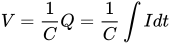
Reactance[edit | edit source]
- = = - j =


Impedance[edit | edit source]


Frequency Response[edit | edit source]
- . DC Applied, capacitor is an open circuit , I = 0
- . HF AC applied, capacitor is a short circuit , I - limited by rest of circuit
- .




With Current's values at three point a I - ш can be drawn.
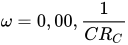
Phase Angle[edit | edit source]
For capacitor without resistance, Voltage and current have a phase difference of 90o
For capacitor with resistance, Voltage and current have a phase difference of θ

When phase angle change, frequency also change . Therefore, capacitor can be used for frequency shifting
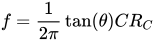
Since frequency is one over time . Therefore, Time

When Tanθ = 1 or θ = 45o
- t = 2π CRC = 0.3 CRC
will the time to charge or discharge capacitor to halved a voltage . Therefore, capacitor can be used as Timer.